Hanfu Fabrics Guide: Linen, Brocade, Gauze & Organza
Introduction to Hanfu Textiles and Material Philosophy
The revival of Hanfu (traditional Han Chinese clothing) is not merely a visual movement; it is a tactile reconnection with centuries of textile artistry. When constructing or purchasing a Hanfu ensemble, the choice of fabric dictates the garment's drape, historical accuracy, seasonal comfort, and overall silhouette. Traditional Chinese clothing philosophy emphasizes the harmony between nature and human craftsmanship, a principle vividly reflected in the diverse weaves used throughout history. As noted by the Metropolitan Museum of Art, the foundational history of sericulture and silk production, which gave birth to delicate gauzes and luxurious brocades, is deeply rooted in China's ancient agricultural and cultural practices The Met Museum: Silk.
Whether you are tailoring a flowing summer Ruqun or a structured winter Mamianqun (horse-face skirt), understanding the mechanical properties and historical context of linen, brocade, gauze, and organza is essential. This comprehensive guide breaks down these four foundational fabrics, providing actionable advice on sourcing, costs, and garment care.
Linen (Ma): The Breathable Foundation
Before the widespread dominance of silk, Ma (ramie and hemp) was the primary textile for everyday clothing in ancient China. Today, modern linen and ramie blends remain the gold standard for summer Hanfu, particularly for inner layers, cross-collar shirts (Jiaoling Youren), and lightweight trousers.
Characteristics and Applications
Linen is highly breathable, moisture-wicking, and possesses a natural, rustic texture that aligns perfectly with the scholar-official aesthetic of the Song and Ming dynasties. It lacks the fluid drape of silk, offering instead a structured yet relaxed silhouette.
- Best Garments: Zhongyi (inner garments), summer Beizi (open-front jackets), and casual daily Ruqun.
- Cost Estimate: $8 to $18 per meter for high-quality washed linen or ramie blends.
- Yardage Required: A standard upper garment requires 2 to 3 meters; a full Ruqun set requires 5 to 7 meters.
Care and Maintenance
Linen wrinkles easily, which is considered part of its natural charm. However, to prevent excessive shrinkage, always pre-wash linen in cold water before tailoring. Iron on a high setting while the fabric is still slightly damp to achieve crisp seams.
Brocade (Zhi Jin): The Imperial Statement
Brocade represents the pinnacle of Chinese textile luxury. Characterized by its raised, intricate patterns woven directly into the fabric using supplementary weft threads, brocade is heavy, lustrous, and highly structured. The evolution of Chinese silk weaving, particularly during the Ming Dynasty, saw the rise of complex brocade techniques that became synonymous with imperial status and formal ceremonies The Met Museum: Ming Dynasty.
Characteristics and Applications
There are three famous traditional brocades: Shu brocade (from Sichuan), Song brocade (from Suzhou), and Yun brocade (from Nanjing). For modern Hanfu, Song and Yun brocades are frequently used due to their rich metallic threads and auspicious motifs like dragons, phoenixes, and peonies.
- Best Garments: Mamianqun (horse-face skirts), winter Ao (lined jackets), and formal wedding attire (Ming-style formal wear).
- Cost Estimate: $35 to $150+ per meter, depending on the purity of silk and the complexity of the metallic threads.
- Yardage Required: A standard Mamianqun requires 4.5 to 6 meters of fabric to accommodate the deep, structured pleats.
Care and Maintenance
Brocade must never be machine washed or submerged in water, as the metallic threads can tarnish and the silk base can distort. Dry cleaning is mandatory. Store brocade garments flat or rolled to prevent permanent creasing in the heavy folds.
Gauze (Luo / Sha): The Ethereal Summer Layer
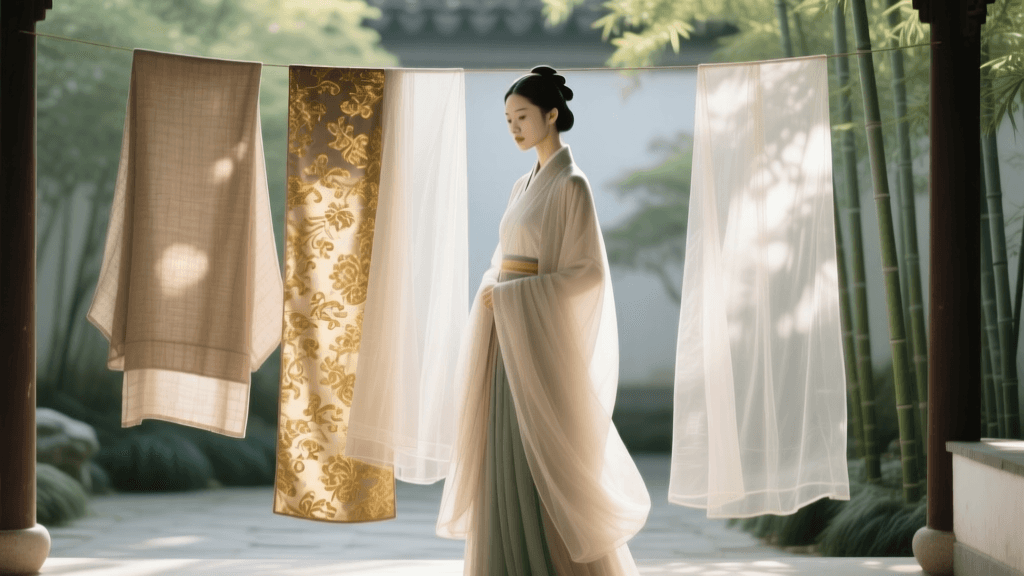
Gauze, specifically the leno-weave silks known as Luo and Sha, is the quintessential fabric for high-end summer Hanfu. Historically, these fabrics were prized by the nobility for their ability to provide modesty and sun protection while remaining entirely translucent and breathable.
Characteristics and Applications
True silk gauze is woven with twisted warp threads that create tiny, stable pores in the fabric. This prevents the fabric from slipping or fraying as easily as plain weaves, while maintaining an ethereal, cloud-like drape.
- Best Garments: Pibo (stoles), outer Dahu (sleeveless vests), and sheer overlay skirts.
- Cost Estimate: $20 to $60 per meter for authentic silk leno-weave gauze.
- Yardage Required: Outer layers generally require 2 to 4 meters, depending on sleeve width (e.g., Pipa sleeves require more fabric).
Care and Maintenance
Hand wash gently in cold water with a pH-neutral silk detergent. Never wring gauze; instead, roll it in a clean towel to absorb excess moisture and lay it flat to dry out of direct sunlight to prevent the silk from yellowing.
Organza (Ou Gen Sha): The Modern Structured Silhouette
While traditional Hanfu relies heavily on natural fibers, modern Hanfu makers frequently incorporate Ou Gen Sha (organza) to achieve specific structural effects. Originally made from silk, most commercially available organza today is woven from synthetic fibers like polyester or nylon, making it an affordable and highly durable alternative to traditional stiff gauzes.
Characteristics and Applications
Organza is crisp, sheer, and holds its shape remarkably well. It is the secret weapon for creating voluminous sleeves, stiff collars, and layered skirts that defy gravity without adding heavy weight to the wearer.
- Best Garments: Tang Dynasty-style chest-high skirts (Qixiong Ruqun), structured collars, and decorative sashes.
- Cost Estimate: $5 to $15 per meter for synthetic organza; $25+ for pure silk organza.
- Yardage Required: Highly voluminous Tang-style skirts may require up to 8 meters to achieve the desired bell shape.
Care and Maintenance
Synthetic organza is incredibly low maintenance and can be machine washed on a gentle cycle in a mesh bag. However, it is prone to static cling; using an anti-static spray is highly recommended when layering organza over silk or linen.
Hanfu Fabric Comparison Chart
To help you select the right material for your next tailoring project, refer to the structured comparison below:
| Fabric Type | Weight & Drape | Ideal Season | Avg. Cost (per meter) | Primary Hanfu Applications |
|---|---|---|---|---|
| Linen (Ma) | Medium weight, rustic drape | Summer / Spring | $8 - $18 | Inner layers, daily jackets, trousers |
| Brocade (Zhi Jin) | Heavy, stiff, highly structured | Winter / Autumn | $35 - $150+ | Mamianqun, formal jackets, wedding wear |
| Gauze (Luo/Sha) | Lightweight, fluid, ethereal | Summer | $20 - $60 | Sheer overlays, Pibo stoles, summer outerwear |
| Organza (Ou Gen Sha) | Lightweight, crisp, voluminous | All Seasons (Layering) | $5 - $25 | Tang skirts, stiff collars, decorative sashes |
Practical Sourcing and Tailoring Advice
When sourcing fabrics for Hanfu, always account for the unique construction methods of traditional Chinese garments. Unlike Western tailoring, which relies heavily on darts and curved seams to fit the body, Hanfu is cut primarily from straight, geometric panels of fabric.
"The beauty of Hanfu lies not in how tightly it hugs the body, but in how the fabric flows and interacts with the wearer's movement and the surrounding air."
Crucial Measurements and Allowances
- Sleeve Width: Traditional wide sleeves (Guangxiu) can measure up to 60 cm in width. Ensure your fabric bolt is at least 110 cm wide, or be prepared to add discreet, historically accurate panel extensions.
- Pleat Depth: If making a Ming Dynasty Mamianqun from brocade, the pleats are typically 4 to 6 cm deep. A skirt with 20 pleats on each side panel requires massive yardage. Always buy 20% more fabric than your mathematical calculation to allow for hemming and pattern matching.
- Pattern Matching: When using brocade with large, directional motifs (like ascending dragons or sprawling lotus flowers), you must purchase extra fabric to ensure the motifs align symmetrically across the front and back panels of the skirt or jacket.
Conclusion
Mastering Hanfu fabrics is a journey into the material culture of China. Whether you are drawn to the humble, breathable elegance of linen, the imperial grandeur of Ming-style brocade, the poetic translucence of silk gauze, or the modern structural utility of organza, each textile offers a unique way to experience traditional Asian fashion. By understanding the specific drape, cost, and care requirements of these materials, you can curate a Hanfu wardrobe that is not only historically inspired but also perfectly suited to your modern lifestyle and climate.