Ainu Attus and Ryukyuan Ryusou: A Guide to Minority Dress
Introduction to Japan's Ethnic Minority Garments
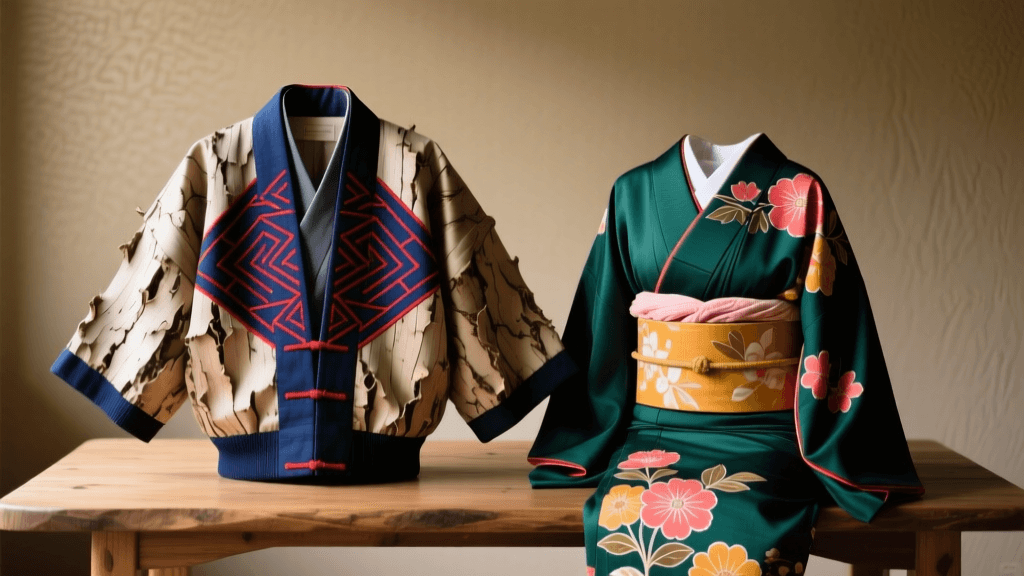
When discussing traditional Japanese clothing, the mainstream silk kimono often monopolizes the global imagination. However, the Japanese archipelago is home to a rich tapestry of indigenous and ethnic minority cultures, each with distinct textile traditions shaped by their unique climates, spiritual beliefs, and historical trade networks. In the northernmost island of Hokkaido, the indigenous Ainu people developed resilient, nature-integrated garments designed for subarctic survival. Conversely, in the southernmost reaches of Okinawa, the Ryukyuan people cultivated a vibrant, subtropical fashion culture heavily influenced by maritime trade with China and Southeast Asia.
Understanding these minority garments—specifically the Ainu attus and the Ryukyuan ryusou—requires looking beyond mere aesthetics. These textiles are living archives of ecological knowledge and cultural resistance. According to the National Ainu Museum and Park (Upopoy), traditional Ainu clothing is deeply intertwined with animistic beliefs, where garments serve as spiritual armor. Similarly, Ryukyuan dress reflects a historical kingdom that thrived as a diplomatic and commercial bridge between empires. This guide explores the craftsmanship, cultural significance, and practical acquisition of these extraordinary textile traditions.
Ainu Attus: The Resilience of Elm Bark Weaving
Materials and Craftsmanship
The cornerstone of traditional Ainu everyday wear is the attus, a robust, breathable textile woven from the inner bark of the Japanese elm (Ulmus davidiana var. japonica), known in the Ainu language as ohyo. The creation of attus is an arduous, multi-step process that begins in early summer, typically June, when the tree's sap is flowing and the bark is easiest to peel. Ainu artisans carefully strip the outer bark to harvest the precious inner layers, which are then dried, soaked in water, and painstakingly split into fine, uniform threads using only the fingertips and nails.
The weaving is traditionally done on a backstrap loom, allowing the weaver to control the tension of the warp threads with their own body weight. The resulting fabric is remarkably durable, water-resistant, and insulating. To elevate the garment from everyday workwear to ceremonial attire, artisans appliqué cotton or silk onto the attus base, embroidering it with sacred Ainu motifs. The moreu (swirl) and aiushi (thorn) patterns are placed at vulnerable openings—such as the collar, cuffs, and hem—to ward off malevolent spirits.
Practical Guide: Sourcing and Wearing Attus Today
For collectors, textile enthusiasts, and cultural practitioners looking to acquire authentic attus garments today, the town of Nibutani in Hokkaido remains the epicenter of production. Because the craft relies on seasonal harvesting and intense manual labor, mass production is impossible, making genuine pieces highly valued.
- Attus Sashes and Belts: A standard hand-woven attus belt measures approximately 10 to 15 centimeters in width and 250 to 300 centimeters in length. These are excellent entry-level pieces for collectors or for use as traditional obi alternatives. Cost: 30,000 to 60,000 JPY ($200–$400 USD).
- Attus Vests and Kimono: Full garments, often lined with cotton and featuring intricate appliqué work, are usually commissioned directly from artisans. Cost: 250,000 to over 500,000 JPY ($1,700–$3,500 USD), depending on the complexity of the embroidery.
- Timing and Lead Time: Due to the seasonal nature of bark harvesting and the backlog of skilled weavers, expect a lead time of 4 to 8 months for bespoke commissions.
- Sizing: Traditional Ainu garments are generally cut in a T-shape similar to the Japanese kimono but are worn more loosely. When commissioning, provide your shoulder-to-ankle measurement and arm span to ensure the sleeves provide adequate coverage for the appliqué protection motifs.
Ryukyuan Ryusou and Bingata: Subtropical Elegance
The Art of Bingata Dyeing
While the Ainu adapted to the cold, the Ryukyuan people of Okinawa designed garments for a hot, humid, subtropical climate. The traditional Ryukyuan garment, the ryusou, features a cross-collar and wide sleeves, but unlike the heavily layered mainland kimono, it is designed to be worn as a single, breathable layer. The fabric of choice was historically bashofu (woven from banana plant fibers) or jofu (ramie), though silk became popular among the aristocracy.
The most iconic element of Ryukyuan dress is bingata, a vibrant stencil-resist dyeing technique. Developed during the Ryukyu Kingdom era (15th–19th centuries), bingata utilizes hand-carved mulberry paper stencils and a resist paste made from sweet rice flour. Artisans apply vivid pigments—traditionally mixed with soybean milk to bind the color to the fiber—using stiff pig-bristle brushes. The motifs are heavily influenced by Chinese and Southeast Asian aesthetics, featuring peonies, dragons, phoenixes, and flowing water patterns. As documented by the Chinen Bingata Studio, one of Okinawa's oldest surviving dyeing houses, the creation of a single bingata kimono can involve over a dozen distinct steps and take several weeks of continuous labor.
Practical Guide: Acquiring Ryusou and Bingata Textiles
Acquiring authentic ryusou and bingata textiles requires navigating a market that caters to both local ceremonial needs and high-end collectors. The city of Naha, particularly the Tsuboya and Shuri districts, is home to several multi-generational studios that still produce museum-quality work.
- Bingata Half-Width Obi: For those who wish to incorporate Ryukyuan aesthetics into mainstream kimono dressing, a bingata half-width obi (measuring 16.5 cm by 360 cm) is the most practical purchase. Cost: 80,000 to 150,000 JPY ($550–$1,000 USD).
- Full Bingata Ryusou: A complete, bespoke silk ryusou featuring full-body stenciling is a masterpiece of textile art. Cost: 400,000 to 800,000+ JPY ($2,700–$5,500+ USD).
- Bashofu and Jofu Textiles: Un-dyed, naturally woven banana fiber or ramie garments are prized for their incredible breathability and subtle, organic textures. These are often sourced from specialized weavers in northern Okinawa or the Amami Islands. Cost: 150,000 to 300,000 JPY.
- Timing and Wearing: Bespoke bingata orders typically require 3 to 6 months. When wearing a ryusou, it is traditionally secured with a woven sash tied in a mae-musubi (front bow), a style that allows the wearer to easily adjust the garment's drape in the sweltering Okinawan heat. Cultural parks like Ryukyu Mura offer excellent visual references for proper tying techniques and historical styling.
Comparative Analysis: Attus vs. Ryusou
To fully appreciate the divergence of Japan's minority dress traditions, it is helpful to compare their structural and material adaptations to their respective environments.
| Feature | Ainu Attus (Hokkaido) | Ryukyuan Ryusou (Okinawa) |
|---|---|---|
| Primary Climate | Subarctic, harsh winters | Subtropical, high humidity |
| Core Material | Elm bark (ohyo), bear/fox fur | Banana fiber (bashofu), ramie, silk |
| Key Decoration | Cotton/silk appliqué, embroidery | Stencil-resist dyeing (bingata) |
| Spiritual Motif | Moreu (swirls) for protection | Dragons/Phoenixes for royal prestige |
| Avg. Bespoke Cost | 300,000+ JPY | 400,000+ JPY |
| Lead Time | 4–8 months (seasonal harvest) | 3–6 months (dyeing complexity) |
Care and Preservation of Minority Textiles
Preserving ethnic minority garments requires specific environmental controls that differ vastly from standard silk kimono care. Attus garments, being composed of natural tree bark, are highly susceptible to extreme dryness, which can cause the fibers to become brittle and snap. They should be stored in a climate-controlled environment with a relative humidity (RH) of around 55%. Avoid folding attus tightly; instead, roll the garment around an acid-free cardboard tube to prevent permanent creasing and fiber breakage.
Conversely, ryusou made from bashofu or ramie can withstand higher humidity but are vulnerable to mold if not properly aired. Bingata textiles require strict protection from ultraviolet (UV) light. The traditional soybean-milk binder and natural mineral pigments used in historical bingata can fade rapidly if exposed to direct sunlight. When displaying or storing bingata, wrap the textile in unbleached, acid-free cotton or traditional tatou-shi paper, and store it in a dark, well-ventilated drawer. Never dry-clean authentic bingata or attus; consult a specialist in Japanese textile conservation for spot cleaning and repairs.
Conclusion
The garments of Japan's ethnic minorities are far more than regional curiosities; they are profound expressions of human adaptation and cultural identity. The rugged, spiritually fortified attus of the Ainu and the vibrant, trade-influenced ryusou and bingata of the Ryukyuan people offer a vital counter-narrative to the homogenized history of Japanese fashion. By understanding the materials, respecting the craftsmanship, and supporting the surviving artisan studios, collectors and enthusiasts can play a crucial role in ensuring that these extraordinary textile traditions continue to weave their stories into the future.