Mongolian Deel Wool Processing And Ornamental Belt Craft
The Enduring Legacy of the Mongolian Deel
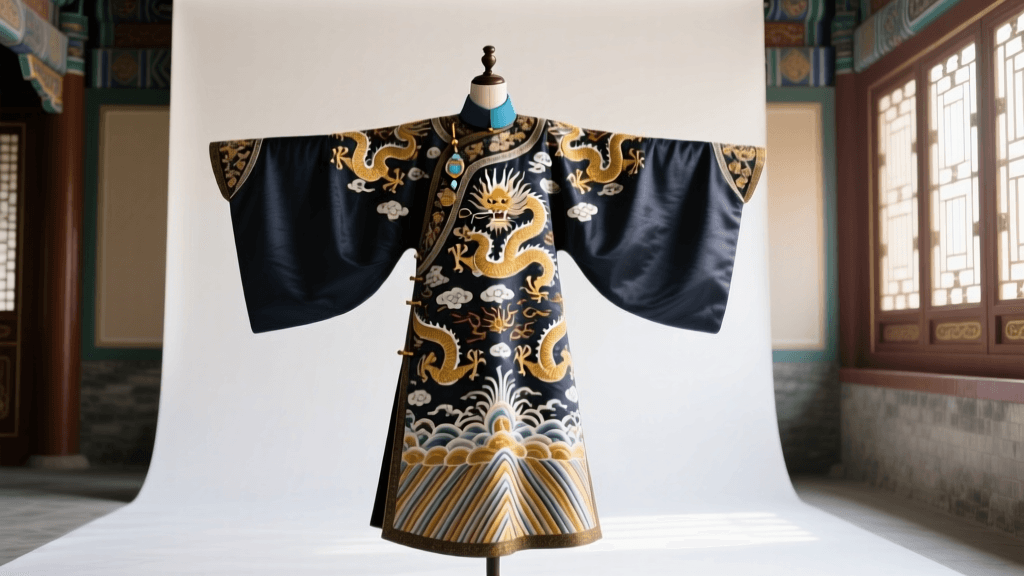
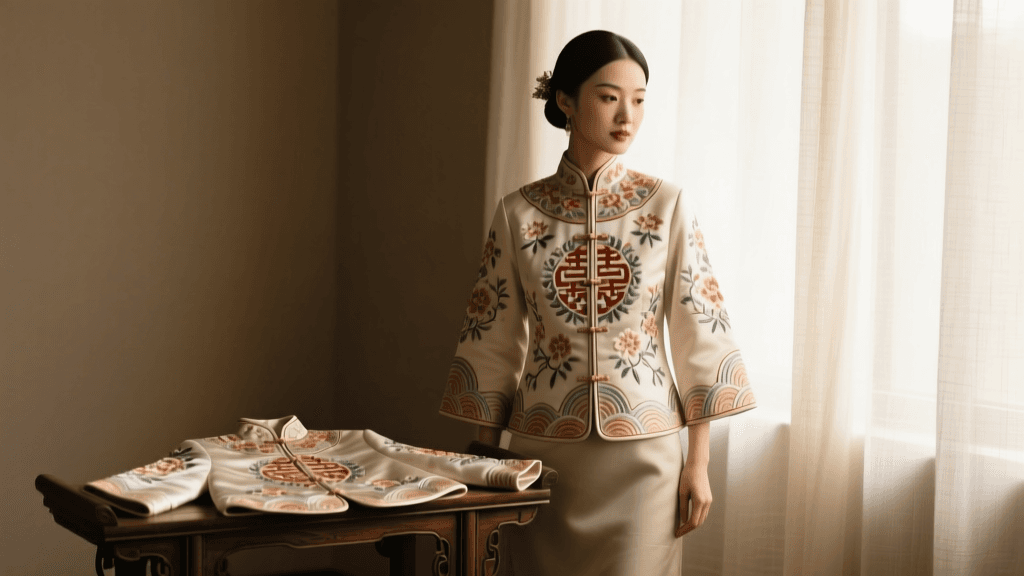
For over eight centuries, the deel—a long, flowing robe with asymmetrical front closure—has served as both practical garment and cultural anchor across the vast steppes of Mongolia. Unlike many East Asian garments that evolved under imperial court influence, the deel emerged from necessity: mobility on horseback, thermal regulation in sub-zero winters (averaging −20°C in Ulaanbaatar January), and adaptability to seasonal shifts. Its origins trace to the 13th-century Mongol Empire, where standardized dress codes were codified in the Yassa, Genghis Khan’s legal code, mandating distinct attire for nobles, warriors, and commoners. The deel’s structure—wide sleeves, high collar, and sash-based fastening—remains functionally unchanged, yet its materiality and ornamentation reflect profound ecological and sociocultural intelligence.
Wool Processing: From Fleece to Fiber
Mongolian wool processing begins not in factories but in seasonal migrations. Herders shear cashmere goats and sheep twice yearly—once in late spring (May–June) and again in early autumn (September). Each adult goat yields only 150–200 grams of raw cashmere annually, while a single sheep produces approximately 2.5–3.5 kilograms of coarse wool per shearing. This scarcity drives meticulous hand-processing: fleece is first sorted by grade and color on open-air drying racks in rural aimags like Khövsgöl, then washed in natural alkaline springs near Lake Hovsgol to preserve lanolin integrity. Carding follows using wooden paddles embedded with iron teeth—tools unchanged since the 14th century—and spinning occurs on drop spindles capable of producing yarns as fine as 18 microns (comparable to Italian merino).
Traditional Spinning Techniques
Spinning is predominantly performed by women aged 45–75, who maintain tension through rhythmic wrist rotation rather than foot treadles. A skilled spinner can produce 30 meters of two-ply yarn per hour. The resulting yarn undergoes no chemical scouring; instead, fermented mare’s milk (airag) is occasionally used as a mild enzymatic cleaner, lowering pH to 4.2–4.6 to prevent fiber damage.
Ornamental Belt Craft: Structure and Symbolism
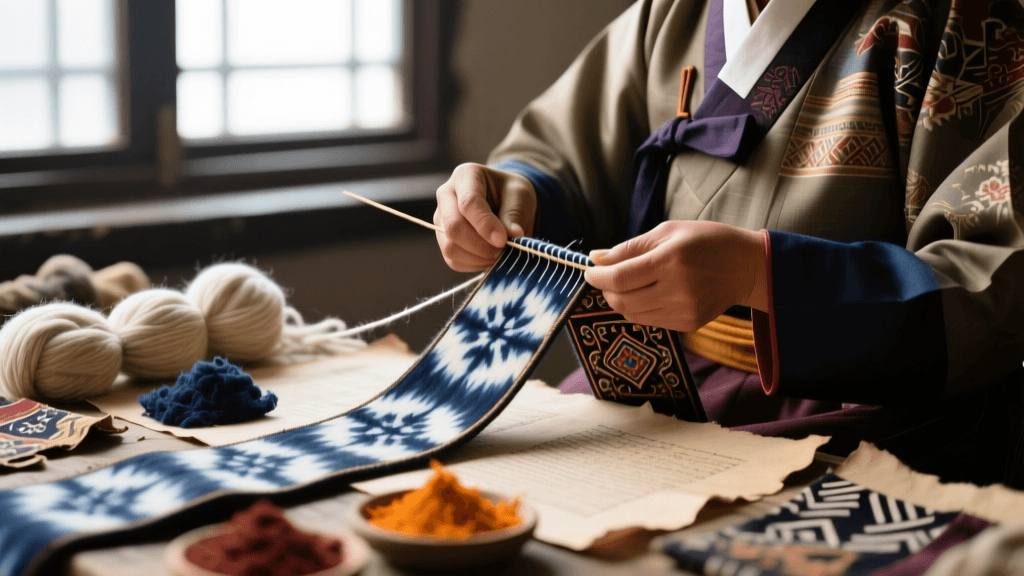
The deel’s ornamental belt—known as the ushnaar or züün—is far more than accessory: it functions as a structural corset, tool holder, and genealogical ledger. Belts measure precisely 3–4 meters in length and 8–12 centimeters in width, woven on narrow horizontal looms called khurkhra. Historically, belt motifs encoded clan affiliation: the Borjigin lineage used triple-diamond patterns representing sky, earth, and underworld; Oirat belts featured interlocking swastikas denoting eternal motion. Today, artisans in the town of Ölgii—capital of Bayan-Ölgii Province—preserve these conventions while adapting scale: modern ceremonial belts incorporate silver-thread embroidery measuring 0.3 millimeters in diameter.
Weaving Tools and Tension Control
Weavers use bone or antler heddle rods to separate warp threads, maintaining tension at 1.8–2.2 kilograms per square centimeter—critical for achieving the belt’s signature stiffness without brittleness. Warp threads are traditionally dyed before weaving, employing plant-based mordants such as oak gall (for iron-rich black) and fermented rhubarb root (for ochre).
Dyeing Traditions and Botanical Sources
Mongolian natural dyeing relies on 27 documented native species, with regional variation dictated by altitude and soil pH. In the Gobi Desert, artisans extract crimson from Alkanna tinctoria roots (yielding 3.2% dye concentration per gram of dried root), while northern forest zones use lichen species like Cladonia rangiferina for soft greys. Dye vats are heated over dung fires to precise temperatures: 65°C for weld yellow, 82°C for madder red. Each dye bath requires 12–14 hours of immersion, followed by sun-drying on quartz-rich riverbeds near the Orkhon River—where UV exposure fixes colorfastness to ISO 105-C06 Level 4.
- Indigo fermentation vats maintained at 28–30°C for 10 days yield deep blues
- Black dye derived from iron sulfate + tannin achieves lightfastness rating of 7/8 on Blue Wool Scale
- Yellow from Reseda luteola roots requires 45 minutes at 95°C for optimal hue saturation
- A single 50-liter dye vat processes up to 8 kilograms of wool per batch
- Traditional dye recipes specify exact water-to-plant ratios: e.g., 1:12 for birch bark infusion
Institutional Preservation and Contemporary Practice
The National Museum of Mongolia in Ulaanbaatar houses the oldest surviving deel fragment—carbon-dated to 1247 CE—woven from camel-hair and silk recovered from the Xiongnu-era Noyon Uul burial site. Conservation efforts there adhere to ICOM-CC Textile Working Group guidelines (2021), prioritizing minimal intervention and humidity-controlled storage at 45% RH ± 3%. Meanwhile, the Mongolian Institute of Archaeology collaborates with UNESCO on the “Steppe Textiles Revival Project,” digitizing 1,200+ archival belt pattern sketches collected between 1953–1978. Fieldwork conducted in 2022 documented 47 active deel-making households across 11 provinces, with an average age of master artisans at 68.2 years.
“The deel is not worn—it is inhabited. Every fold holds memory; every stitch measures time.” — Dr. Tserendorj Batbayar, Senior Curator, National Museum of Mongolia, 2019
Museum Collections and Research Access
Scholars may examine primary textile artifacts at three key institutions: the National Museum of Mongolia (Ulaanbaatar), the Ethnographic Museum of the Peoples of Siberia (Novosibirsk, Russia), and the Victoria and Albert Museum’s Asian Textiles Study Room (London). The V&A holds 83 deels acquired between 1892–1937, including a 1912 ceremonial deel with gold-thread embroidery weighing 2.7 kilograms. At the Ethnographic Museum of the Peoples of Siberia, researchers access the Kharitonov Collection—217 belts catalogued with GPS coordinates of origin and herder family names. Digitized archives from all three institutions are cross-referenced via the International Council of Museums’ Silk Road Textile Database (2023 release).
| Institution | Key Deel Holdings | Access Protocol |
|---|---|---|
| National Museum of Mongolia | 1247 CE fragment; 17th c. noblewoman’s deel (silk/cashmere blend) | By appointment only; 72-hour advance request for fragile items |
| Ethnographic Museum of the Peoples of Siberia | 1920s nomadic family ensemble (3 deels, 2 belts, 1 saddle cover) | Digital access via Kharitonov Portal; physical viewing limited to scholars |
| Victoria and Albert Museum | 1912 coronation deel; 1935 field-collected children’s deel | Open study room; appointment required 5 business days prior |
Contemporary designers in Ulaanbaatar now reinterpret traditional techniques: the label “Kharaa” uses laser-cut leather appliqués mimicking historic belt motifs, while “Gobi Cashmere” partners with herder cooperatives to certify wool traceability from pasture to product. Yet innovation remains grounded in empirical knowledge: a 2020 study by the Mongolian Academy of Sciences confirmed that deels lined with layered felt (3.5 mm thick) reduce wind-chill exposure by 42% compared to synthetic alternatives at −30°C. Such data reaffirms what generations of herders have known—that every measurement, every pigment, every knot serves survival first, symbolism second.
The persistence of deel craftsmanship challenges assumptions about “living traditions” as static relics. In Bayan-Ölgii, teenage girls apprentice under belt-weavers while simultaneously learning digital pattern design. In Kharkhorin, archaeologists excavate 13th-century dye vats alongside students testing pH-stable natural dyes for commercial textile mills. These dualities—past and present, empirical and expressive—are not contradictions but continuities, measured in microns, degrees Celsius, and centuries.
Textile historians increasingly recognize Mongolian wool processing as a benchmark for sustainable fiber systems. Unlike industrial wool scouring—which consumes 150 liters of water per kilogram of fleece—traditional Mongolian methods use less than 8 liters per kilogram. Similarly, the average lifespan of a hand-woven deel exceeds 40 years, with repair traditions like khöshöö (invisible reweaving) extending usability beyond 60 years. Such longevity defies fast-fashion metrics, offering instead a calibrated relationship between human labor, animal husbandry, and environmental constraint.
At its core, the deel embodies reciprocity: wool sustains humans; humans steward flocks; flocks shape grassland ecology. This triadic balance informs every stage—from the 2.5-meter length of ceremonial belts (symbolizing the three realms of sky, earth, and underworld) to the 18-ply yarn count used in winter deels (representing the eighteen sacred mountains of Mongolian cosmology). No element exists in isolation; each measurement, each hue, each technique is a negotiated response to steppe life’s unrelenting demands.
When the wind rises across the Gobi, and temperatures plunge below −40°C, the deel’s functionality becomes undeniable. But its deeper significance lies in how it transforms necessity into narrative—how a 3.2-micron fiber becomes lineage, how fermented milk becomes chemistry, how a 4-meter belt becomes cartography. These are not abstractions. They are calculations made in real time, by real hands, on real land.