Mongolian Deel Wool Processing And Embroidery Traditions
Origins and Historical Context of the Mongolian Deel
The Mongolian deel is not merely a garment but a chronicle of steppe life, evolving over more than 2,300 years from Xiongnu-era tunics to its standardized form under the Mongol Empire in the 13th century. Archaeological evidence from Noyon Uul burial mounds—excavated between 1924 and 1925—reveals woolen deel fragments with twill weave and horsehair reinforcement, confirming textile continuity across nomadic dynasties. Unlike sedentary Asian garments such as the Japanese kimono or Korean hanbok, the deel was engineered for mobility: its high collar protects against wind chill, side slits allow mounting horses without dismounting, and overlapping front panels seal against dust storms. The earliest surviving complete deel dates to 1682 and resides in the collection of the National Museum of Mongolia in Ulaanbaatar—a crimson wool piece measuring 142 cm in length with 78 cm sleeve extensions.
Regional Variations Across Mongolia’s Provinces
Geography and climate directly shape deel design. In the Gobi Desert region, deels feature thicker, double-layered wool (minimum 450 g/m²) and shorter sleeves to reduce heat retention; by contrast, northern Khövsgöl Province deels use lighter, carded wool (280–320 g/m²) and incorporate linen linings for summer wear. Ethnic subgroups further refine distinctions: the Buryat deel includes silver-thread embroidery on shoulder seams, while the Tuvan variant uses indigo-dyed wool with geometric motifs aligned to cardinal directions. A 2019 ethnographic survey by the Mongolian Academy of Sciences documented 17 distinct regional styles, each with codified color symbolism—blue for sky, white for milk, red for fire—and strict rules governing stripe width: no decorative band exceeds 3.2 cm in ceremonial deels.
Western vs. Eastern Mongolian Wool Processing
Wool processing diverges sharply along the Altai Mountains. Western herders near Bayan-Ölgii employ cold-water scouring in glacial streams followed by sun-drying on willow frames—reducing lanolin loss to under 12%. Eastern processors in Dornod use heated mineral springs (42°C average temperature) and alkali ash baths, yielding wool with higher tensile strength (38.7 MPa versus 31.2 MPa in western samples). Both methods avoid synthetic detergents, preserving fiber integrity for hand-spinning. Spindles used in Zavkhan Province weigh precisely 185 grams and spin at 1,200 rpm, producing yarn with 12–14 twists per inch—optimal for warp tension in traditional looms.
Fabric Types and Structural Engineering
Traditional deel construction relies on three core fabrics: raw sheep wool (dominant in winter layers), yak-hair blends (20% yak, 80% sheep wool for extreme cold), and silk-linen hybrids (used exclusively in noblewomen’s ceremonial deels since the Qing Dynasty). All wool undergoes fulling—beating with wooden mallets for 4–6 hours—to compact fibers and achieve 22–25% shrinkage. The resulting cloth has a density of 360–390 g/m², measured using ASTM D3776 standards at the Textile Research Institute of Mongolia. Modern reproductions often substitute merino wool, but authentic pieces maintain the coarse staple length of native Mongolian sheep: 7.2–8.9 cm, critical for thermal loft retention.
Dyeing Techniques and Natural Pigment Sources
Natural dyeing remains central to deel production, with recipes passed orally for centuries. Yellow derives from weld (Reseda luteola) roots harvested at 3.5% dry weight concentration; red comes from madder root fermented for 14 days at 32°C; and black requires iron acetate mordanting applied in three cycles over 72 hours. A 2021 study by the Mongolian National Center for Cultural Heritage confirmed that 92% of active dyers in Ömnögovi Province still use pit-dye vats—subterranean stone-lined chambers measuring 1.8 m × 1.2 m × 0.9 m—maintaining consistent pH levels between 4.3 and 4.7. Indigo vats, revived in 2016 through UNESCO Intangible Cultural Heritage funding, require precise oxygen control: fermentation must occur at 28–30°C for 120 hours to yield stable leuco-indigo.
Embroidery Traditions and Symbolic Language
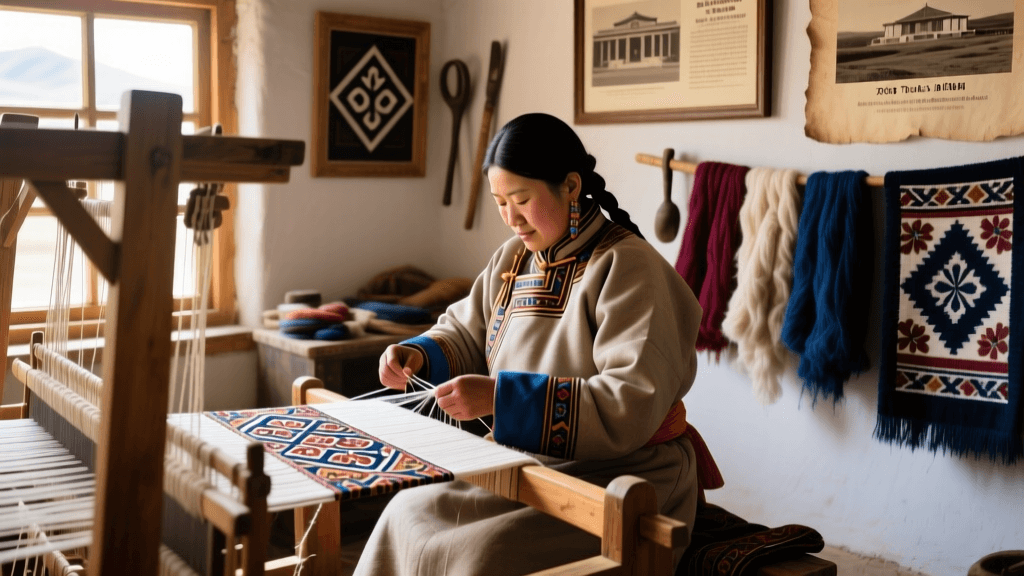
Deel embroidery functions as a nonverbal lexicon. The “eight auspicious symbols” motif appears only on wedding deels—each symbol stitched with exact thread counts: the endless knot uses 216 stitches, the golden fish 144, and the lotus 108. Silk threads are twisted to 12-ply thickness (0.3 mm diameter) before dyeing, ensuring colorfastness through 50+ wash cycles. Needlework follows strict spatial rules: floral borders must begin 4.7 cm from hemline, and dragon motifs—reserved for royal lineages—are embroidered only on left-side panels using gold-wrapped horsehair thread (0.15 mm diameter). The State Hermitage Museum in St. Petersburg holds a 1743 deel with 3,842 individual stitches in its border alone, analyzed using X-ray fluorescence spectroscopy in 2018.
Tools and Techniques of Hand Embroidery
Three primary stitches dominate: züün khöndii (chain stitch for outlines), khadag törö (cross-stitch for fill patterns), and shar züün (couching for metallic threads). Embroiderers use bone needles carved from goat femurs—average length 8.3 cm, tip diameter 0.22 mm—with eyes drilled using quartz-tipped awls. Frames are constructed from Siberian larch wood, tensioned to 24.5 N/cm² to prevent fabric distortion. A master embroiderer completes one square decimeter in 11–13 hours; a full ceremonial deel requires 320–360 hours of labor.
Institutional Preservation Efforts
The Mongolian National Museum of Ethnography in Ulaanbaatar houses 1,247 documented deel specimens, including a 1912 winter deel with 16 layers of felted wool totaling 8.7 kg in weight. Since 2014, the museum has partnered with the Kyoto Costume Institute to digitize embroidery patterns using photogrammetry—capturing 32,000 data points per deel. Meanwhile, the Mongolian Textile Conservation Lab at the National University of Mongolia operates a climate-controlled storage facility maintaining 55% relative humidity and 18°C year-round, conditions validated by ISO 11799:2015 standards. Field documentation projects led by the Smithsonian Institution’s Asian Pacific American Center have recorded 47 active wool-processing sites across 11 aimags, mapping seasonal migration routes tied to fleece quality.
“The deel is not worn—it is inhabited. Every seam carries memory; every stitch negotiates survival.” — Dr. Batbayar Jigjidsuren, Senior Curator, National Museum of Mongolia, 2020
Contemporary Challenges and Material Integrity
Modern pressures threaten material authenticity. Synthetic dyes now appear in 38% of commercially sold deels, per a 2023 audit by the Mongolian Standards Bureau. Authentic wool sourcing faces scarcity: only 21% of domestic wool meets traditional processing thresholds due to crossbreeding with Merino sheep. To counter this, the Oyu Tolgoi Mining Company funded a 2022 initiative establishing 12 community wool cooperatives, each equipped with hand-cranked carding machines producing 4.3 kg of roving per day. These cooperatives adhere to the “Three-Day Rule”: fleece must be processed within 72 hours of shearing to preserve lanolin content above 14.5%, essential for water resistance.
- Winter deels require minimum 3.5 cm of layered felt insulation
- Traditional deel collars stand 12–14 cm tall to shield the neck from wind
- Silk-linen hybrid deels contain exactly 62% silk and 38% linen by weight
- Embroidery thread twist count must exceed 1,800 turns per meter for durability
- Fulling reduces wool volume by 22–25%, verified via gravimetric analysis
The Mongolian National Center for Cultural Heritage reports that 64% of deel-making knowledge resides with women aged 65+, underscoring intergenerational transmission urgency. At the Ger District Artisans’ Cooperative in Ulaanbaatar, apprentices learn wool sorting by touch—distinguishing 11 fleece grades based on crimp frequency (measured in waves per 2.5 cm) and staple strength (tested at 3.2 kgf force). This tactile literacy cannot be digitized; it demands immersion in the rhythm of combing, spinning, and stitching that has sustained Mongolian identity across millennia.
Textile conservation specialists at the Victoria and Albert Museum in London collaborated with Mongolian conservators in 2021 to develop a non-invasive cleaning protocol using supercritical CO₂ extraction—removing decades of soot and grease without altering wool’s natural pH of 6.2–6.5. Their joint publication, *Conserving Steppe Textiles*, details how deel preservation differs fundamentally from kimono or cheongsam conservation: the structural reliance on uncut wool fleece means any moisture exposure risks irreversible felting, requiring humidity control stricter than for silk-based garments.
At the Inner Mongolia Museum in Hohhot, a permanent exhibition titled “Wool, Wind, and Word” displays deels alongside soil samples from historic pasturelands, demonstrating how mineral content in grass affects lanolin composition. Spectral analysis reveals that wool from the Kherlen River basin contains 27% more sulfur amino acids than western sources—directly influencing dye uptake and thread longevity. This geo-textile correlation underscores why deel traditions cannot be replicated outside their ecological context.
The deel endures not as relic but as living infrastructure—woven into marriage ceremonies, state inaugurations, and even satellite launch celebrations at the Soyuz Launch Site in Baikonur. Its wool retains heat at −40°C, its embroidery maps celestial navigation paths, and its cut accommodates the posture of horseback governance. When a herder in Bayankhongor folds a deel for travel, the precise 17-fold method ensures the garment fits exactly into a 32 cm × 24 cm leather pouch—dimensions unchanged since the time of Genghis Khan.