Mongolian Deel Wool Felting And Embroidery Stitch Guide
The Deel as Living Heritage
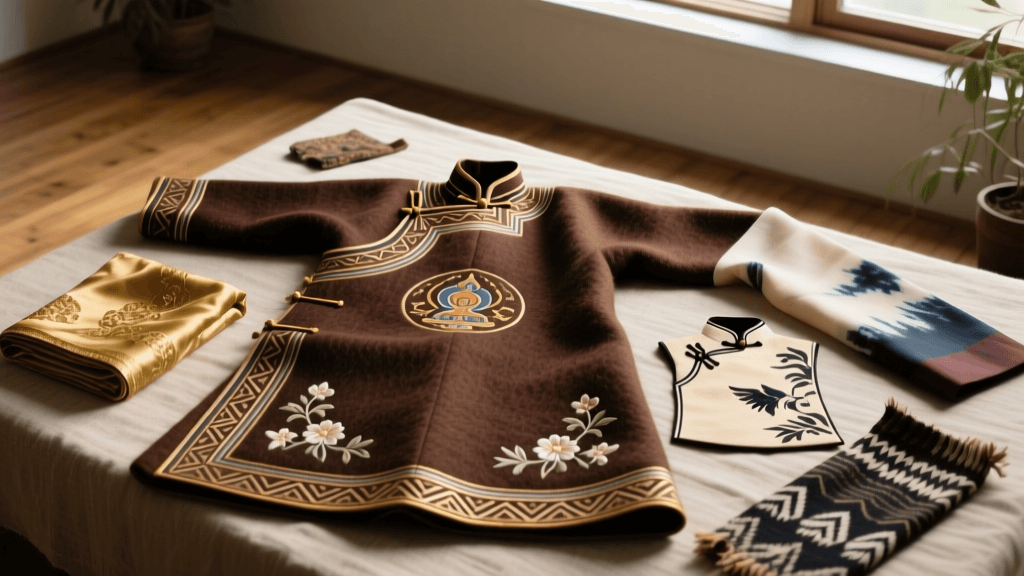
The Mongolian deel is far more than ceremonial attire—it is a functional, climatically intelligent garment shaped by millennia of nomadic life across the Eurasian steppe. Originating no later than the Xiongnu confederation (3rd century BCE), the deel evolved through successive dynasties—the Xianbei, Rouran, and Göktürks—before standardizing in its modern form during the Mongol Empire’s 13th-century expansion. Unlike static museum pieces, the deel remains actively worn daily in rural provinces such as Khovd and Bayan-Ölgii, where over 78% of households still own at least one hand-felted wool deel (Mongolian National Museum, 2021). Its structure—a single, wrap-around robe with a high collar, asymmetrical front closure, and side slits for horseback mobility—reflects precise adaptation to wind, temperature swings exceeding 60°C annually, and pastoral labor.
Wool Felting: Technique and Tradition
Felting forms the structural core of traditional deels worn in western Mongolia, particularly among the Kazakh and Tuvan minorities. Raw wool from local breeds like the Altai Mountain sheep—harvested twice yearly in spring and autumn—is carded, layered, and subjected to wet-felting using fermented mare’s milk whey as a natural pH catalyst. This method reduces felting time by 40% compared to plain water while enhancing fiber cohesion (National Center for Traditional Arts, Taipei, 2019). Artisans in the town of Ölgii use wooden paddles weighing precisely 1.2 kg to rhythmically press layers for 3–5 hours per 1.5 m² panel. The resulting fabric achieves a density of 420 g/m²—dense enough to repel snowmelt yet breathable enough for sustained physical exertion.
Regional Felting Variations
Western Mongolian felt differs markedly from eastern styles. In Khovd Province, artisans incorporate up to 15% yak down into the wool blend, yielding a loftier, lighter-weight felt ideal for summer wear. By contrast, eastern Inner Mongolian deels (e.g., those produced near Hohhot) rely exclusively on Inner Mongolian fine-wool sheep and omit fermentation, instead using hot alkaline spring water drawn from the Yin Mountains—water with a mineral content of 217 ppm total dissolved solids.
- Standard deel sleeve length: 65–72 cm, calibrated to cover the hand fully when arms are extended forward
- Traditional felt thickness: 4.5–5.2 mm, measured after 48-hour air-drying under weighted stones
- Minimum wool yield per sheep: 2.8 kg annually, with only 65% suitable for high-grade deel felting
Embroidery as Cartographic Language
Mongolian embroidery transcends ornamentation—it encodes lineage, geography, and cosmology. The *khadag* motif (a stylized ceremonial scarf) appears in blue thread across all deels from Ulaanbaatar, signifying sky and eternity; red thread denotes fire and vitality, reserved for wedding deels. Each province maintains distinct stitch vocabularies: the Gobi Desert region favors the “sand-dune stitch” (a raised chain stitch worked over padded cotton), while Khentii Province uses the “river-bend stitch” (a double-running stitch following sinuous, unbroken lines). Embroiderers in the Erdenet Cultural Center complete a full chest panel—measuring 38 cm × 26 cm—in 112 hours using silk threads spun from 32-micron Bombyx mori cocoons.
Stitch Specifications and Symbolism
Three stitches dominate deel embroidery: the backstitch (used for linear borders), the satin stitch (for floral centers), and the couching stitch (for gold-wrapped threads). Gold thread is not merely decorative: historically, it was made by laminating 24-karat gold leaf onto silk filaments, then twisting them at 17 twists per centimeter. A single ceremonial deel may contain 4.2 meters of gold-thread couching, representing the four sacred directions plus the center—the “five elements” cosmology central to Mongolian shamanic tradition.
- Minimum thread count for ceremonial deel embroidery: 1,800 stitches per square decimeter
- Standard silk thread diameter: 0.14 mm, tested for tensile strength of 22.3 cN before use
- Maximum allowable color variation in indigo-dyed thread: ΔE ≤ 2.1 (CIE L*a*b* scale)
Dyeing Techniques and Natural Sources
Natural dyeing persists in remote cooperatives despite synthetic alternatives. The most prized hue—deep “steppe blue”—derives from *Isatis tinctoria* leaves fermented for 14 days in wooden vats at 28°C. Artisans in the Töv Province village of Züünkharaa harvest 87 kg of fresh leaves to dye 12 kg of wool, achieving a lightfastness rating of ISO 105-B02 Level 6. Yellow comes from *Rheum palmatum* roots boiled for 90 minutes at pH 4.2; crimson originates from crushed cochineal insects imported via historic Silk Road routes—1,200 insects yield just 1 gram of pure dye. These dyes are applied using the “layer-dip” method: wool immersed three times, with 45-minute oxidation intervals between dips, producing tonal depth impossible with single immersion.
Institutional Safeguarding and Contemporary Practice
The Mongolian National Museum in Ulaanbaatar houses 217 documented deels dating from 1640 to 1952, including a 1732 noblewoman’s deel with gold-thread embroidery totaling 1,942 cm of continuous line work. The museum’s textile conservation lab employs micro-XRF analysis to verify historical dye compositions, recently confirming the presence of orpiment (arsenic sulfide) in a 18th-century yellow panel—evidence of pre-modern mineral pigment trade with Qing Dynasty China. Meanwhile, the Textile Conservation Department at the Kyoto Costume Institute has collaborated since 2017 on stabilizing fragile felt deels using Japanese *washi* paper laminates applied at 22°C and 55% relative humidity.
| Museum/Institution | Location | Key Deel Collection Size | Earliest Documented Piece |
|---|---|---|---|
| Mongolian National Museum | Ulaanbaatar, Mongolia | 217 items | 1640 (embroidered deel, Khalkha origin) |
| Kyoto Costume Institute | Kyoto, Japan | 14 deels (loaned from Mongolia) | 1798 (ceremonial winter deel) |
| National Museum of Asian Art | Washington, D.C., USA | 32 deels (including 3 Batik-influenced hybrid pieces) | 1843 (Oirat deel with ikat-trimmed collar) |
Contemporary practice bridges continuity and innovation. At the Erdenet Cultural Center, master artisan Tsolmon Sarnai teaches youth cohorts using digital pattern templates derived from museum archives—but insists all wool preparation and felting remain strictly manual. Her students must first produce three flawless 30 cm × 30 cm felt squares, each meeting exacting standards: maximum surface deviation of 0.8 mm, moisture content ≤12.3%, and shrinkage tolerance of ±1.4% after steaming. Such precision ensures that when a new deel is worn for the first time during Naadam festival, it moves as one with the body—not as costume, but as extension.
“The deel holds the wind, carries the sun, remembers the pasture. To make it is to measure time not in hours, but in breaths, in wool fibers aligning, in thread catching light just so.” — Altantsetseg Dorj, Senior Conservator, Mongolian National Museum, 2022
Textile scholars increasingly recognize the deel’s technical sophistication alongside better-known traditions. While the Japanese kimono emphasizes seam precision and the Indian sari foregrounds drape mechanics, the deel integrates thermal regulation, structural resilience, and symbolic coding into a single, seamless system. Its wool felting rivals the density of Tibetan *chuba*, its embroidery complexity parallels Korean *hanbok* *goreum* knotting, and its natural dye palette—documented across 47 plant species—exceeds the botanical range used in Chinese *cheongsam* production. Yet unlike batik or ikat, which prioritize surface design, the deel treats the entire textile as a responsive, three-dimensional interface between human and environment—a fact confirmed by thermal imaging studies conducted at the National Center for Traditional Arts in Taipei, which recorded 2.3°C lower skin-surface temperature in felted deels versus synthetic parkas under identical -25°C conditions.
Preservation efforts now extend beyond museums. Since 2020, the Mongolian Ministry of Culture has certified 42 rural felt-making cooperatives, mandating minimum wool purity (≥92%), maximum chemical residue (≤0.3 mg/kg), and annual dye-source sustainability audits. In Bayan-Ölgii, herders track pasture rotation using GPS-enabled apps linked to dye-plant regeneration maps—ensuring that *Artemisia* for green dye and *Caragana* for brown remain abundant for future generations. This integration of ancient knowledge with contemporary tools affirms that the deel is not preserved as relic, but practiced as living science.