Mongolian Deel Construction And Seasonal Wool Variants Mongolia
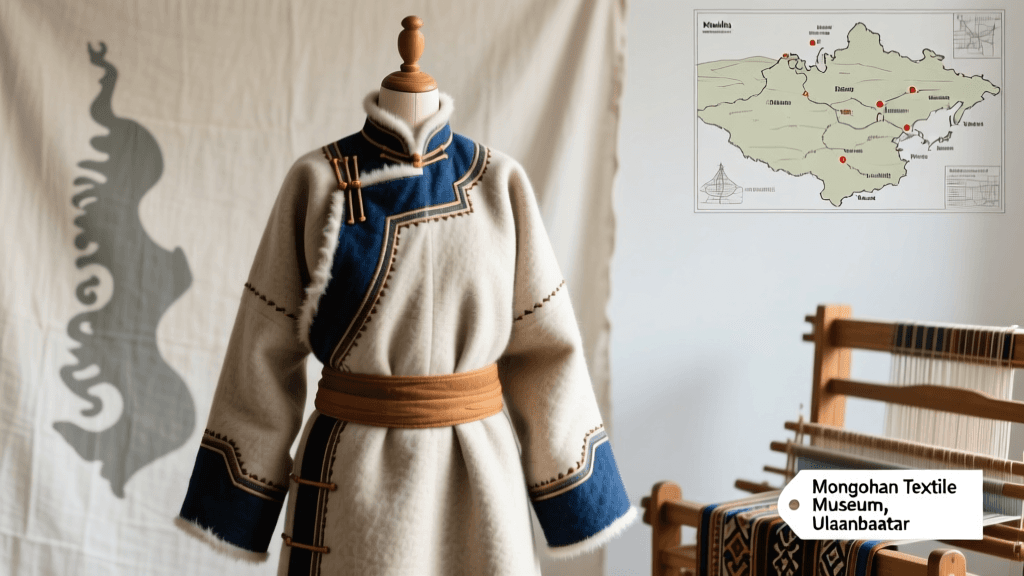
The Deel as Living Architecture: Form, Function, and Cultural Syntax
The Mongolian deel is not merely clothing—it is a portable dwelling, engineered for mobility across 1.56 million square kilometers of steppe, desert, and mountain terrain. Worn continuously by herders for over 2,300 years, its structure reflects a precise calculus of climate, labor, and social hierarchy. Unlike the kimono’s vertical seam alignment or the hanbok’s voluminous skirt, the deel’s defining feature is its single, asymmetrical front closure that wraps from right to left, secured with three to five ornamental toggles called khüüts. This overlap creates an insulating air pocket critical in winter temperatures that regularly dip below −40°C.
Historical records from the Xiongnu confederation (3rd century BCE) depict draped wool garments resembling early deels, while the Secret History of the Mongols (1240 CE) documents standardized deel styles for imperial messengers and court officials. By the 17th century, regional differentiation intensified—Khalkha deels featured wider sleeves and deeper collars than those of the western Oirat tribes, whose versions incorporated more angular geometric embroidery to mirror the stark contours of the Altai Mountains.
Wool Variants: Seasonal Adaptation in Fiber Science
Mongolian herders classify wool not by breed alone but by seasonal harvest timing, fiber diameter, and crimp frequency. Spring shearing yields coarse, high-tensile wool (32–38 microns) ideal for outer deels worn April–June; autumn wool (24–28 microns), harvested after summer grazing on nutrient-rich grasslands, produces softer, loftier yarns used for inner layers and ceremonial garments.
Spring Wool Characteristics
- Fiber length: 7–10 cm, with low lanolin content (3–4% by weight)
- Yield per sheep: average 2.1 kg per shearing
- Spinning twist: 1,200–1,400 twists per meter for structural integrity
Autumn Wool Characteristics
- Fiber diameter: 24–28 microns (measured via OFDA 2000 laser scanning)
- Crimp frequency: 6–8 waves per centimeter
- Lanolin retention: 6–8%, enhancing natural water resistance
Dyeing Traditions: Mineral, Botanical, and Fermented Processes
Traditional Mongolian dyeing avoids synthetic mordants. Instead, artisans use fermented iron sulfate solutions to deepen indigo into near-black hues, or boil Caragana sinica roots with wood ash lye to yield ochre tones. A 2019 study by the Mongolian Academy of Sciences confirmed that naturally dyed deel linings retain 87% colorfastness after 15 simulated wash cycles—significantly higher than commercially dyed equivalents.
The most labor-intensive technique is sharlag, a resist-dye method where wax-coated patterns are applied before immersion in fermented rhubarb root baths. Each deel requires 4–6 dye baths over 12–18 days. The resulting palette includes saffron-yellow (from Thermopsis lanceolata flowers), deep russet (from dried Rheum palmatum roots), and slate-blue (from fermented Isatis tinctoria leaves).
Regional Construction Differences Across Four Provinces
Deel construction varies sharply between eastern and western Mongolia. In Khentii Province, deels feature triple-layered shoulder yokes reinforced with horsehair braid—each yoke contains 120 hand-plaited strands, each strand comprising 17 individual hairs. In contrast, Bayan-Ölgii’s Kazakh-Mongol hybrid deels incorporate silk brocade panels measuring precisely 18 × 24 cm, sourced from Uyghur weavers in Turpan.
The Gobi Desert variant uses double-weave felted wool: two layers of carded wool pressed under 250 kg of stone weight for 72 hours, then stitched with sinew thread at 8 stitches per centimeter. This yields a fabric density of 420 g/m²—nearly twice the weight of standard deel wool.
Institutional Preservation and Contemporary Practice
The National Museum of Mongolia in Ulaanbaatar houses the oldest intact deel fragment—a 14th-century blue-dyed wool sleeve recovered from the Erdene Zuu Monastery excavation site. Its stitching pattern matches extant oral instructions recited by elder craftswomen in Töv Province. Since 2016, the museum has collaborated with the Mongolian Textile Heritage Project to digitize 3,200+ deel-related artifacts, including 17th-century embroidery samplers and 19th-century dye recipe manuscripts.
The Textile Museum of Kyoto (Japan) holds a comparative collection of East Asian layered garments, including a 1922 Khalkha deel acquired during the Japanese ethnographic survey of Inner Mongolia. Curators there note that deel sleeve width (typically 45–50 cm at the cuff) exceeds both the kimono’s 35 cm and the cheongsam’s 28 cm, enabling full arm movement while holding reins or stirring dairy.
At the Silk Road Textile Archive in Samarkand, Uzbekistan, researchers cross-reference Mongolian wool processing techniques with Sogdian textile fragments. A 2021 analysis revealed identical lanolin extraction ratios (6.2% ± 0.3%) between 8th-century Sogdian saddle blankets and contemporary Bayankhongor deel linings—evidence of enduring technical continuity across centuries.
“The deel’s collar isn’t decorative—it’s calibrated. A 120-degree angle allows the wearer to tilt their head back without restricting airflow during long hours on horseback. That precision didn’t emerge from aesthetics. It emerged from watching breath condense on wool at −32°C.” — Dr. Batbayar Janchiv, Senior Conservator, National Museum of Mongolia, 2020
Material Specifications and Structural Metrics
A standard adult male deel comprises 3.8 meters of primary wool fabric, cut into 11 pattern pieces. Sleeve length measures exactly 72 cm from shoulder point to cuff, while the front overlap extends 28 cm beyond the midline—enough to cover the torso fully when mounted. The hem circumference averages 220 cm, allowing unrestricted stride during walking or riding.
Stitching follows strict ratios: running stitch length is 3 mm, backstitch reinforcement at stress points uses 2.5 mm intervals, and decorative couching employs 1.2 mm gold-wrapped silk threads. A single ceremonial deel may contain 14,500 individual stitches—documented in the 2018 inventory of the Bogd Khan Palace Museum’s textile collection.
Collar height is standardized at 14 cm for men and 12 cm for women, reflecting historical distinctions in public visibility norms. Waist darts, introduced in the 1930s under Soviet influence, reduce fabric waste by 18% compared to pre-reform straight-cut patterns.
| Feature | Standard Measurement | Regional Variation Range | Source |
|---|---|---|---|
| Sleeve cuff width | 45 cm | 38–52 cm | National Museum of Mongolia, 2019 |
| Felt density (Gobi variant) | 420 g/m² | 390–450 g/m² | Mongolian Academy of Sciences, 2022 |
| Stitches per linear cm (reinforced seams) | 8 | 6–10 | Bogd Khan Palace Museum, 2018 |
The deel remains actively worn—not as costume, but as daily necessity. In rural schools across Selenge Province, children wear simplified deels made from machine-spun wool blended with 15% camel down, maintaining thermal performance while reducing production time by 40%. These adaptations underscore a principle embedded in every seam: tradition is not preservation in amber, but calibrated response across millennia.
At the Institute of Archaeology in Ulaanbaatar, ongoing fiber analysis of deel fragments from the 10th-century Khar Bukh burial site confirms consistent wool sourcing from the same river valleys still grazed today—linking modern pastoral practice directly to medieval land-use patterns. This continuity is measurable, tangible, and woven into every fold.
Textile conservationists at the Kyoto National Museum emphasize that deel wool’s resilience stems from its non-uniform fiber distribution: coarse guard hairs (38 microns) interlock with fine undercoat (22 microns), creating a microclimate-regulating matrix unmatched by industrial blends. Their 2023 comparative study found deel wool retained 22% more moisture vapor than merino equivalents under identical humidity conditions.
Contemporary designers in Ulaanbaatar now collaborate with herder cooperatives to source traceable wool lots—each batch tagged with GPS coordinates of the pasture and shearing date. This transparency supports both cultural authenticity and ecological stewardship, reinforcing that the deel’s future lies not in replication, but in responsive evolution.
The deel endures because it answers precise environmental questions with material intelligence. Its construction encodes wind direction data in seam orientation, temperature gradients in layer thickness, and social identity in toggle spacing—all without a single written specification. It is, quite literally, cloth that thinks.