Modern Hanbok Styling 2026: Pairing Jeogori With Denim
The Renaissance of the Jeogori in 2026
The global fashion landscape in 2026 has witnessed a profound shift toward heritage fusion, moving beyond the novelty phase of cultural apparel into the realm of everyday, functional capsule wardrobes. At the forefront of this movement is the modern hanbok, specifically the jeogori—the traditional upper garment of Korean dress. Once reserved strictly for weddings, lunar new year celebrations, and formal ceremonies, the jeogori has been radically reimagined by contemporary designers for daily wear. Today, fashion enthusiasts are seamlessly mixing these historically rich pieces with modern staples like selvedge denim and tailored office trousers, creating a sophisticated dialogue between antiquity and modernity.
When examining the historical context of Korean textiles, institutions like the Victoria and Albert Museum highlight the meticulous construction and vibrant color theories inherent in traditional East Asian garments. However, the 2026 consumer demands versatility. The modern iteration of the jeogori respects the foundational architecture of the garment while adapting its proportions, fabrics, and closures to suit the fast-paced dynamics of contemporary urban life.
Anatomy of the 2026 Contemporary Jeogori
What exactly makes a jeogori "modern" this year? The answer lies in structural tweaks and a heavy reliance on sustainable, next-generation textiles. According to Encyclopædia Britannica, the hanbok's basic structure has remained remarkably consistent for centuries, characterized by its elegant curves and harmonious color combinations. Yet, contemporary designers are now reinterpreting these lines for modern mobility.
In 2026, the most sought-after fusion jeogori are crafted from Tencel-hemp blends, matte crepe, and lab-grown peace silk. This shift is largely driven by a demand for eco-conscious luxury. As noted by the UNFCCC Fashion Industry Charter for Climate Action, the integration of low-impact, biodegradable textiles is a primary goal for the global fashion sector, and Korean heritage brands are leading the charge by applying these sustainable fabrics to traditional silhouettes.
Key anatomical updates in the 2026 contemporary jeogori include:
- The Git (Collar) and Dongjeong (White Lining): Modern versions often feature a slightly narrower git to frame the face more sharply, with the dongjeong replaced by contrast topstitching or a removable, magnetic white collar band for easy laundering.
- The Baerae (Sleeve Curve): While traditional sleeves feature a dramatic, sweeping curve, 2026 streetwear adaptations utilize a tapered, 3/4-length balloon sleeve that ends precisely at the mid-forearm, preventing the fabric from dragging through food or catching on desk edges.
- The Goreum (Ribbon Ties): The long, flowing silk ribbons of the past are often shortened to a decorative 6-inch bow, or replaced entirely with hidden interior snap buttons and structural hook-and-eye closures to maintain a clean, minimalist exterior.
Look 1: Streetwear Fusion — The Jeogori and Wide-Leg Denim
The most popular way to style the jeogori in 2026 is by contrasting its delicate, historical lines with the rugged, utilitarian nature of heavy-weight denim. This juxtaposition creates a visually striking streetwear silhouette that is both comfortable and deeply expressive.
Proportions and Fit
The golden rule for this pairing is waistline alignment. A contemporary fusion jeogori typically features a cropped hem that ends exactly at the natural waist or the lower ribcage. To complement this, opt for high-waisted, wide-leg denim with a 12-inch to 14-inch front rise. This ensures that the hem of the jeogori overlaps the waistband of the jeans by about half an inch, preventing any awkward gaps and creating a continuous, elongated line from the torso down.
Color Theory and Fabric Weight
For a cohesive look, lean into muted interpretations of Obangsaek (the traditional Korean five-color spectrum). A dusty indigo or slate-grey jeogori crafted from a 180 GSM hemp-cotton blend pairs beautifully with vintage-wash, light-blue denim. Avoid heavily distressed denim; the clean, structured lines of rigid, unwashed selvedge denim better mirror the architectural integrity of the hanbok.
Footwear and Accessories
Ground the outfit with chunky, lug-sole loafers or minimalist, unbranded white leather sneakers. To bridge the gap between traditional and modern, accessorize with a contemporary norigae (traditional pendant) reimagined as a minimalist brass lapel pin or a detachable charm on a modern crossbody bag.
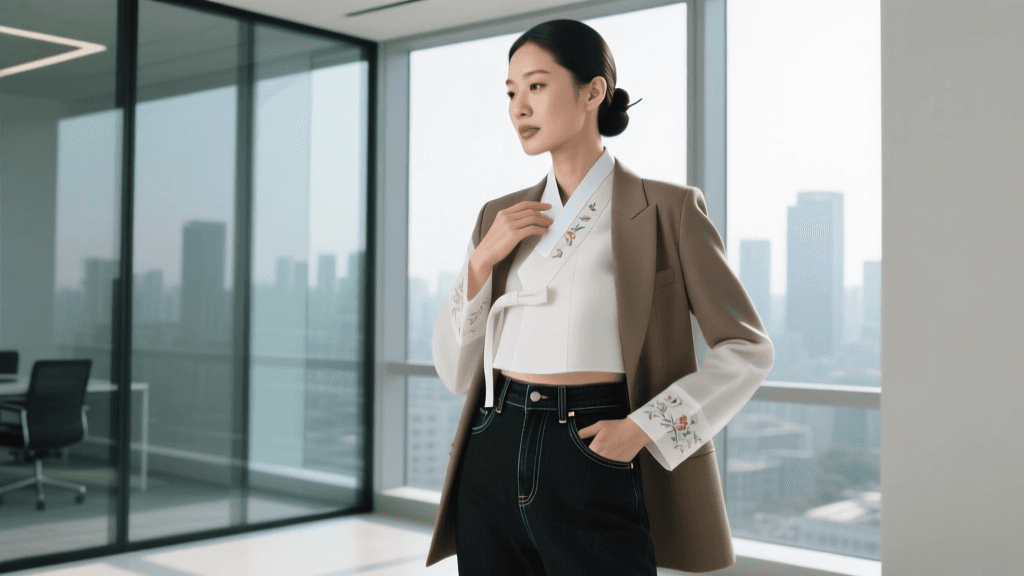
Look 2: The Smart-Casual Office — Tailored Trousers and Layering
Bringing the jeogori into the corporate or creative office space requires a focus on drape, subtlety, and sophisticated layering. In 2026, the workplace dress code has fully embraced cultural heritage pieces, provided they are styled with intentionality and tailored precision.
The Layering Technique
Because the modern office jeogori is often cut with a slightly deeper V-neckline to mimic the traditional collar crossover, layering is essential. Wear your jeogori over a fitted, ribbed silk-blend turtleneck in the winter, or a sleeveless, high-neck matte crepe camisole in the summer. This provides modesty while adding a rich textural contrast between the inner layer and the structured outer garment.
Trousers and Tailoring
Swap the denim for high-waisted, pleated wool-blend trousers. A wide-leg or straight-cut trouser in charcoal, camel, or deep olive allows the jeogori to act as a statement jacket. Ensure the trousers are hemmed to just graze the top of your footwear—no bunching at the ankle. The fluid movement of the wool trousers beautifully echoes the traditional chima (skirt) or baji (trousers) without being overly costumey.
Color Blocking for the Boardroom
Monochromatic or tonal dressing works exceptionally well here. Imagine a soft, blush-pink matte crepe jeogori worn over a matching tone camisole, paired with deep burgundy or chocolate brown tailored trousers. This tonal depth reads as highly professional and avant-garde, perfectly suited for creative directors, architects, and modern professionals.
Comparison Chart: Traditional vs. 2026 Fusion Jeogori
To fully understand the evolution of the garment, it is helpful to compare the ceremonial standards with the contemporary adaptations currently dominating the market.
| Feature | Traditional Ceremonial Jeogori | 2026 Contemporary Fusion Jeogori |
|---|---|---|
| Primary Fabric | Heavy silk brocade, stiff ramie | Matte crepe, Tencel-hemp blends, organic cotton |
| Sleeve Length & Cut | Long, wide with dramatic baerae curve | Cropped, tapered, 3/4 length balloon or straight |
| Closure System | Long, flowing silk goreum (ribbon ties) | Hidden magnetic snaps, interior hook-and-eye, short decorative ties |
| Hemline | Extends past the waist, covering the hips | Cropped precisely at the natural waist or ribcage |
| Primary Styling | Worn exclusively over chima (skirt) or baji (trousers) | Layered over denim, tees, turtlenecks, and tailored office trousers |
| Care & Maintenance | Strictly professional dry clean only | Often machine washable on delicate or easy hand-wash |
Sourcing and Pricing in 2026
As the demand for everyday hanbok has surged, the market has responded with a wide array of price points. In 2026, you do not need to commission a bespoke piece from a master artisan in Seoul to achieve a high-quality look, though supporting independent Korean designers remains the best way to ensure cultural authenticity and ethical labor practices.
- Entry-Level ($80 - $140): Mass-market fusion brands and global fast-fashion collaborations offer cotton-blend jeogori. While accessible, these often lack the structural interfacing in the collar that gives the garment its distinct shape.
- Mid-Tier Contemporary ($150 - $280): This is the sweet spot for 2026. Independent Korean labels operating on platforms like Etsy, Musinsa, and dedicated global heritage marketplaces offer incredible quality. These pieces feature proper collar interfacing, sustainable fabrics, and thoughtful hardware.
- Bespoke & Designer ($350 - $800+): For those seeking luxury, established modern hanbok houses offer made-to-measure services utilizing artisanal natural dyes and hand-woven regional textiles.
Care and Maintenance for Modern Blends
One of the primary barriers to integrating traditional garments into a modern wardrobe is the fear of ruining delicate fabrics. Fortunately, the 2026 textile innovations have made the contemporary jeogori remarkably resilient. For Tencel-hemp and organic cotton blends, turn the garment inside out, place it in a mesh laundry bag, and wash it on a cold, delicate cycle with a pH-neutral detergent. Lay it flat to dry to preserve the structural integrity of the collar. For matte crepe and peace silk variations, a gentle hand wash in cool water followed by air drying is recommended to maintain the fabric's luster and drape. Always avoid high-heat ironing; instead, use a handheld steamer to gently release wrinkles while preserving the subtle texture of the sustainable fibers.
Conclusion
Mixing traditional Asian pieces with modern wardrobes is no longer a trend reserved for fashion week runways; it is a lived, daily practice of cultural appreciation and personal expression. By pairing the historically rich jeogori with the grounded, utilitarian nature of contemporary denim and tailored trousers, you create a wardrobe that honors the past while actively participating in the sustainable, boundary-pushing fashion landscape of 2026. Whether you are navigating the streets of a bustling metropolis or stepping into a modern creative office, the fusion hanbok stands as a testament to the enduring, adaptable beauty of Asian sartorial traditions.