Ming to Qing Dragon Robes: Court Fashion Evolution & Buying Guide
The Apex of Imperial Sartorial Power
When discussing Asian traditions, few garments command the reverence, complexity, and historical weight of the Chinese dragon robe, or Jifu. Serving as the ultimate symbol of imperial authority and cosmic harmony, the evolution of court fashion from the Ming (1368–1644) to the Qing (1644–1912) dynasties reflects profound shifts in politics, ethnic dominance, and textile technology. For collectors, historical reenactors, and haute couture enthusiasts, understanding this evolution is crucial. This guide explores the dynastic shifts in court fashion and provides a highly actionable framework for commissioning, sourcing, and measuring authentic replicas today.
Ming Dynasty Jifu: The Han Renaissance
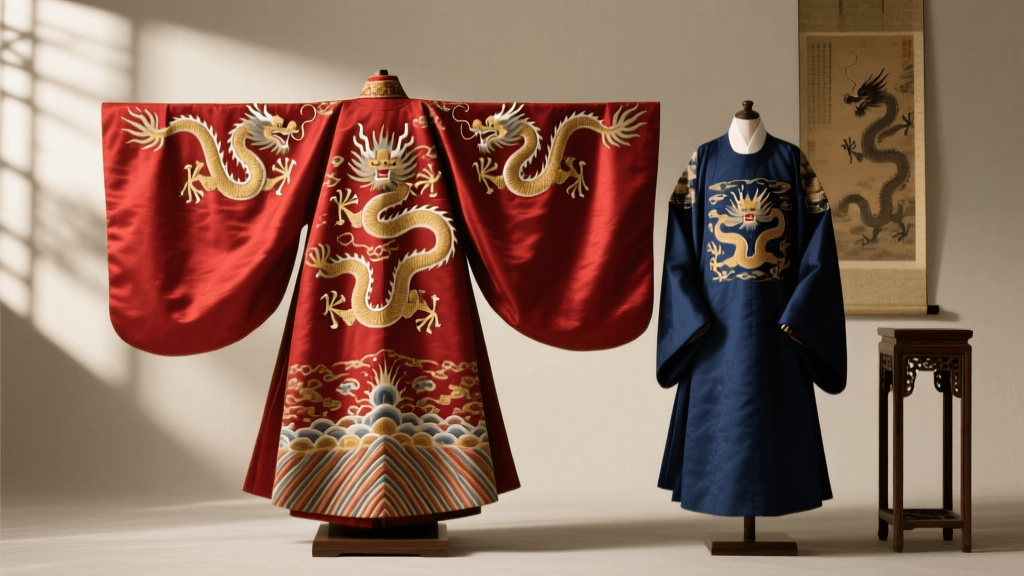
Following the collapse of the Mongol-led Yuan Dynasty, the Ming Dynasty sought to restore traditional Han Chinese cultural and sartorial norms. According to the Metropolitan Museum of Art's Heilbrunn Timeline of Art History, the Ming court established a highly regulated sumptuary system where clothing color, motif, and fabric strictly denoted rank. The quintessential Ming court garment was the Yuanlingpao (round-collar robe). Unlike later dynastic fashions, the Ming silhouette was characterized by its voluminous, sweeping elegance. Sleeves were extraordinarily wide, often hanging past the knees to create a majestic, grounded presence. The primary decorative focus was the Buzi (rank badge) for officials, and the five-clawed dragon (Long) for the Emperor, woven directly into the fabric using the labor-intensive Kesi (silk tapestry) technique or embroidered with metallic couching.
Qing Dynasty Jifu: Manchu Tailoring and Symbolism
The transition to the Qing Dynasty introduced Manchu nomadic traditions to the Han-dominated court, radically altering the silhouette of court fashion. As noted by the Metropolitan Museum of Art's Qing Dynasty overview, the Manchu rulers mandated specific sartorial codes to maintain their ethnic identity while ruling a vast Han majority. The Qing Jifu became narrower, tailored closer to the body, and featured side slits to facilitate horseback riding—a nod to their equestrian heritage. The most distinctive Qing innovation was the Matixiu, or "horse-hoof cuff." These cuffs were folded back during daily activities but pulled down to cover the hands during formal kowtowing, symbolizing respect and submission. Furthermore, the Qing court formalized the "Twelve Symbols of Sovereignty" on the Emperor's robes, embedding cosmic iconography like the sun, moon, and stars into a dense, highly structured visual hierarchy.
Comparative Analysis: Ming vs. Qing Court Robes
| Feature | Ming Dynasty (1368–1644) | Qing Dynasty (1644–1912) |
|---|---|---|
| Silhouette | Voluminous, A-line, flowing drape | Tailored, narrower shoulders, straight drape |
| Sleeves | Extremely wide, hanging past knees | Narrower, fitted to wrist with horse-hoof cuffs |
| Collar | Round collar (Yuanling), often with inner white liner | Round collar with detachable, contrasting collar piece |
| Slits | Typically side slits, sometimes back slits | Four slits (front, back, both sides) for riding |
| Hem Motif | Subtle cloud or wave motifs | Pronounced Lishui (standing water) diagonal stripes |
Practical Guide: Commissioning an Authentic Replica
For those looking to acquire a museum-quality replica for a private collection, theatrical production, or historical exhibition, commissioning a bespoke piece requires precise specifications. Below is an actionable guide to measurements, materials, and costs.
1. Measurements and Silhouette Specifications
When communicating with master tailors in Suzhou or Hangzhou, you must provide exact historical measurements, not modern sizing. Modern garments are cut for mobility; historical court garments were cut for ceremonial posture.
- Ming Yuanlingpao Specifications: Request a sleeve span (tip to tip) of 180cm to 220cm. The hem circumference should be approximately 240cm to 280cm to allow for the deep, pleated folds characteristic of the era. The robe length should be measured from the base of the neck to the ankle bone (typically 130cm–145cm).
- Qing Jifu Specifications: The shoulder width must be tailored exactly to the wearer (e.g., 45cm–50cm) as Qing robes lacked the dropped-shoulder drape of the Ming. The sleeve length should reach the wrist bone, with the Matixiu cuff adding an extra 15cm. The hem circumference is much narrower, usually between 120cm and 140cm.
2. Fabric Selection and Weaving Techniques
Authenticity relies heavily on textile selection. Avoid modern polyester brocades. Instead, specify traditional weaving methods:
- Nanjing Yunjin (Cloud Brocade): The premier choice for Qing Emperor replicas. This jacquard weave incorporates real gold and peacock feather threads. Expect to pay a premium, as authentic Yunjin is woven on traditional wooden draw-looms at a rate of only 5cm per day.
- Zhangzhou Velvet: Ideal for Ming Dynasty winter court robes. This uncut looped velvet provides a rich, matte texture that contrasts beautifully with metallic embroidery.
- Kesi (Silk Tapestry): Used for the highest-ranking Ming and Qing dragons. Kesi weaves the pattern directly into the fabric, leaving tiny slits at the color boundaries. It is reversible and incredibly durable.
3. Embroidery: The 5-Clawed Dragon and the 12 Symbols
When commissioning, you must navigate the strict historical rules of dragon claws. The five-clawed dragon (Long) was strictly reserved for the Emperor and his immediate heirs. High-ranking officials and princes were permitted the four-clawed Mang (python). If you are commissioning a piece for personal wear or non-imperial theatrical use, a four-clawed Mang robe is historically appropriate and avoids the cultural faux pas of usurping imperial authority. Ensure the embroiderer uses the Suzhou "Pingxiu" (flat stitch) for the dragon scales, and "Dingjin" (couching) for the metallic outlines.
4. Cost and Timeline Expectations
Commissioning historical court fashion is an investment in intangible cultural heritage. Below are the current market rates for bespoke commissions from reputable ateliers in China:
- Entry-Level (Machine Embroidered, Silk Blend): $300 – $800. Timeline: 3–4 weeks. Suitable for background theatrical use or casual Hanfu enthusiasts.
- Mid-Tier (Hand-Embroidered Details, Real Silk Jacquard): $2,000 – $5,000. Timeline: 3–6 months. Features hand-couched gold threads and authentic Lishui hems. Ideal for serious collectors and lead theatrical roles.
- Museum-Grade (Full Kesi Weave or Complete Suzhou Hand-Embroidery): $15,000 – $60,000+. Timeline: 12–24 months. Woven on traditional looms with real gold leaf threads and peacock yarn. These pieces are investment-grade assets often acquired by institutions like the Victoria and Albert Museum's Asian Collections.
Sourcing Artisans and Authentic Materials
Finding legitimate artisans requires bypassing mass-market e-commerce platforms. Seek out ateliers located in Suzhou (the historic center of silk embroidery) and Nanjing (the home of Yunjin brocade). Look for workshops designated as "Intangible Cultural Heritage" (非物质文化遗产) inheritors by the Chinese Ministry of Culture. When negotiating, request a "shrinkage test" report for the silk base fabric, as traditional dyes and weaves can shrink up to 8% upon the first professional steaming. Always mandate a 30% deposit, a mid-production photographic update of the embroidery framing, and the final 70% upon completion before international shipping.
Care and Archival Storage
Once acquired, a bespoke dragon robe requires archival care. Never hang a heavily embroidered Jifu on a standard hanger; the weight of the metallic threads will distort the silk warp over time. Instead, store the garment flat in an acid-free, unbuffered archival box. Interleave the folds with unbleached, washed muslin to prevent crease lines from becoming permanent stress fractures in the silk. Maintain a storage environment with a relative humidity of 45-55% and a temperature of 65°F (18°C) to prevent the metallic threads from tarnishing or the silk proteins from degrading.
Conclusion
The evolution from the sweeping, Han-centric elegance of the Ming Dynasty to the structured, equestrian-influenced tailoring of the Qing Dynasty represents one of the most fascinating intersections of politics and fashion in Asian traditions. Whether you are studying the semiotics of the twelve imperial symbols or actively commissioning a bespoke replica, understanding the precise measurements, textile requirements, and historical context is essential. By supporting traditional weaving and embroidery ateliers, collectors and historians play a vital role in keeping these magnificent sartorial traditions alive for future generations.