Ming vs Qing Court Robes: Evolution and Collector Guide
The Evolution of Imperial Chinese Court Fashion
For over two millennia, clothing in Imperial China was not merely a matter of aesthetic preference but a rigid, codified language of power, cosmology, and social hierarchy. Nowhere is this more evident than in the evolution of court robes from the Ming (1368–1644) to the Qing (1644–1912) dynasties. As the Metropolitan Museum of Art notes in its Heilbrunn Timeline of Art History, the Ming dynasty sought to restore Han Chinese traditions after Mongol rule, resulting in sweeping, elegant silhouettes. In stark contrast, the subsequent Qing dynasty, established by the Manchu people, introduced equestrian-inspired tailoring that forever altered the trajectory of Chinese fashion.
For modern collectors, museum curators, and historical fashion enthusiasts, understanding the structural and symbolic differences between these two eras is paramount. This guide explores the dynasty evolution of court fashion and provides a practical, actionable framework for sourcing, authenticating, and preserving antique Chinese textiles.
The Ming Dynasty: Han Revival and the Round-Collar Robe
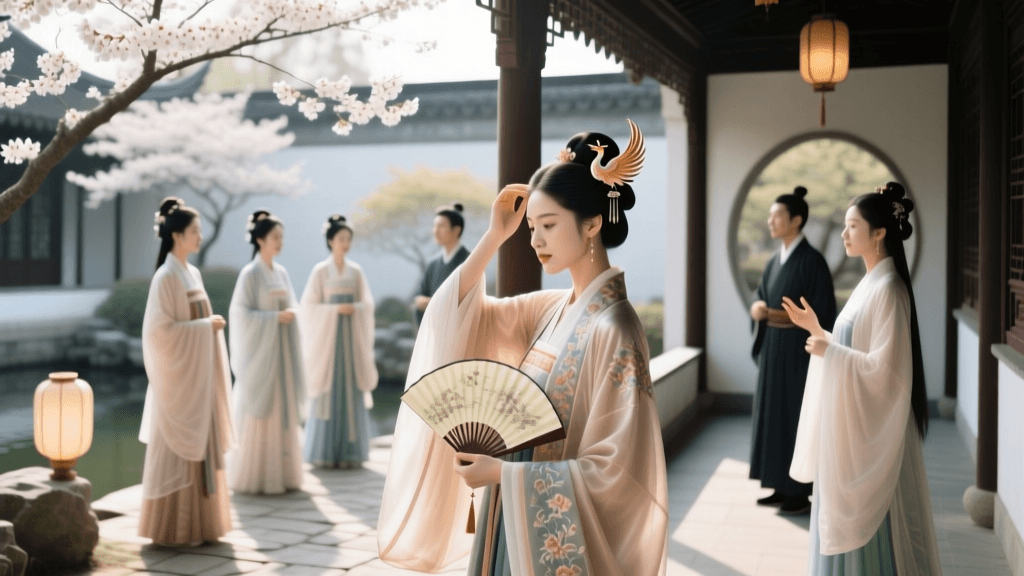
Following the collapse of the Mongol-led Yuan dynasty, the Hongwu Emperor established the Ming dynasty and immediately implemented strict sumptuary laws to purge foreign sartorial influences. The defining garment of the Ming court was the Yuanlingpao (round-collar robe). These garments were characterized by their voluminous, wide sleeves and a distinct lack of front slits, reflecting a sedentary, scholar-official lifestyle rather than an equestrian one.
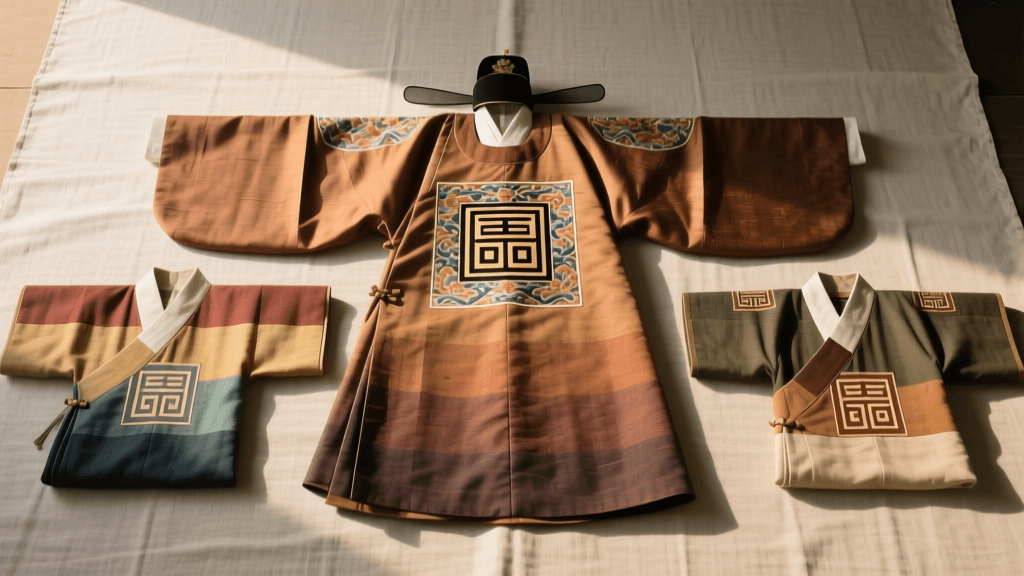
Ming court fashion heavily utilized the buzi (rank badge) system. These square or round embroidered patches were affixed to the front and back of surcoats to denote the wearer's civil or military rank. Civil officials wore birds (such as the crane or peacock), while military officials wore beasts (such as the tiger or leopard). The weaving techniques of the Ming era were highly advanced, with a strong emphasis on zhuanghua (brocade) and heavy, continuous patterns woven directly into the silk.
The Qing Dynasty: Manchu Influence and the Jifu Robe
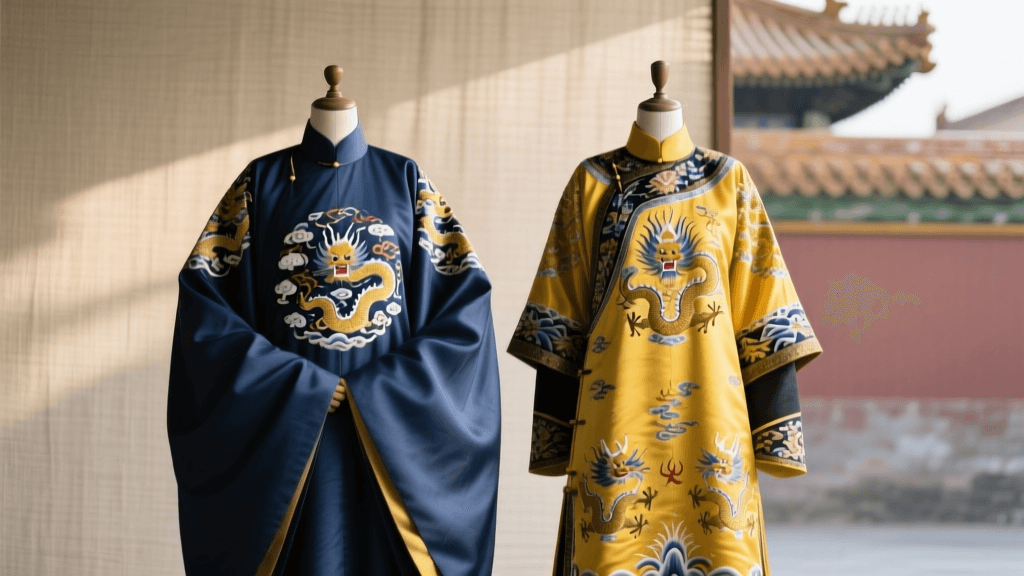
The Manchu conquest of 1644 brought a seismic shift to Chinese court fashion. The Qing emperors mandated that Han Chinese officials adopt Manchu dress, fundamentally changing the silhouette of imperial garments. The most iconic garment of this era is the Jifu (semi-formal court robe), often colloquially referred to in the West as the 'Dragon Robe' or Longpao.
According to the Victoria and Albert Museum, Qing dragon robes were masterpieces of political propaganda. The Manchu rulers used these garments to assert their mandate to rule the Han majority while maintaining their own martial heritage. The Jifu featured several distinct equestrian elements:
- Horse-Hoof Cuffs (Matixiu): Curved, fitted sleeve extensions designed to protect the hands from the cold while riding.
- Four Slits: Slits at the front, back, and both sides of the skirt to allow for ease of movement on horseback.
- Side Fastenings: Unlike the center-front closures of some Ming garments, Qing robes fastened at the right side using intricately knotted silk toggle buttons.
The Twelve Symbols of Sovereignty
While lower-ranking nobles wore robes featuring蟒 (mang, or pythons), only the Emperor could wear the true Longpao adorned with the five-clawed dragon and the Twelve Symbols of Sovereignty. These ancient motifs included the sun, moon, and stars (representing the heavens); the mountain (earth); the dragon (adaptability); and the pheasant (literary refinement). The Metropolitan Museum of Art's Qing Dynasty archive highlights how the Qianlong Emperor strictly codified these symbols in the 18th century, ensuring that the emperor's robe was a literal map of the cosmos.
Comparison Chart: Ming vs. Qing Court Robes
| Feature | Ming Dynasty (1368–1644) | Qing Dynasty (1644–1912) |
|---|---|---|
| Primary Silhouette | Voluminous, wide-sleeved, A-line drape | Tailored, narrower sleeves, fitted bodice |
| Sleeve Cuffs | Wide, open, and flowing | Fitted with horse-hoof shaped extensions |
| Skirt Slits | Typically none or two side slits | Four slits (front, back, left, right) |
| Closure System | Often center-front or right lapel | Strict right-side lapel with toggle knots |
| Collar Style | Round collar (Yuanling) prominent | Mandarin collar with detachable hems |
| Rank Identification | Woven badges integrated into surcoats | Embroidered Buzi appliqued onto surcoats |
Practical Guide for Modern Collectors and Enthusiasts
Acquiring antique Chinese court robes requires a blend of historical knowledge, material science, and market awareness. Whether you are building a private collection or sourcing pieces for theatrical and educational display, the following actionable guidelines will help you navigate the market safely.
1. Authentication and Condition Assessment
The market is flooded with 20th-century tourist-trade reproductions and modern theatrical costumes. To authenticate a genuine 18th or 19th-century Qing Jifu, examine the following:
- Metallic Threads: Authentic Qing robes used real gold leaf applied to paper or animal intestine, which was then wrapped around a silk core. Under a jeweler's loupe (30x magnification), genuine gold will show micro-cracking and a distinct paper core. Modern fakes use synthetic Lurex or plastic films, which appear perfectly uniform and melt when touched with a hot needle.
- Lining and Construction: Antique robes were typically lined with plain or patterned silk, and the interior stitching was done entirely by hand. Machine stitching is an immediate indicator of a post-1920s garment.
- Dye Analysis: Early Qing robes utilized natural dyes (indigo, safflower, madder). By the late 19th century (Guangxu period), synthetic aniline dyes from Europe were introduced. A harsh, neon-bright magenta or purple often indicates late-Qing or Republican-era synthetic dyes, which affects the valuation.
2. Sizing, Measurements, and Display
Antique Chinese robes were cut flat and meant to drape loosely. Displaying them on modern Western mannequins will distort the shoulders and damage the fragile silk.
- Standard Measurements: A typical adult Qing Jifu measures approximately 140 cm (55 inches) across the shoulders and cuffs, and 135 cm (53 inches) in length from the nape to the hem.
- Mannequin Preparation: Never use rigid fiberglass mannequins. Use an archival, armless torsos made of polyethylene foam (such as Ethafoam). Carve the foam to create a sloped, narrow shoulder profile that mimics the natural drape of the garment.
- Padding: Wrap the carved foam in washed, unbleached cotton jersey or Tyvek. Stuff the sleeves lightly with acid-free tissue paper to prevent hard creases at the elbow and shoulder joints.
3. Market Pricing and Acquisition Costs
The valuation of Chinese court robes varies wildly based on provenance, condition, and the rank of the original wearer. Here is a practical pricing matrix for the current auction market:
- Antique Fragments & Buzi (Rank Badges): $200 – $800. Ideal for framing and study.
- Late Qing (1850-1911) Official's Robes: $2,000 – $8,000. Often feature synthetic dyes and minor wear, but remain highly collectible.
- Mid-Qing (1750-1850) Imperial Jifu: $20,000 – $80,000. Characterized by exquisite kesi (cut silk) tapestry weaving and real gold thread.
- High-End Auction Timing: To acquire museum-quality pieces, monitor the Asian Art Weeks in New York and London, which typically occur in March and September. Houses like Christie's and Sotheby's release their textile catalogs four weeks prior to the auction.
Preservation and Archival Storage
Silk is a protein fiber that is highly susceptible to light, humidity, and pests. If you are storing your acquisitions rather than displaying them, flat storage is mandatory. Hanging an antique robe will cause gravity to tear the heavy, embroidered silk from the warp threads over time.
'The cardinal rule of textile conservation is to support the weight of the object entirely. Gravity is the enemy of antique silk.' — Textile Conservation Guidelines
Purchase acid-free, lignin-free archival storage boxes (minimum dimensions: 100 cm x 80 cm x 15 cm). Line the box with unbuffered, acid-free tissue paper. Gently fold the robe with tissue 'sausages' placed inside the folds to prevent sharp creases. Store the boxes in a climate-controlled environment maintained at exactly 50% Relative Humidity (RH) and 65°F (18°C). Avoid cedar chests, as the acidic oils in cedar wood can migrate and stain the silk; instead, use powder-coated steel shelving in a dark, interior room.
Conclusion
The transition from the sweeping, scholar-centric robes of the Ming dynasty to the tailored, equestrian-influenced garments of the Qing dynasty represents a fascinating intersection of politics, culture, and craftsmanship. For the modern collector, these garments are not just beautiful textiles; they are historical documents woven in silk and gold. By understanding the structural nuances, employing rigorous authentication techniques, and adhering to strict conservation standards, enthusiasts can ensure that these masterpieces of Asian tradition survive for centuries to come.