Ming Dynasty Hanfu: Decoding Rank, Color Codes, and Buzi
The Visual Language of the Ming Court
When we discuss traditional Chinese clothing, the Ming Dynasty (1368–1644) represents a pinnacle of sartorial regulation. Unlike modern fashion, where personal expression reigns supreme, Ming Dynasty Hanfu was a rigid visual language. Every thread, color, and motif communicated the wearer's exact social standing, bureaucratic rank, and proximity to the Emperor. For modern Hanfu enthusiasts, collectors, and historical reenactors, understanding these codes is essential for achieving true historical accuracy. The garments were not merely clothes; they were wearable legislation, designed to maintain cosmic and social order.
Color Codes: Wearing Your Status
In the Ming Dynasty, color was never a casual choice. The imperial court enforced strict sumptuary laws that dictated which hues could be worn by specific tiers of society. Violating these color codes was not a fashion faux pas; it was a treasonous offense that could result in severe punishment.
- Bright Yellow (Ming Huang): Reserved exclusively for the Emperor, the Empress, and the Empress Dowager. The use of gold thread and bright yellow silk was strictly forbidden for all other subjects, including royal princes.
- Scarlet and Crimson (Da Hong): The colors of power and high authority. First- through fourth-rank civil and military officials were permitted to wear scarlet robes. This vibrant red, often dyed using expensive safflower or madder root, signaled proximity to the throne.
- Blue and Green (Qing/Lu): Worn by fifth- through ninth-rank officials. The deeper the blue or green, the higher the rank within this lower-tier bracket. These colors were derived from indigo and plant-based green dyes.
- Forbidden Colors for Commoners: Commoners (farmers, merchants, artisans) were restricted to dull, muted tones such as ochre, pale blue, gray, and undyed hemp white. They were strictly forbidden from wearing black, purple, or bright red, which were reserved for the scholarly and official classes.
According to the Metropolitan Museum of Art, the Ming court's obsession with visual hierarchy meant that even the subtle shade of a dye could elevate or demote a man in the eyes of the public before he ever spoke a word.
Decoding the Buzi: Mandarin Squares Explained
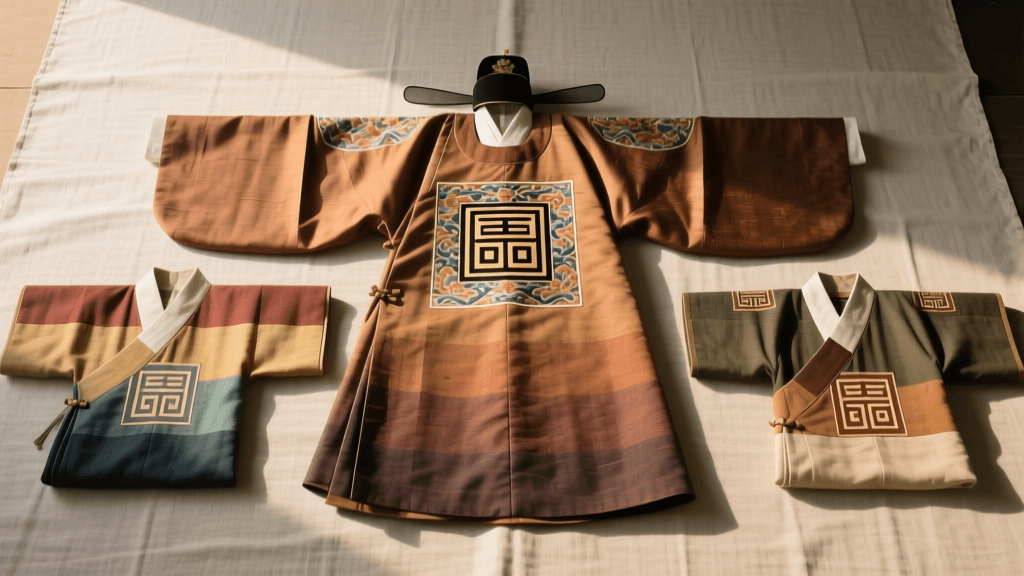
The most recognizable symbol of Ming officialdom is the Buzi, commonly known in the West as the Mandarin Square. These intricately embroidered or woven badges were affixed to the front and back of the official's round-collar robe (Yuanlingpao). The Victoria and Albert Museum notes that these squares served as an immediate visual resume, allowing courtiers to identify each other's exact rank and department across a crowded ceremonial hall.
Civil officials wore squares depicting birds, symbolizing elegance, literary prowess, and grace. Military officials wore squares depicting beasts, symbolizing courage, ferocity, and protective strength. The background almost always featured a sun or a pearl, surrounded by stylized clouds and crashing waves, representing the universe and the official's place within it.
The Complete Ming Dynasty Rank Chart
| Rank | Civil Official (Birds) | Military Official (Beasts) |
|---|---|---|
| 1st | White Crane (Xianhe) | Qilin (Mythical Unicorn) |
| 2nd | Golden Pheasant (Jinji) | Lion (Shi) |
| 3rd | Peacock (Kongque) | Tiger (Hu) |
| 4th | Wild Goose (Yan) | Leopard (Bao) |
| 5th | Silver Pheasant (Xianzhi) | Bear (Xiong) |
| 6th | White Egret (Lu) | Panther (Biao) |
| 7th | Mandarin Duck (Xichi) | Rhinoceros (Xi) |
| 8th | Quail (An) | Rhinoceros (Xi) |
| 9th | Paradise Flycatcher (Lianshou) | Sea Horse (Haima) |
Note: The Censorate, an independent oversight body, uniquely wore the Xiezhi, a mythical beast capable of distinguishing truth from lies, regardless of their specific numerical rank.
Practical Guide: Commissioning an Authentic Ming Official Robe
For modern collectors, historical cosplayers, and Hanfu revivalists, acquiring a historically accurate Ming official robe requires navigating a complex market of mass-produced costumes and high-end artisanal replicas. Here is your actionable guide to sourcing the perfect garment.
Essential Measurements for the Yuanlingpao
To achieve the correct Ming silhouette, modern off-the-rack sizing will not suffice. You must commission or tailor your Yuanlingpao using traditional flat-cutting methods, which rely on geometric fabric panels rather than Western darts and seams.
- Wingspan (Sleeve Tip to Sleeve Tip): 200cm to 220cm. The Ming silhouette requires massive excess fabric that pools gracefully at the wrists and drapes over the hands.
- Body Length: 135cm to 145cm, ending just above the ankle bone to reveal the pleated mamianqun (horse-face skirt) or trousers beneath.
- Cuff Width: 25cm to 30cm for standard daily court sleeves, or up to 70cm for grand ceremonial 'swallowtail' sleeves.
- Collar Diameter: The round collar should sit snugly against the base of the neck, typically measuring 45cm to 50cm in circumference, fastened with a jade or gold toggle on the right shoulder.
Sourcing Materials and Cost Breakdown
Authenticity comes at a price, particularly when sourcing traditional silk brocades like Yunjin (cloud brocade) or Zhuanghua (woven floral brocade). As documented by the Smithsonian Institution, the metallic threads and complex weaves of historical rank badges required immense artisanal labor, a tradition that remains expensive today.
- Mass-Produced Poly-Cotton Blends: $50 - $120. (Delivery: 1-2 weeks). Suitable for casual cosplay or stage performances, but lacks the heavy drape, breathability, and luster of real silk. The Buzi is usually digitally printed.
- Custom Woven Silk Brocade (No Buzi): $400 - $800. (Delivery: 30-45 days). Requires sourcing from specialized mills in Suzhou or Nanjing. The fabric will feature woven damask patterns but will require separate embroidery for the rank badge.
- Hand-Embroidered Buzi Patches: $150 - $400 per pair. (Delivery: 3-6 weeks). Look for metallic thread couching, silk floss, and a damask base. Ensure the artisan uses the traditional Peking or Su embroidery styles.
- Fully Custom Museum-Grade Replica: $1,500 - $3,000+. (Delivery: 90-120 days). Includes hand-woven Yunjin fabric, historically accurate natural plant dyes, and master-level hand-embroidery of the Buzi. This is an investment piece for serious collectors.
Accessorizing by Rank: Belts and Headwear
A Ming official robe is incomplete without its mandated accessories, which were just as strictly regulated as the colors and Buzi.
The Wusha Hat (Black Gauze Cap)
The iconic winged hat, known as the Wusha mao, was the daily wear for civil officials. The oval-shaped cap featured two stiff, wing-like flaps extending from the back. The length and stiffness of these wings varied slightly by era and specific court function, but standard wings extend roughly 15cm to 20cm outward. When commissioning a replica, ensure the frame is made of flexible rattan or wire covered in stiffened black silk gauze, rather than heavy plastic.
The Official Belt (Dai)
The belt was a heavy, ornamental sash that hung loosely around the hips, supported by the robe's own ties. The material of the belt plaques indicated rank:
- 1st Rank: Jade plaques.
- 2nd Rank: Rhinoceros horn or gold plaques.
- 3rd and 4th Rank: Gold plaques.
- 5th through 7th Rank: Silver plaques.
- 8th and 9th Rank: Black horn or dark wood plaques.
For modern reenactors, high-quality resin or carved bone replicas of jade and horn plaques are available for $80 to $150, offering a historically accurate visual weight without the astronomical cost of antique jade or solid gold.
Conclusion
The clothing of the Ming Dynasty was a masterpiece of symbolic engineering. By understanding the strict color codes, the intricate language of the Buzi, and the precise tailoring of the Yuanlingpao, modern enthusiasts can do more than just wear a costume—they can step into a meticulously reconstructed historical reality. Whether you are commissioning a $2,000 museum-grade silk robe or carefully selecting hand-embroidered patches for a personal collection, respecting these ancient rank and color codes ensures that the profound cultural heritage of traditional Chinese garments is preserved with dignity and accuracy.