Ming vs Qing Court Fashion: Evolution of the Dragon Robe
The Visual Language of Imperial Power
Chinese court fashion was never merely about aesthetics; it was a rigid, highly codified visual language that communicated cosmic order, political legitimacy, and social hierarchy. For modern historians, collectors, and traditional garment enthusiasts, understanding the transition from the Ming (1368–1644) to the Qing (1644–1912) dynasty offers a masterclass in how clothing reflects geopolitical shifts. According to the Metropolitan Museum of Art's Heilbrunn Timeline of Art History, the Ming dynasty sought to restore Han Chinese orthodoxy after centuries of Mongol rule, while the subsequent Qing dynasty imposed Manchu sartorial codes to cement their conquest. This article explores the structural and symbolic evolution of Chinese court garments, specifically the iconic Dragon Robe (Longpao), and provides a practical guide for modern collectors and those commissioning historical replicas.
The Ming Dynasty: Restoring Han Orthodoxy
When the Hongwu Emperor established the Ming dynasty, he instituted strict sumptuary laws to erase the influence of the preceding Yuan (Mongol) dynasty. The court fashion returned to the sweeping, voluminous silhouettes of the Han and Tang dynasties. The quintessential Ming court garment was the Daopao (Taoist robe) and the Yesa (a structured, pleated robe with Mongol origins but Han adaptations). Ming robes featured wide, flowing sleeves and round or cross-collars that wrapped right over left, adhering to ancient Confucian principles of civilization over barbarism.
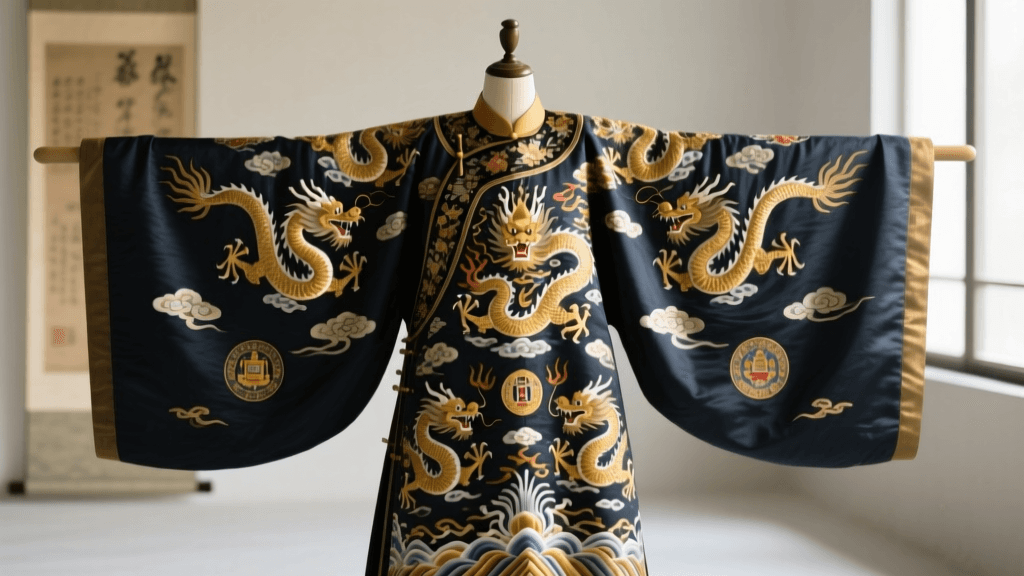
While the Emperor wore the Gunlongpao (a formal dragon robe), high-ranking officials were granted Mang (python) and Feiyu (flying fish) robes. These garments were woven using Zhuanghua (woven gold) and Kesi (silk tapestry) techniques. The motifs were heavily symbolic, featuring cloud bands, crashing waves, and mountains, representing the Emperor's dominion over the heavens, the earth, and the seas. As detailed by Encyclopedia Britannica, Ming textiles were characterized by their flat-pattern cutting, which allowed the fabric to drape naturally over the body, emphasizing a harmonious, unstructured silhouette that concealed the physical form in favor of spiritual and social presence.
The Qing Dynasty: Manchu Influence and the Buzi
The Manchu conquest in 1644 radically altered Chinese court fashion. To enforce submission, the Qing court mandated the queue hairstyle and Manchu riding garments for all Han officials. The Qing Longpao (dragon robe) evolved from the semi-formal Chenwan (dragon gown) and was distinctly tailored for horseback riding. Unlike the wide sleeves of the Ming, Qing robes featured tapered sleeves ending in Matixiu (horse-hoof cuffs), which could be pulled over the hands for warmth or folded back for court etiquette.
The most significant Qing innovation in court hierarchy was the formalization of the Buzi (rank badges), also known as Mandarin squares. While Ming officials also wore badges, the Qing system was strictly standardized and sewn onto the front and back of the Bugua (surcoat) worn over the dragon robe. Civil officials wore birds (e.g., the crane for first-rank, the peacock for third-rank), while military officials wore beasts (e.g., the qilin for first-rank, the lion for second-rank). The Victoria and Albert Museum (V&A) notes that Qing textiles reached unprecedented levels of technical complexity, heavily utilizing Panjin (gold-wrapped thread couching) and intricate embroidery to cover nearly every inch of the garment, leaving no negative space.
Comparison Chart: Ming vs. Qing Court Garments
| Feature | Ming Dynasty (Han) | Qing Dynasty (Manchu) |
|---|---|---|
| Silhouette & Tailoring | Voluminous, flat-pattern cut, A-line pleats, conceals body shape. | Form-fitting bodice, A-line skirt with side slits for riding. |
| Collar Style | Cross-collar (right over left) or round collar. | Round collar with a detachable, stiffened collar band. |
| Sleeves | Extremely wide, flowing sleeves (Pipa sleeves). | Tapered sleeves with horse-hoof cuffs (Matixiu). |
| Fastenings | Hidden ties, fabric knots, or subtle buttons. | Visible toggle buttons (Pankou) made of silk, jade, or metal. |
| Rank Identification | Color of the robe and woven蟒 (python) motifs. | Embroidered Buzi (rank badges) on the outer surcoat. |
The Twelve Imperial Symbols
By the mid-Qing dynasty (specifically codified in the 1759 Illustrated Precedents for the Ritual Paraphernalia of the Dynasty), the Emperor's dragon robe was mandated to feature the Twelve Ancient Symbols of Imperial Authority. When authenticating or commissioning a replica, verifying the placement of these symbols is crucial:
- Sun, Moon, and Three-Star Constellation: Placed on the chest and back, representing the heavens.
- Mountain: Placed on the shoulders, symbolizing the earth and stability.
- Dragon and Pheasant: Representing adaptability and literary refinement.
- Cups (Zongyi), Waterweed, and Grains: Symbolizing filial piety, purity, and prosperity.
- Axe (Fu) and Fu Symbol: Representing executive justice and moral discernment.
Practical Guide: Collecting and Commissioning Court Replicas
For collectors, museum curators, and historical reenactors, navigating the market for antique Qing dragon robes or commissioning high-fidelity Ming and Qing replicas requires specific technical knowledge. Here is an actionable guide to sourcing, measuring, and budgeting for traditional Chinese court garments.
1. Authentication and Material Identification
When evaluating an antique Longpao (typically 18th or 19th century), the first step is verifying the silk and metallic threads. Authentic Qing court robes used Panjin, where gold leaf was glued to paper, cut into microscopic strips, and wrapped around a silk core. Modern fakes often use synthetic metallic yarns. Actionable Tip: Perform a discreet burn test on a loose thread. Authentic silk will smell like burning hair and leave a crushable ash, while synthetics will melt into a hard plastic bead. Furthermore, examine the Kesi (slit tapestry) weave. Genuine Kesi will show tiny vertical slits where color blocks meet, a hallmark of the 'cut silk' technique that cannot be replicated by modern jacquard power looms.
2. Commissioning a Historical Replica: Fabrics and Costs
If you are commissioning a bespoke replica from a traditional atelier in Suzhou or Nanjing, material selection will dictate both the cost and the historical accuracy.
- Song Brocade (Songjin): Ideal for Ming dynasty outer garments. It features a flat, matte finish with complex geometric and floral patterns. Cost: $120 to $250 per yard.
- Xiangyunsha (Gambiered Canton Gauze): A luxury, mud-dyed silk that is water-resistant and historically favored in southern China. Cost: $300 to $500+ per yard.
- Zhuanghua (Woven Gold Brocade): Required for authentic Ming Mang robes. Because it requires weaving real gold-wrapped threads on wooden drawlooms, it is incredibly rare. Cost: $800+ per yard.
3. Tailoring Measurements and Timing
Traditional Chinese tailoring relies on flat-pattern cutting, which differs vastly from Western 3D draping. When providing measurements to a traditional tailor (Caifeng), you must account for the structural requirements of the garment.
- Cross-Collar Overlap (Ming): For a Ming Daopao, the inner collar must overlap the outer collar by at least 15cm to maintain structural integrity and historical modesty standards.
- Sleeve Length: Court formality dictates that sleeves must extend past the fingertips. For Ming robes, add 20cm to your standard wrist measurement to allow for the elegant 'drape' at the wrist. For Qing horse-hoof cuffs, the tapered sleeve should end exactly at the knuckles so the white cuff extension can fold back.
- Shoulder Drop: Traditional robes lack shoulder seams. The fabric is folded over the shoulder. You must provide the 'cross-shoulder' measurement (from wrist to wrist across the back) rather than just shoulder width.
Timing and Budgeting: A fully hand-embroidered Qing Longpao replica, featuring all twelve imperial symbols and intricate wave motifs at the hem (Lishui), requires between 300 and 500 hours of master-level embroidery. You must commission these pieces 8 to 14 months in advance. Expect to pay between $4,500 and $12,000 for a museum-quality, hand-loomed and hand-embroidered replica, whereas machine-embroidered theatrical versions can be sourced for under $500 but lack historical and structural integrity.
Conclusion
The evolution from the flowing, philosophical drapery of the Ming dynasty to the structured, highly ornamented riding garments of the Qing dynasty represents one of the most fascinating intersections of politics, ethnicity, and textile engineering in global history. Whether you are studying the Buzi rank badges to decode a historical painting, authenticating a 19th-century Kesi tapestry, or commissioning a bespoke Longpao for a cultural exhibition, understanding the precise tailoring, materials, and symbolism of these garments is essential. By respecting the traditional techniques and measurements, modern enthusiasts can help preserve the living legacy of China's imperial sartorial traditions.