Ming Dynasty Mamianqun Drape Analysis Research Guide 2026
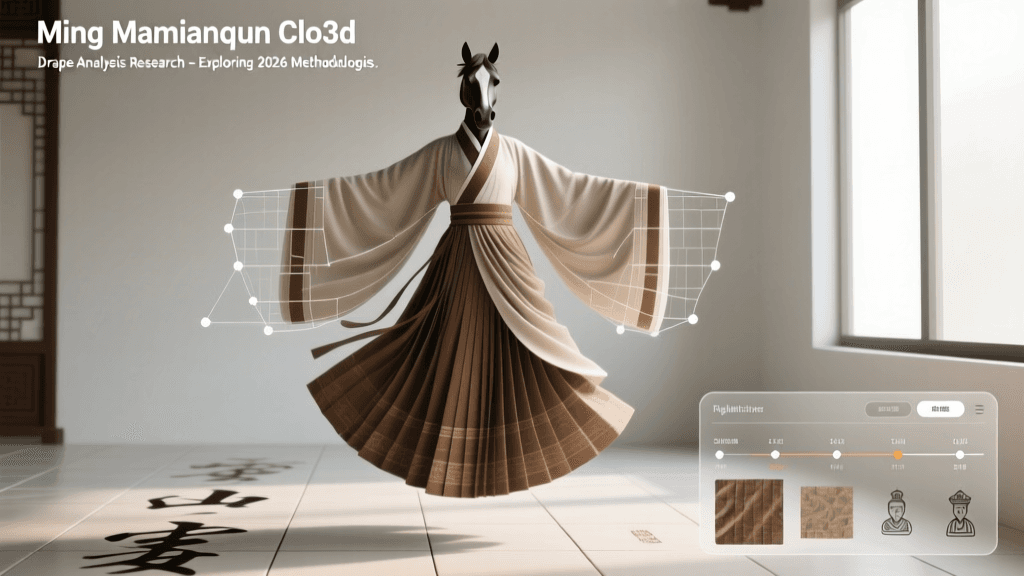
The Intersection of Antiquity and Algorithmic Simulation
The year 2026 marks a transformative era in the academic study of Chinese fashion history. As global interest in traditional Asian garments surges, universities and research institutions have moved beyond static archival photography and physical reproduction. Today, the vanguard of Chinese fashion history education relies heavily on 3D fabric drape analysis, algorithmic pattern drafting, and digital twin technology. At the forefront of this pedagogical shift is the study of the Mamianqun (horse-face skirt), a quintessential garment of the Ming Dynasty that presents unique structural and kinetic challenges for modern researchers.
For academic researchers, graduate students, and digital archivists, understanding how to accurately simulate the complex pleating systems and heavy silk brocades of the Ming era requires a rigorous, data-driven approach. This guide explores the current 2026 academic methodologies for analyzing, reconstructing, and teaching the drape mechanics of the Ming Dynasty Mamianqun.
The 2026 Landscape of Chinese Fashion History Education
Institutions such as Donghua University in Shanghai and the Beijing Institute of Fashion Technology (BIFT) have fully integrated digital simulation into their historical textile curricula. In 2026, it is no longer sufficient for a fashion history student to merely memorize the dynastic timelines or sketch flat illustrations of traditional garments. Academic programs now require students to engage in 'digital archaeology'—the process of reverse-engineering extant garments using non-destructive 3D scanning and physics-based cloth simulation.
This shift is largely driven by the need to preserve fragile artifacts. According to the China National Silk Museum, many Ming dynasty textiles are too degraded to be physically mounted or draped on mannequins for extended periods. Digital drape analysis allows researchers to study the kinetic behavior, weight distribution, and structural integrity of these garments in a virtual environment, ensuring that the physical artifacts remain safely in climate-controlled storage while their digital counterparts are studied, manipulated, and shared globally.
Deconstructing the Mamianqun: Academic Methodologies
The Mamianqun, characterized by its two flat, overlapping front and back panels (the 'horse faces') and its heavily pleated sides, is a masterpiece of traditional Chinese flat-pattern cutting. Unlike Western tailoring, which relies on darts and seams to create three-dimensional volume, the Mamianqun achieves its voluminous, kinetic drape entirely through rectangular geometry, pleating, and the intrinsic properties of the woven textile.
Digital Pattern Drafting vs. Historical Flat-Patterns
In a 2026 academic setting, the first step in drape analysis is the creation of a historically accurate digital pattern. Researchers use CAD software to draft the base rectangles. A standard Ming Mamianqun requires two identical trapezoidal or rectangular panels that overlap at the center front and back. The side sections are then pleated. The academic challenge lies in calculating the precise depth and spacing of the pleats based on the waist circumference and the desired hem width, which historically could exceed three meters.
Modern researchers utilize parametric design scripts to automate the pleat calculations, ensuring that the digital pattern perfectly mirrors the mathematical ratios found in extant Ming artifacts. This parametric approach allows students to instantly visualize how altering the pleat depth by just five millimeters affects the overall rotational drape and flare of the skirt when the avatar is in motion.
Fabric Physics and Drape Simulation Parameters
The most critical phase of academic research in this field is the assignment of fabric physics. Ming dynasty garments were frequently constructed from heavy silk brocades, damasks, and Kesi (silk tapestry), which behave vastly differently from modern lightweight silks. If a researcher applies standard digital silk parameters to a Mamianqun, the simulation will fail, resulting in a skirt that collapses and clings to the avatar rather than standing away from the body in its characteristic bell-like silhouette.
Below is a standardized parameter table utilized in 2026 academic labs for simulating historical Ming textiles in leading 3D fashion software:
| Fabric Type (Historical) | Digital Equivalent Category | Bending Rigidity (U-value) | Particle Distance (mm) | Simulation Use Case |
|---|---|---|---|---|
| Zhuanghua Brocade | Heavy Jacquard / Tapestry | High (85-95) | 5.0 - 8.0 | Winter court garments, formal Mamianqun |
| Plain Weave Zhangzhou Silk | Medium Taffeta / Dupioni | Medium (50-65) | 10.0 - 15.0 | Everyday wear, transitional season skirts |
| Unlined Ramie / Linen | Light Canvas / Heavy Linen | Medium-Low (30-45) | 15.0 - 20.0 | Summer wear, inner pleated layers |
| Kesi (Silk Tapestry) | Stiff Embroidered Organza | Very High (90-100) | 3.0 - 5.0 | Ceremonial panels, highly structured hems |
Note: Particle distance dictates the mesh density. A lower particle distance (e.g., 5.0mm) is computationally heavy but necessary for capturing the micro-folds and sharp creases of heavy brocade pleats, as noted in current CLO Virtual Fashion Education documentation for historical garment rendering.
Case Study: Extant Garments and the Shandong Museum
Academic research often relies on cross-referencing digital simulations with physical artifacts. The Shandong Museum houses an exceptional collection of Ming dynasty textiles, excavated from the tombs of the Lu Huang family. These extant Mamianqun provide the empirical data necessary to calibrate digital simulations.
In recent 2026 graduate seminars, students are tasked with analyzing the high-resolution photogrammetry scans of these Shandong artifacts. They map the degradation of the silk fibers, the stretching of the waistbands, and the permanent set of the centuries-old pleats. By comparing the digital strain maps of their simulated skirts against the physical stress points observed on the historical garments, students can deduce how the original owners moved, sat, and lived. This level of biomechanical analysis bridges the gap between costume history and material science, offering profound insights into the daily lives of Ming dynasty women.
Furthermore, understanding the broader context of Ming aesthetics is crucial. As detailed by the Metropolitan Museum of Art's Heilbrunn Timeline of Art History, the Ming period was characterized by a resurgence of Han Chinese cultural identity and highly regulated sumptuary laws that dictated textile motifs, colors, and weaves based on social rank. Accurate digital reconstruction must therefore account not only for the physical drape but also for the correct placement of rank-specific motifs, such as the python robe patterns or specific floral roundels, ensuring they do not distort unnaturally across the pleated sections.
The 2026 Academic Software Stack
To conduct rigorous drape analysis, researchers in 2026 rely on a specific suite of software tools, moving away from generic 3D modeling programs toward specialized, physics-based cloth simulators:
- CLO 3D / Marvelous Designer: The industry standard for academic fashion history programs. Its ability to handle multi-layered pleating, precise internal line sewing, and advanced fabric property customization makes it indispensable for Mamianqun research.
- Browzwear VStitcher: Frequently used in programs that focus on the intersection of historical research and modern commercial manufacturing, allowing students to test how historical patterns can be graded for modern sizing.
- Unreal Engine 5 (with Chaos Cloth Physics): Utilized by advanced digital heritage labs to create real-time, interactive museum exhibits where users can manipulate the wind, gravity, and movement speed to observe how a Ming Mamianqun reacts in different environmental conditions.
Bridging Academia and the Xin Zhongshi Movement
The rigorous academic study of the Mamianqun is not confined to the ivory tower; it directly fuels the booming Xin Zhongshi (New Chinese Style) fashion movement of 2026. As modern consumers increasingly demand historical authenticity in their traditional-inspired clothing, commercial brands rely on academic research to inform their designs.
By understanding the exact drape mechanics and fabric physics of the Ming era, modern designers can adapt the Mamianqun for contemporary life without losing its structural soul. For instance, academic research into the kinetic flare of the side pleats has led to the development of modern Xin Zhongshi skirts that use advanced heat-setting techniques and engineered synthetic-silk blends to maintain the dramatic Ming silhouette while offering machine-washability and reduced weight for urban commuting.
Furthermore, academic research helps combat the rampant cultural appropriation and historical inaccuracies that often plague fast-fashion interpretations of traditional garments. When brands collaborate with university researchers, they ensure that the overlapping panels, the direction of the pleats, and the placement of the waist ties adhere to the historical record, elevating the Xin Zhongshi movement from a mere aesthetic trend to a respected continuation of Chinese sartorial heritage.
Conclusion
The academic study of Chinese fashion history in 2026 is a dynamic, interdisciplinary field that marries the meticulousness of historical archaeology with the cutting-edge capabilities of digital simulation. By mastering 3D fabric drape analysis, researchers and students are not only preserving the fragile legacy of the Ming Dynasty Mamianqun but also breathing new, kinetic life into it. As digital archiving tools continue to evolve, the ability to accurately simulate, study, and adapt traditional Asian garments will remain a cornerstone of cultural preservation and innovative fashion education.