Ming Dynasty Hanfu: Decoding Rank Badges and Color Codes
Introduction to Ming Dynasty Sartorial Hierarchy
The Ming Dynasty (1368–1644) represents a golden era of Hanfu, characterized by a meticulous return to Han Chinese traditions after the Mongol-led Yuan Dynasty. To restore social order, the Hongwu Emperor instituted a rigid sumptuary system. Clothing was no longer just a matter of personal taste or regional climate; it became a wearable ledger of one's exact social standing, profession, and imperial favor. At the heart of this system were two defining elements: strict color codes and the iconic buzi (rank badges). Today, as the Hanfu revival movement sweeps across the globe, understanding these historical codes is essential for enthusiasts, collectors, and cultural historians alike.
According to the Metropolitan Museum of Art's Heilbrunn Timeline of Art History, the Ming court placed unprecedented emphasis on textile production and the visual communication of state power through dress. Wearing the wrong color or an unauthorized animal badge was not merely a fashion faux pas; it was considered treasonous and punishable by severe penalties.
The Color Code: What Your Hanfu Hue Meant
Color in Ming Dynasty official dress was governed by the principles of the Five Elements (Wu Xing) and strict imperial decrees. The hierarchy of colors was absolute, ensuring that an official's rank could be identified from a distance across the vast courtyards of the Forbidden City.
- Yellow (Huang): Reserved exclusively for the Emperor and the immediate imperial family. Bright yellow represented the center of the universe and the earth element. Commoners and officials caught wearing bright yellow faced execution.
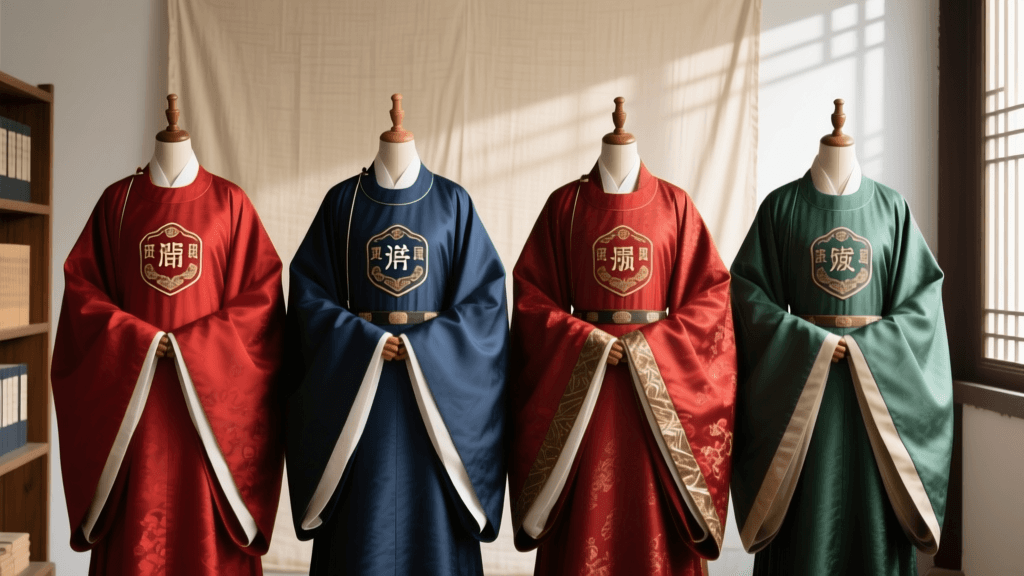
- Crimson and Red (Chi/Hong): The colors of high-ranking officials (First to Fourth rank). Red symbolized fire, prosperity, and high status. The specific shade of red could also denote seniority within the upper echelons of the court.
- Blue and Green (Qing/Lu): Designated for mid-to-lower ranking officials (Fifth to Ninth rank). These colors, associated with wood and spring, represented growth but subservience to the higher ranks.
- White, Black, and Undyed Fabrics: Generally worn by commoners, scholars who had not yet passed the imperial examinations, and mourners. Sumptuary laws restricted commoners from using expensive dyes, silk brocades, or vibrant colors.
For modern Hanfu wearers, these color codes offer a fascinating framework for choosing garments for specific events. While you are no longer bound by imperial sumptuary laws, wearing a crimson Ming-style Daopao (a scholar's robe) still commands a sense of authority and festivity, making it a popular choice for modern Hanfu weddings and cultural galas.
Buzi (Rank Badges): Animals of Power and Prestige
While color indicated broad rank categories, the buzi (mandarin square or rank badge) pinpointed an official's exact grade. Affixed to the front and back of the official's outer robe, these intricately embroidered squares featured specific birds for civil officials and beasts for military officers. The Victoria and Albert Museum's comprehensive guide on Chinese Court Dress notes that these badges were masterpieces of embroidery, often utilizing gold thread, peacock feathers, and complex satin stitches to create a shimmering effect in candlelit court halls.
Civil vs. Military Badges: A Structured Hierarchy
The following table outlines the Ming Dynasty rank system, detailing the corresponding colors and the specific animals used on the buzi.
| Rank | Official Color | Civil Badge (Bird) | Military Badge (Beast) |
|---|---|---|---|
| 1st Rank | Crimson | White Crane (Xianhe) | Qilin (Mythical Chimera) |
| 2nd Rank | Crimson | Golden Pheasant (Jinji) | Lion (Shi) |
| 3rd Rank | Crimson | Peacock (Kongque) | Leopard (Bao) |
| 4th Rank | Crimson | Wild Goose (Yan) | Tiger (Hu) |
| 5th Rank | Green/Blue | Silver Pheasant (Baihan) | Bear (Xiong) |
| 6th Rank | Green/Blue | Egret (Sier) | Panther (Biao) |
| 7th Rank | Green/Blue | Mandarin Duck (Xichi) | Rhinoceros (Xi) |
| 8th Rank | Green/Blue | Quail (Anchun) | Rhinoceros (Xi) |
| 9th Rank | Green/Blue | Paradise Flycatcher (Lianque) | Sea Horse (Haima) |
Symbolic Note: Civil officials wore birds to represent elegance, literary grace, and peace. Military officers wore beasts to symbolize courage, ferocity, and martial prowess. The White Crane, associated with longevity and immortality, was the highest civil honor.
Practical Guide: Sourcing and Wearing Ming-Style Hanfu Today
Transitioning from historical theory to modern practice requires navigating the contemporary Hanfu market. Whether you are commissioning a museum-grade replica or buying an entry-level garment for a cultural festival, understanding sizing, fabrics, and costs is crucial.
Measurements and Sizing: The Flat-Pattern Cut
Unlike Western tailoring, which uses darts and curved seams to contour the body, traditional Hanfu relies on flat-pattern cutting and cross-collars (Jiaoling Youren). Therefore, standard S/M/L sizing is often inadequate. You must know your Xiongwei (flat chest width) and Tongxiu (total sleeve length from wrist to wrist).
- Chest Width (Xiongwei): A standard Ming Dynasty Daopao requires significant ease. If your actual chest circumference is 38 inches (96 cm), you need a garment with a flat chest width of at least 55-60 cm (110-120 cm circumference) to ensure the cross-collar overlaps securely without pulling.
- Sleeve Length (Tongxiu): Ming official robes feature wide, sweeping sleeves. A proper Pipa sleeve or wide sleeve should have a total span of 160 cm to 180 cm. This allows the fabric to pool elegantly at the wrists, a hallmark of Ming aesthetics.
- Garment Length (Yichang): Official robes must graze the ankle or the top of the foot. Measure from the base of your neck (C7 vertebra) to the floor, then subtract 5 cm to account for footwear and prevent tripping.
Authenticity Markers: Huling and Baibian
When purchasing a Ming-style Daopao or Yesa, look for the inclusion of the Huling (a stiff, white, removable inner collar that protects the main garment from neck oils) and the Baibian (the distinct white fabric borders at the cuffs and hem). These are not merely decorative; they are structural hallmarks of Ming tailoring. A garment missing these elements is often a generic 'ancient Chinese' costume rather than an accurate Hanfu replica.
Costs, Fabrics, and Timing
The modern Hanfu market is tiered, catering to different budgets and accuracy requirements.
- Entry-Level ($40 - $90): Typically made from polyester-cotton blends or chiffon. The buzi are often digitally printed rather than embroidered. These are ideal for casual outings, photography, or first-time buyers. Turnaround time is usually immediate from stock.
- Mid-Tier ($120 - $280): Crafted from jacquard weaves, silk-cotton blends, or matte satin. The rank badges are machine-embroidered with decent thread density. Expect a production and shipping time of 15 to 30 days.
- High-End / Museum Grade ($400 - $1,500+): Authentic mulberry silk, heavy brocade (Zhuanghua), and hand-embroidered buzi using traditional techniques like seed stitch and gold-wrapped thread. Because these are often made-to-order, expect a waiting period of 60 to 120 days.
Styling and Etiquette for Modern Wearers
When wearing a Ming-style robe with a buzi today, context is everything. While historical laws no longer apply, cultural sensitivity and aesthetic harmony remain important.
- Weddings: If incorporating Ming elements into a wedding, avoid standard official buzi like the Tiger or Peacock. Instead, opt for garments featuring the Fengguan Xiapei (phoenix crown and clouded shoulder cape) or badges featuring Mandarin Ducks, which symbolize marital fidelity and lifelong partnership.
- Festivals and Ceremonies: The White Crane or Golden Pheasant are excellent choices for cultural performances, graduations, or tea ceremonies, as they project respect, scholarly achievement, and elegance.
- Accessories and Footwear: A Ming official robe must be paired with the correct headwear to complete the silhouette. The Wushamao (black gauze cap) is strictly for officials, while the Wangjin (hair net) paired with a scholar's cap are more appropriate for modern civilian wearers. Historically, officials wore black leather or silk boots with thick white layered-cloth soles (Zhaodi). For modern wear, traditional cloth boots or plain black leather loafers work best. Avoid modern sneakers, as the thick rubber soles disrupt the drape and historical silhouette of the ankle-length robe.
Conclusion
The Ming Dynasty's approach to clothing was a masterclass in visual communication. Through the deliberate use of color and the intricate symbolism of the buzi, the empire maintained a visible, wearable hierarchy. Today, as we study and revive these garments, we do more than just put on old clothes; we drape ourselves in centuries of philosophy, artistry, and social history. By understanding the measurements, costs, and symbolic weight of these garments, modern enthusiasts can honor the legacy of Ming sartorial traditions with accuracy, respect, and undeniable style.
For further reading on the evolution of Chinese textiles and imperial dress, the Smithsonian Institution's analysis of Chinese imperial robes provides excellent context on how these Ming foundations influenced subsequent dynastic fashion and the enduring legacy of the dragon and rank motifs.