Guizhou Miao Dress: Silver, Embroidery, and Folk Style
The Living Tapestry of Guizhou's Miao Province
Nestled in the mountainous terrain of southwestern China, Guizhou province is the cultural heartland of the Miao people. Unlike the standardized silk robes of China's imperial courts, Miao folk dress is a vibrant, decentralized expression of clan identity, mythological history, and extraordinary craftsmanship. For the Miao, who historically lacked a written language, clothing serves as a wearable archive. Every stitch of embroidery and every hammered silver motif tells a story of migration, animist belief, and regional pride. Today, as global interest in regional folk and provincial dress surges, understanding the nuances of Miao garments offers a masterclass in textile artistry and cultural preservation.
Anatomy of the Miao Folk Ensemble
The Indigo-Dyed Pleated Skirt (Baidaiqun)
The foundation of many Miao women's ensembles is the baidaiqun, or hundred-pleat skirt. Creating a single skirt is an exercise in extreme patience. Artisans weave hemp or cotton, dye it repeatedly in vats of fermented indigo until it achieves a deep, lustrous navy, and then hand-pleat the fabric. A high-quality ceremonial skirt can feature over 500 individual pleats. To set the pleats permanently, the fabric is treated with a natural resin or ox-hide glue, then bound tightly and left to cure for weeks. The result is a structured, accordion-like garment that flares beautifully during the rhythmic stomping of traditional Lusheng festival dances.
The Embroidered Jacket and the Butterfly Mother
Miao embroidery is renowned for its complexity, utilizing over a dozen distinct stitching techniques, including flat stitch, braid stitch, and the incredibly rare tin-thread embroidery. The motifs are not merely decorative; they are deeply symbolic. The most prominent is the 'Butterfly Mother' (Mais Bangx), a central figure in Miao creation mythology who birthed the first humans and animals. You will also find stylized water buffalo horns, dragons, and river motifs, representing the agricultural life and the arduous historical migrations across the Yellow and Yangtze rivers.
The Alchemy of Indigo Dyeing
The creation of Miao indigo is a biochemical art form that dictates the rhythm of village life. The dye is extracted from the leaves of the Strobilanthes cusia plant. The leaves are harvested, soaked in wooden vats, and allowed to ferment with rice wine, wood ash lye, and sometimes local herbs. This fermentation process must be carefully monitored for temperature and pH levels. The fabric is dipped into the vat, exposed to the air to oxidize and turn blue, and then re-dipped. Achieving the deep, almost black-navy hue required for a premium baidaiqun skirt can require up to thirty separate dips over the course of several months. The final step often involves rubbing the dyed fabric with a mixture of egg white and ox-hide glue, then polishing it with a smooth river stone to achieve a striking, metallic sheen.
The Weight of Tradition: Miao Silverwork
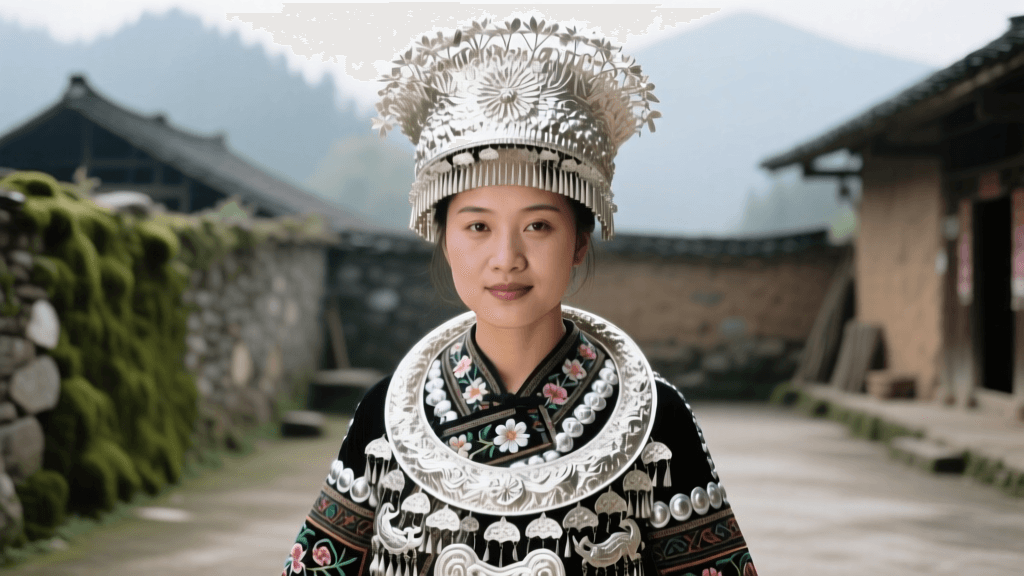
No Miao festival ensemble is complete without silver. Miao silversmithing is a highly respected, male-dominated craft passed down through generations. The silver ornaments serve as a display of family wealth, spiritual protection, and aesthetic grandeur. A full ceremonial silver set can weigh anywhere from 3 to 10 kilograms (6.6 to 22 lbs).
- Silver Horns (Yinjiao): The crowning piece of the headdress, shaped like water buffalo horns, symbolizing strength and agricultural prosperity. These can span up to 80 centimeters across.
- Neck Rings (Yinxiang): Heavy, twisted silver torques worn in multiples around the neck and chest.
- Hairpins and Combs: Intricately filigreed pieces used to secure the elaborate topknots and integrate the heavy horn headdresses.
Regional Variations: A Provincial Comparison
Guizhou is geographically fractured, leading to hyper-local variations in dress. What is worn in the Xijiang valley differs vastly from the styles in Shidong or Rongjiang. Below is a comparison of three prominent regional styles:
| Region | Skirt Style & Length | Primary Embroidery Technique | Silver Headdress Profile |
|---|---|---|---|
| Xijiang (Leishan) | Mid-calf, heavily pleated indigo | Double-needle flat stitch, vibrant silk threads | Massive, wide-spanning horns with dangling bells |
| Shidong (Taijiang) | Long, wrapped, often layered with aprons | Tin-thread embroidery (Xixian), geometric motifs | Elaborate silver combs, floral crowns, moderate weight |
| Rongjiang | Short, layered mini-skirts with leg wrappings | Appliqué and cross-stitch, darker color palette | Lighter, intricate filigree pins and smaller horns |
Practical Guide: Sourcing, Costs, and Care
For collectors, textile enthusiasts, and cultural preservationists, acquiring authentic Miao garments requires specific knowledge. The market is currently flooded with machine-made replicas aimed at the tourist trade. Here is actionable advice for sourcing genuine provincial dress.
1. Authenticating Hand-Embroidery
Turn the garment inside out. Hand-embroidery will show slight irregularities, and the thread transitions will be visible and knotted. Machine embroidery features perfectly uniform stitching and often uses a continuous bobbin thread on the reverse side. Furthermore, authentic indigo dye has a distinct, earthy scent and will crock (rub off slightly) on your fingers when new, whereas chemical dyes will not.
2. Market Costs and Timelines
- Vintage Ceremonial Jacket (1970s-1990s): 3,000 to 8,000 RMB ($420 - $1,100 USD). Sourced from antique dealers in Kaili or Beijing's Panjiayuan market.
- New, Handmade Pleated Skirt: 1,500 to 3,500 RMB ($210 - $490 USD). Expect a lead time of 2 to 4 months if commissioning directly from an artisan in Guizhou.
- Authentic Silver Horn Headdress: Priced by weight and craftsmanship. Expect to pay 15 to 25 RMB per gram of silver, plus the artisan's labor fee. A 2kg headdress will cost roughly 35,000 to 50,000 RMB ($4,900 - $7,000 USD).
3. Garment Care and Preservation
Never wash authentic indigo-dyed pleated skirts in water, as the pleats will collapse and the resin binder will dissolve. Spot clean only, or use a specialized textile conservator for deep cleaning. Store silver pieces in airtight containers with anti-tarnish silica gel packets, as the high humidity of southern China and coastal regions will rapidly oxidize the metal. For embroidered jackets, store them flat in acid-free tissue paper to prevent the heavy silk threads from pulling and tearing the base cotton fabric over time.
Integrating Provincial Dress into Modern Wardrobes
While a full ceremonial Miao ensemble is reserved for festivals like the Lusheng Festival or the Sisters' Meal Festival, individual elements can be respectfully integrated into contemporary wardrobes. A vintage, heavily embroidered Miao jacket can be worn open over a simple linen turtleneck and wide-leg trousers, allowing the intricate sleeve and shoulder motifs to serve as the focal point. When styling these pieces, it is crucial to avoid mixing them with other loud patterns. Let the garment speak for itself. For collectors, framing rare tin-thread embroidered panels in UV-protective glass is an increasingly popular way to display these textiles as fine art within modern interior design schemes.
Preserving the Heritage
The survival of Miao dress relies on a delicate balance between tourism-driven commercialization and genuine cultural transmission. As younger generations migrate to urban centers, the time-intensive skills of indigo fermentation and tin-thread embroidery are at risk. However, cultural cooperatives are emerging to provide fair-trade wages to rural female artisans, ensuring these techniques remain viable livelihoods rather than mere museum relics.
Institutions and cultural journalists play a vital role in documenting these shifts. According to extensive cultural reporting by Sixth Tone, grassroots initiatives in Guizhou are successfully bridging the gap between ancient Miao craftsmanship and contemporary global fashion markets, providing economic incentives for young women to remain in their villages and learn from their grandmothers. Furthermore, the anthropological archives maintained by The British Museum and the textile conservation efforts at The Metropolitan Museum of Art's Asian Art Department provide crucial historical baselines, allowing modern artisans to study and revive lost stitching techniques from the 19th and early 20th centuries.
By understanding the profound history, regional nuances, and proper care of these garments, collectors and enthusiasts can participate in the respectful preservation of one of Asia's most spectacular folk dress traditions.