DIY Hanfu Sewing: Song Dynasty Beizi Patterns and Fabric Guide
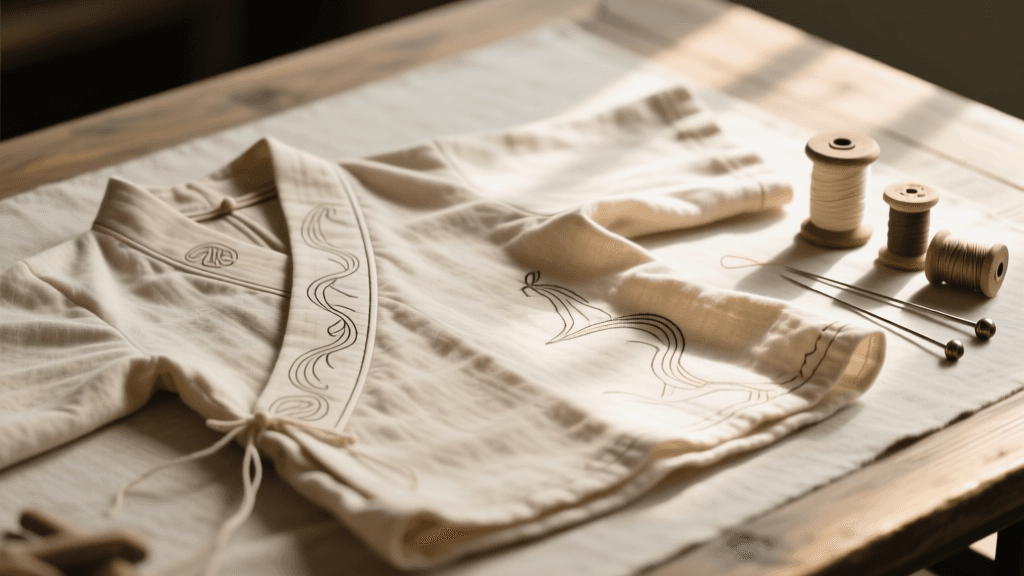
The global resurgence of traditional Chinese clothing, widely known as the Hanfu movement, has inspired thousands of enthusiasts to not only wear these historical garments but to craft them by hand. For beginners stepping into the world of DIY historical sewing, the Song Dynasty (960 to 1279 AD) offers some of the most elegant, accessible, and structurally forgiving silhouettes. Among these, the Beizi (a long, open-front jacket) paired with a pleated skirt is a staple. Unlike Western tailoring, which relies on darts and curved seams to mold fabric to the body's three-dimensional contours, traditional Chinese garment construction is rooted in flat-pattern cutting. This philosophy respects the integrity of the textile, treating the fabric as a canvas of geometric shapes that drape naturally over the wearer.
Understanding the Song Dynasty Beizi
The Song Dynasty Beizi is characterized by its straight, parallel collars, open front, and dramatic side slits that run from the waist or hip down to the hem. Historically worn by both men and women, the women's Beizi in the Song era often featured slender, refined lines, reflecting the period's aesthetic preference for understated elegance and intellectual restraint. Because the garment is cut entirely on the straight grain, it minimizes fabric waste and eliminates the need for complex fitting adjustments, making it an ideal first project for DIY Hanfu sewists.
Fabric Selection: The Foundation of Drape
In flat-pattern cutting, the fabric does the work of shaping the garment. Therefore, selecting the right textile is arguably the most critical step in your Hanfu sewing journey. According to the Metropolitan Museum of Art's Heilbrunn Timeline of Art History, silk has been the cornerstone of Chinese textile culture for millennia, prized for its luminous drape and breathability. However, modern sewists have a variety of options ranging from historically accurate silks to accessible plant-based fibers.
Fabric Comparison Chart for Song Beizi
| Fabric Type | Weight and Drape | Historical Accuracy | Best For | Approx. Cost (per yard) |
|---|---|---|---|---|
| Silk Crepe de Chine | Lightweight, fluid, excellent drape | High | Elegant, flowing everyday Beizi | $20 - $40 |
| Ramie or Linen | Medium weight, crisp, structured | High (Summer wear) | Casual, breathable summer garments | $12 - $25 |
| Cotton Sateen | Medium weight, soft, moderate drape | Moderate | Beginner practice, winter layering | $8 - $15 |
| Polyester Chiffon | Very light, sheer, slippery | Low (Modern substitute) | Layering, budget-friendly ethereal looks | $4 - $8 |
When browsing the Victoria and Albert Museum's Asian textile collections, one can observe how historical garments utilized the natural stiffness of ramie for summer structure and the fluidity of silk damask for formal occasions. For your first Beizi, a medium-weight linen or a cotton-linen blend is highly recommended. These fabrics are easy to cut, hold a press beautifully, and are forgiving of beginner stitching errors, unlike slippery silk charmeuse or chiffon.
Taking Measurements and Drafting the Pattern
Traditional Chinese garments do not use standard Western sizing. Instead, they are drafted using a few key personal measurements combined with desired ease.
Essential Measurements
- Shoulder Span (Extended): Measure from the tip of one shoulder, across the back of the neck, to the other shoulder tip. For a traditional dropped-shoulder look, add 4 to 6 inches to this measurement.
- Sleeve Length: Measure from the base of your neck (center back) down over the shoulder to your wrist. Traditional Song sleeves often extended slightly past the wrist or featured a narrow cuff.
- Bust or Chest: Measure around the fullest part. Add at least 4 to 6 inches of positive ease so the jacket overlaps comfortably at the front.
- Garment Length: Measure from the base of the neck down to your desired hemline (typically mid-calf or ankle for a Song Beizi).
Drafting the T-Shape
The Beizi pattern is essentially a modified T or cross shape.
- The Body Panel: Cut two large rectangles for the front panels and one for the back (or cut the back on a fold). The width of each front panel should be roughly one-quarter of your total bust circumference plus ease, plus an additional 2 inches for the front overlap and seam allowance.
- The Sleeves: Historically, Chinese looms produced narrow fabric (around 20 to 24 inches wide). Consequently, sleeves were cut as separate rectangles and sewn to the body. Cut two sleeve rectangles. The width of the sleeve at the armhole should be generous (12 to 16 inches) to allow for deep, comfortable folds, tapering slightly toward the wrist if desired.
- The Collar: Cut two long strips of fabric, roughly 3 to 4 inches wide (which will fold down to 1.5 to 2 inches) and long enough to run from the front hem, up around the neck, and down to the opposite front hem.
The beauty of traditional Hanfu construction lies in its geometry. By avoiding curved armholes and darts, the garment remains a flat, two-dimensional plane until it is worn, at which point the fabric's weight and the body's movement bring it to life in three dimensions.
Step-by-Step Sewing Instructions
1. Assembly of the Main Body and Sleeves
Begin by sewing the shoulder seams if you have cut the front and back as separate pieces. If you cut the back on a fold and the front panels separately, attach the front shoulders to the back shoulders using a French seam or a flat-felled seam to ensure the interior is as clean as the exterior. Next, align the center of the sleeve cap with the shoulder seam and pin the sleeve to the armhole. Sew the sleeves in place. Because there is no curved armhole, this is a simple straight line.
2. The Side Seams and Slits
Fold the garment in half, right sides together, matching the underarm seams and the side seams. Sew from the wrist, down the underarm, and down the side of the body. Stop sewing at your desired slit starting point, typically at the waistline or high hip. Backstitch securely at the top of the slit to prevent tearing.
3. Constructing and Attaching the Collar
The straight collar is the defining feature of the Beizi. Fold your long collar strips in half lengthwise, wrong sides together, and press. You may apply a lightweight woven interfacing to one half of the collar strip before folding to give it structure. Pin the raw edges of the collar to the neckline and down the front edges of the Beizi. Sew with a 3/8-inch seam allowance. Fold the collar over to the inside of the garment, encasing the raw edges, and slip-stitch or topstitch it down for a clean finish.
4. Hemming and Finishing the Slits
Hem the bottom of the Beizi and the sleeve cuffs using a narrow double-fold hem. For the side slits, finish the raw edges with a bias binding or a narrow rolled hem. In high-quality Hanfu, the slit edges are sometimes reinforced with a thin strip of contrasting silk or brocade, adding both durability and a subtle flash of color when walking.
Embracing the DIY Hanfu Community
Sewing your own Hanfu is more than just a crafting project; it is an act of cultural preservation and personal expression. As you master the Song Dynasty Beizi, you will naturally begin to experiment with different collar variations, sleeve shapes (such as the wide pipa sleeves of the Ming Dynasty), and intricate embroidery techniques. Share your progress, fabric swatches, and finished garments with online Hanfu communities and local cultural societies. The collective knowledge of these groups is invaluable for troubleshooting historical accuracies and discovering the best modern textile suppliers. By drafting your own patterns and carefully selecting your fabrics, you are participating in a living tradition, weaving the past into the fabric of the present.