Ming Dynasty Hanfu: Decoding Official Rank and Color Codes
The Hierarchy of Color in Ming Court Attire
The Ming Dynasty (1368–1644) represents a golden era of Hanfu, characterized by the restoration of Han Chinese cultural identity and the implementation of rigorous sumptuary laws. Under the reign of the Hongwu Emperor, clothing was not merely a matter of personal expression but a strict visual ledger of social hierarchy, political power, and cosmic order. According to the Metropolitan Museum of Art's Heilbrunn Timeline of Art History, the Ming era saw an unprecedented codification of textile production and dress codes, ensuring that every hue and motif served a distinct administrative purpose.
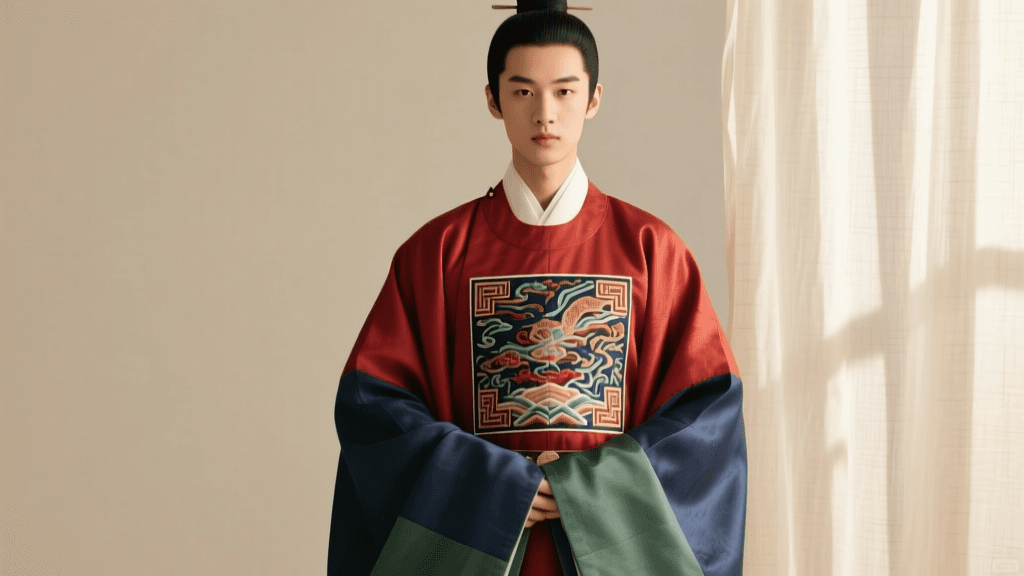
Color in Ming official attire was heavily regulated by the Five Elements theory and strict court mandates. Bright yellow (Minghuang) was exclusively reserved for the Emperor, symbolizing the center of the universe and the earth element. The Crown Prince and direct imperial heirs were permitted to wear apricot yellow. For civil and military officials, the color of the round-collar robe (Yuanlingpao) immediately communicated their tier within the imperial bureaucracy.
- First to Fourth Rank: Scarlet or deep red (Feihong), representing fire, passion, and high authority.
- Fifth to Seventh Rank: Cyan or deep blue (Qing), associated with wood, growth, and administrative stability.
- Eighth to Ninth Rank: Green (Lv), denoting entry-level scholars and local magistrates.
Commoners, merchants, and artisans were legally restricted to dull, muted tones such as ochre, pale blue, and undyed hemp, though historical records show that wealthy merchants in the late Ming period frequently flouted these laws, leading to periodic imperial crackdowns.
Buzi (Mandarin Squares): The Ultimate Rank Identifier
While color provided a general tier, the exact rank of an official was identified by the Buzi, or Mandarin Square. These intricately embroidered badges were affixed to the front and back of the official's outer robe. As noted by the Victoria and Albert Museum's Asian textile archives, these rank badges are masterpieces of Chinese embroidery, utilizing metallic threads, seed pearls, and complex stitching techniques to depict specific mythological and real-world creatures.
Civil officials wore birds, symbolizing literary elegance and scholarly virtue, while military officials wore beasts, representing courage, ferocity, and martial prowess. The highest-ranking officials wore mythical creatures, bridging the gap between earthly administration and divine mandate.
Complete Guide to Ming Dynasty Buzi Rankings
| Rank | Civil Official (Bird) | Military Official (Beast) | Symbolic Meaning |
|---|---|---|---|
| 1st Rank | Red-Crowned Crane | Qilin (Mythical Chimera) | Longevity, supreme virtue, divine benevolence |
| 2nd Rank | Golden Pheasant | Lion | Royal majesty, bravery, protection |
| 3rd Rank | Peacock | Tiger | Beauty, dignity, fierce authority |
| 4th Rank | Wild Goose | Leopard | Loyalty, marital fidelity, agility |
| 5th Rank | Silver Pheasant | Bear | Resilience, strength, steadfastness |
| 6th Rank | Egret | Panther | Purity, patience, stealth |
| 7th Rank | Mandarin Duck | Tiger Cat (Civet) | Harmony, domestic peace, vigilance |
| 8th Rank | Quail | Seal | Contentment, adaptability, endurance |
| 9th Rank | Paradise Flycatcher | Sea Horse (Mythical) | Swiftness, traversing boundaries, divine reach |
Contrasting Codes: Ethnic Minorities and Regional Autonomy
While the Han-dominated Ming court enforced rigid color and rank codes, the diverse ethnic groups across the empire maintained vastly different sartorial philosophies. The Smithsonian National Museum of Asian Art highlights that for groups like the Miao and Zhuang in the southern provinces, clothing was not a tool of imperial subjugation but a canvas of ancestral memory and clan identity. Unlike the Ming court's restriction of yellow and red, Miao textiles utilized indigo dyeing and vibrant, unrestricted embroidery to record migration histories and mythological genealogies. A Miao festival jacket (Bird's Eye jacket) might feature hundreds of colors, completely ignoring Han sumptuary laws, proving that in Asian traditions, the strictness of color codes often correlates directly with proximity to the imperial center.
'Let the garments reflect the virtue and the rank of the man, so that the people may know their place and the heavens may smile upon the order of the earth.' — Ming Court Sumptuary Edicts, circa 1391.
Practical Guide: Sourcing and Styling Ming-Style Official Hanfu Today
For modern Hanfu enthusiasts, historical reenactors, and cultural scholars, accurately recreating Ming official attire requires attention to specific garment structures, measurements, and sourcing strategies. The modern Hanfu revival market offers a wide array of options, but distinguishing between costume-grade and historically accurate pieces is crucial.
Key Garments and Measurements
The core of the Ming official wardrobe is the Yuanlingpao (round-collar robe). To achieve an authentic Ming silhouette, you must pay attention to the shoulder and sleeve construction:
- Drop-Shoulder Seam (Luojian): Unlike modern Western tailoring, Ming robes did not have set-in sleeves at the natural shoulder. The seam should sit 10 to 15 cm below your natural shoulder line, creating a sloping, relaxed silhouette that signifies scholarly leisure.
- Sleeve Length and Width: Sleeves should extend at least 15 cm past the fingertips. The traditional 'hand-covering' gesture of respect requires the fabric to drape entirely over the hands when arms are resting. Sleeve width at the cuff should be a minimum of 60 cm for a luxurious drape.
- The Wushamao (Winged Hat): No official outfit is complete without the black winged hat. Ensure the wings are stiffened with wire or heavy buckram, extending horizontally to prevent officials from whispering to one another in court.
Costs, Materials, and Timing for Buzi Patches
Sourcing the Buzi (Mandarin Squares) is where most of the budget and time will be allocated. Here is a practical breakdown for modern buyers:
- Machine-Embroidered Patches (Entry Level): Cost between $30 and $80 per pair. These are typically made with polyester threads on a cotton-blend base. Timing: Readily available in stock on platforms like Taobao or specialized Hanfu retail sites. Delivery takes 2-3 weeks internationally.
- Hand-Embroidered Silk Patches (Enthusiast Level): Cost between $300 and $800 per pair. Look for traditional stitches like the Peking knot and satin stitch, using genuine mulberry silk threads. Timing: Custom orders from artisans in Suzhou or Hangzhou take 4 to 8 weeks to complete.
- Kesi Silk Tapestry Patches (Collector Level): Cost between $2,000 and $5,000+. Kesi (cut silk) is a painstaking weaving technique where the weft threads are discontinuous, creating a carved, three-dimensional effect. Timing: Requires commissioning a master weaver; expect a wait time of 4 to 6 months.
Styling and Maintenance Advice
When styling your Ming official Hanfu for photography or cultural events, pair the scarlet Yuanlingpao with a dark leather or silk-embroidered belt (Dai) and black leather boots. For garment care, never machine-wash silk Hanfu. Spot clean the Buzi patches with a damp microfiber cloth and store the robe flat or on a wide, padded hanger to prevent stress on the drop-shoulder seams. By understanding and respecting these historical color codes and rank symbols, modern wearers do more than just wear a beautiful garment; they actively preserve a complex, centuries-old language of Asian sartorial tradition.