DIY Hanfu Sewing: Pattern Drafting and Fabric Selection
Introduction to the DIY Hanfu Movement
The resurgence of traditional Chinese clothing, known as Hanfu, has transformed from a niche historical interest into a vibrant, global cultural movement. As highlighted by Smithsonian Magazine, this youth-led revival is not merely about wearing historical costumes; it is a deeply engaged community dedicated to reconstructing, sewing, and living in these garments. For the modern maker, creating your own Hanfu is a rewarding journey that bridges the gap between ancient textile arts and contemporary DIY fashion. However, transitioning from modern Western sewing patterns to traditional Chinese garment construction requires a fundamental shift in how you view fabric, geometry, and the human body.
This comprehensive guide focuses on the practical aspects of DIY Hanfu sewing, specifically targeting the popular Ming Dynasty silhouette: the cross-collar Ao (jacket) and the Mamianqun (horse-face skirt). We will explore the philosophy of traditional flat cutting, break down the mathematics of pleating, and provide a detailed fabric selection guide to ensure your handmade garments drape and move with historical authenticity.
The Philosophy of Traditional Chinese Flat Cutting
Modern Western tailoring relies heavily on three-dimensional draping, utilizing darts, princess seams, and curved armholes to mold flat fabric to the contours of the human body. Traditional Chinese garment construction, known as Pingmian Caijian (flat pattern cutting), takes an entirely different approach. The garment is conceived as a two-dimensional, geometric composition that only takes its final three-dimensional shape when worn and tied.
When drafting Hanfu patterns, you will notice a distinct lack of darts and a prevalence of straight lines, right angles, and symmetrical folds. The fabric is often cut in a T-shape, with the front and back panels integrated into a single piece of cloth folded over the shoulder. Furthermore, historical fabric widths were much narrower than modern textiles (often around 50-60 cm). While modern fabrics are typically 110 cm to 150 cm wide, traditionalists still incorporate the center-back seam (Zhongfeng) and center-front seams. This is not just a historical artifact; the center-back seam is deeply symbolic, representing uprightness, moral integrity, and the alignment of the wearer’s spine with the heavens.
Drafting the Ming Dynasty Cross-Collar Ao (Jacket)
The Ming Dynasty Ao is a lined or unlined jacket characterized by its crossed collar (Jiaoling Youren), where the left side crosses over the right side. Drafting this piece requires understanding the dropped shoulder and the iconic Pipa (lute-shaped) sleeve.
Key Measurements and Pattern Drafting
- Shoulder and Sleeve Integration: Unlike set-in sleeves, the Ao sleeve is cut as a continuous extension of the bodice. Measure from the center back of your neck, across the shoulder, and down to your desired wrist point. Historical sleeves often extended past the hands (Hui Xiu), but a modern DIY adaptation can end at the wrist bone.
- The Dropped Armhole: The armhole depth on an Ao is exceptionally deep, often dropping down to the waistline. This creates a relaxed, flowing fit and allows for thick layers of undergarments without restricting movement.
- Pipa Sleeve Curvature: The sleeve is not a perfect rectangle. It flares out gently from the shoulder and curves back inward at the wrist, mimicking the shape of a traditional Chinese lute. The wrist opening is deliberately narrow (often 15-20 cm in circumference) to contrast with the voluminous arm.
- The Collar (Ling): The cross-collar is drafted as a separate, curved strip of fabric. It must be cut on the bias or gently curved to sit flush against the neck and chest without gaping. The inner collar is usually white or a contrasting light color, while the outer collar matches or contrasts with the main body.
Tackling the Mamianqun (Horse-Face Skirt)
The Mamianqun is a marvel of structural engineering and mathematical precision. It consists of two identical, overlapping panels of fabric that wrap around the body, featuring flat, unpleated sections (the "horse faces") at the front and back, with deep pleats on the sides.
The Mathematics of Pleating
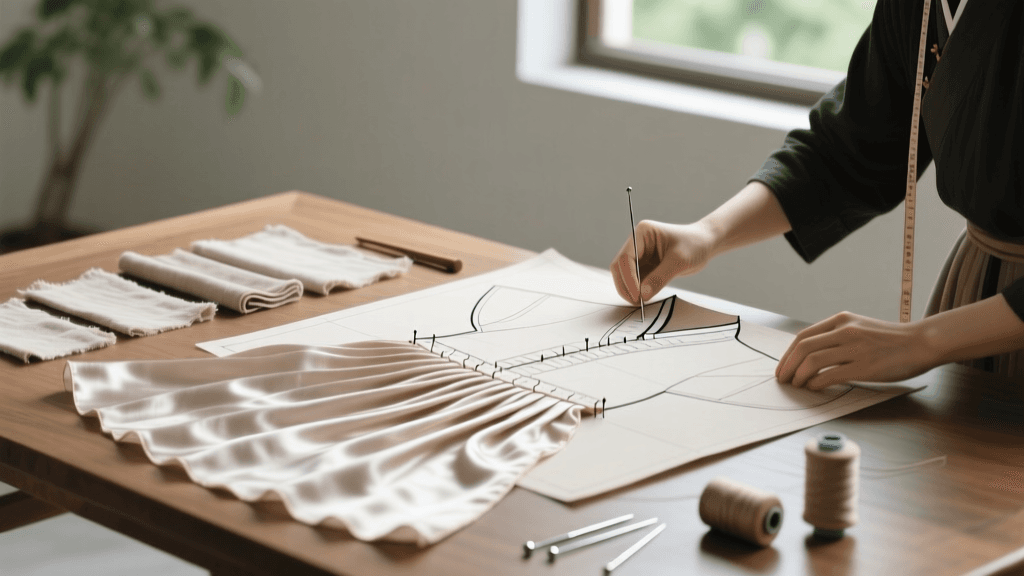
Drafting a Mamianqun requires careful calculation based on your waist measurement and desired skirt volume. Here is a foundational formula for a standard side-pleated Mamianqun:
- The Flat Panel (Ma Mian): The width of the flat front and back panels should be roughly one-quarter of your total waist circumference, plus an allowance for overlap.
- The Pleated Sections: The remaining fabric width is dedicated to the pleats. A standard skirt might use 4 to 6 box pleats on each side.
- Calculating Fabric Width: If your flat panel is 20 cm wide, and you want 5 box pleats on the side that are 4 cm deep each (requiring 12 cm of fabric per pleat), your side section will require 60 cm of fabric. Therefore, one half-panel of the skirt requires 80 cm of fabric width. Since the skirt uses two overlapping panels, you will need approximately 3.2 meters of fabric width just for the skirt body, assuming standard 110 cm wide fabric.
- The Waistband (Yao Tou): Historically made of white or undyed cotton/linen to prevent dye transfer and provide grip against the jacket, the waistband is a long, straight strip that wraps around the waist and ties with extended ribbons.
Fabric Selection: Weight, Drape, and Material
Selecting the correct fabric is arguably the most critical step in Hanfu construction. The wrong fabric weight will cause a Mamianqun to lose its pleats or an Ao to look stiff and boxy. According to The Metropolitan Museum of Art, silk has been the cornerstone of Chinese textile history for millennia, prized for its luster, dye affinity, and structural versatility. However, modern makers also utilize high-quality cottons, linens, and ramie.
When shopping for silk, you will encounter the term Momme (mm), which is the traditional unit of weight for silk fabrics (1 momme = 4.3056 grams per square meter). Understanding momme weight is essential for assigning fabrics to the correct garment components.
| Fabric Type & Weight | Metric Equivalent | Best Hanfu Component | Drape and Handling Notes |
|---|---|---|---|
| Lightweight Silk Charmeuse (12-14 mm) | 50-60 GSM | Summer inner layers, linings, lightweight Ruqun | Highly fluid, slippery to sew. Requires French seams and delicate machine needles (Microtex 60/8). |
| Medium Silk Crepe or Satin (16-19 mm) | 70-85 GSM | Ming Dynasty Ao (Jackets), Tang Dynasty Shan | Excellent drape with enough body to hold collar structure. Ideal for cross-collar jackets. |
| Heavy Silk Crepe / Brocade (22-30+ mm) | 95-130+ GSM | Mamianqun (Skirts), Winter Ao, outer garments | Stiff, heavy drape. Essential for Mamianqun to ensure pleats hang straight and hold their shape. |
| Ramie or Fine Linen | 100-150 GSM | Song Dynasty Beizi, Summer everyday Hanfu | Crisp, breathable, and textured. Requires pre-washing to account for shrinkage before cutting. |
| Cotton Sateen or Twill | 150-200 GSM | Waistbands, linings, structured collars | Durable and provides necessary friction to keep tucked-in jackets from slipping out of skirts. |
Essential Sewing Techniques and Finishing
Because traditional Hanfu is often unlined (especially summer garments) or features wide, flowing sleeves, the interior finishing is just as important as the exterior appearance. The inside of a well-made Hanfu should look nearly as pristine as the outside.
Seam Finishes
Forget the modern serger or overlocker. Traditional Hanfu relies on enclosed seams. The Lai Feng (French seam) is the gold standard for lightweight silks and ramie. This technique encloses the raw edges entirely within the seam allowance, providing a clean, durable finish that prevents fraying without adding the bulk of modern seam binding. For heavier brocades used in Mamianqun, flat-felled seams or bound seams using silk bias tape are historically accurate and visually stunning.
Edge Binding and Hems
The edges of the Ao, particularly the hem, side slits, and sleeve cuffs, are frequently finished with contrasting bias binding. This not only protects the edges from wear but also adds a striking visual frame to the garment. When applying bias tape to curved areas like the collar or side slits, it is crucial to ease the fabric carefully to prevent puckering. For the hem of the Mamianqun, a wide, weighted facing is often applied to the bottom edge. This hidden weight acts as an anchor, pulling the heavy pleats downward and ensuring the skirt swings beautifully with every step.
Pleat Setting
Setting the pleats on a Mamianqun requires patience, precision, and heat. After calculating and folding your pleats, they must be basted meticulously by hand. Once basted, use a tailor’s clapper and a steam iron to press the pleats sharply. For synthetic blends or stubborn silks, a diluted vinegar-water solution can be lightly misted onto the fabric before pressing to help set the creases permanently. Never remove the basting stitches until the waistband is fully attached, as the tension of the waistband is what ultimately locks the top of the pleats into place.
Conclusion
Sewing your own Hanfu is an exercise in patience, geometry, and deep respect for textile history. By abandoning the dart-driven mindset of Western tailoring and embracing the elegant, flat-cut geometry of traditional Chinese design, you unlock a completely new way of interacting with fabric. Whether you are carefully calculating the box pleats of a heavy silk Mamianqun or hand-finishing the bias binding on a delicate cross-collar Ao, the DIY Hanfu process connects you directly to centuries of artisanal tradition. Armed with the right measurements, an understanding of momme weights, and a dedication to enclosed seams, your handmade garments will not only look historically magnificent but will endure for years to come.