Ming Dynasty Hanfu: Decoding Rank Badges and Colors
The Visual Resume of the Ming Dynasty
In the rich tapestry of Asian traditional garments, few systems of dress were as strictly codified and visually communicative as the official attire of the Ming Dynasty (1368–1644). Governed by the exhaustive sumptuary laws detailed in the Da Ming Hui Dian (Collected Statutes of the Ming Dynasty), clothing was not merely a matter of personal taste or regional climate; it was a wearable resume. For modern Hanfu enthusiasts, collectors, and historians, understanding the intricate symbolism of Ming rank badges (Buzi) and official color codes is essential for accurate historical reproduction and respectful cultural appreciation.
Unlike the flowing, unstructured robes of earlier eras, Ming official wear was a masterclass in structured symbolism. According to the Metropolitan Museum of Art's Heilbrunn Timeline of Art History, Ming textile production reached unprecedented heights, integrating complex weaving and embroidery techniques specifically to denote bureaucratic hierarchy. Today, as the global Hanfu revival movement gains momentum, accurately decoding these symbols allows wearers to step into history with authenticity.
The Hierarchy of Color in Ming Official Attire
Long before the Qing Dynasty introduced the ubiquitous black and mandarin orange, the Ming court relied on a strict chromatic hierarchy to denote an official's rank from a distance. The color of the Yuanlingpao (round-collar robe) was the first indicator of a bureaucrat's standing.
The Three Tiers of Official Colors
- Crimson and Deep Red (1st to 4th Ranks): High-ranking ministers and generals wore variations of crimson. The most prized dyes were derived from safflower and madder root, requiring multiple intensive dye baths to achieve a colorfast, deep red that resisted fading in the sun.
- Blue and Azure (5th to 7th Ranks): Mid-level officials wore blue robes. High-quality indigo dye was heavily regulated, and the depth of the blue often correlated with the specific sub-rank within this tier.
- Green (8th and 9th Ranks): Entry-level magistrates and local clerks wore green, typically dyed using a combination of indigo and pagoda tree buds to achieve the correct yellow-green hue.
Collector's Note: When sourcing modern reproductions, always inquire about the dyeing process. Plant-dyed silk (using traditional madder or indigo) costs between $40 and $80 per yard but offers the subtle, uneven depth characteristic of antique garments. Synthetic chemical dyes, while cheaper ($10–$15 per yard), often appear overly glossy and flat, immediately marking the garment as a modern costume rather than a historical reproduction.
Decoding the Buzi (Rank Badges)
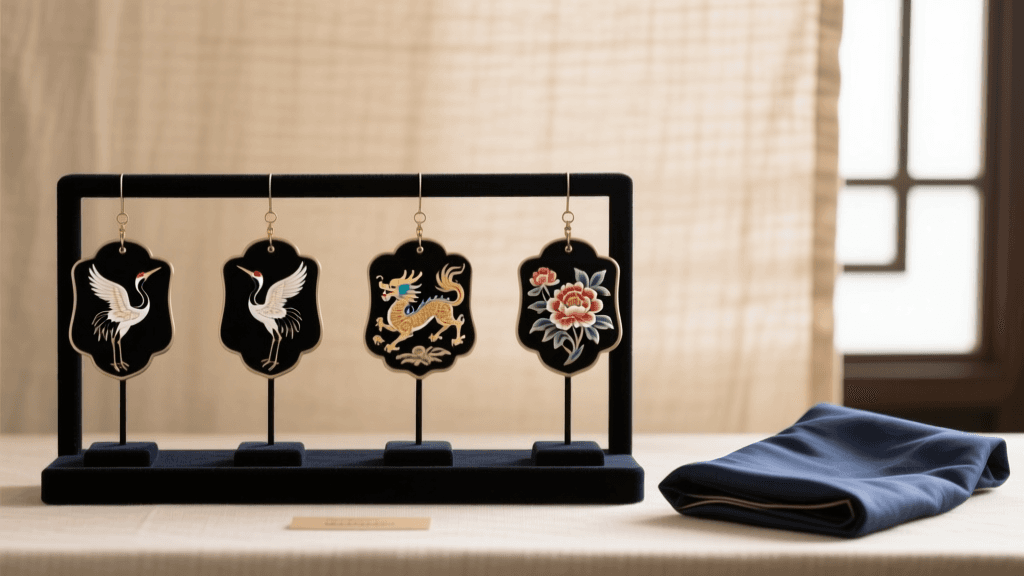
While color indicated general rank, the Buzi—or Mandarin square—pinned to the chest and back of the robe specified the exact grade and whether the official belonged to the civil or military administration. As noted by the Victoria and Albert Museum (V&A), these square badges were masterpieces of silk embroidery, often featuring mythical beasts, birds, and ocean waves representing the universe.
Civil officials were represented by birds, symbolizing literary elegance and peace, while military officials were denoted by beasts, representing courage and martial prowess. Below is the definitive guide to the Ming Dynasty Buzi system.
| Rank | Civil Official (Birds) | Military Official (Beasts) |
|---|---|---|
| 1st Rank | Crane (Xianhe) | Qilin (Mythical Chimera) |
| 2nd Rank | Golden Pheasant (Jinji) | Lion (Shizi) |
| 3rd Rank | Peacock (Kongque) | Leopard (Bao) |
| 4th Rank | Wild Goose (Yan) | Tiger (Hu) |
| 5th Rank | Silver Pheasant (Baihan) | Bear (Xiong) |
| 6th Rank | Egret (Bailu) | Panther (Biao) |
| 7th Rank | Mandarin Duck (Xichi) | Sea Horse (Haima - Mythical) |
| 8th Rank | Quail (Anchun) | Rhinoceros (Xi) |
| 9th Rank | Paradise Flycatcher (Lianshou) | Sea Horse (Haima - Mythical) |
For a deeper dive into the evolution of these squares from the Ming into the subsequent Qing dynasty, historical records on the Mandarin Square provide excellent visual comparisons of how the framing and background elements (like the sun and clouds) shifted over the centuries.
Practical Guide: Sourcing and Wearing Ming Hanfu Today
Whether you are commissioning a piece for a historical reenactment, a traditional wedding, or adding to a serious textile collection, translating Ming sumptuary laws into a modern purchase requires precise planning. Here is your actionable guide to acquiring an authentic Ming-style Yuanlingpao with Buzi.
1. Measurements and Silhouette
The Ming round-collar robe is characterized by its structured shoulders, side slits, and distinctive sleeve shapes. When providing measurements to a tailor or Hanfu studio, ensure you include the following:
- Sleeve Length: Ming official sleeves were designed to cover the hands when arms were clasped in front. Add 15–20 cm to your standard wrist measurement to achieve the correct 'Pipa' or curved sleeve drape.
- Collar Width: The round collar should sit snugly against the base of the neck. Measure the circumference of your neck at the C7 vertebra and add 2 cm for comfort and the overlapping button closure.
- Robe Length: Measure from the prominent C7 vertebra at the base of the neck down to the ankle bone. The robe should graze the top of the foot, allowing traditional cloud-toe boots to peek out.
2. Fabric Selection and Weight
For an authentic drape, avoid lightweight, flimsy silks. Official Ming robes were heavy and structured.
- Silk Damask (Zhijin): Look for 19 to 22 momme silk damask with woven geometric or floral background patterns. This provides the necessary body and historical accuracy.
- Cost Expectation: High-quality, historically accurate woven silk damask will cost between $60 and $120 per yard. A full robe requires roughly 4 to 5 yards of fabric, depending on your height and the sleeve width.
3. Embroidery Techniques and Costs
The Buzi is the centerpiece of the garment. You have three main options for modern reproduction:
- Machine Embroidery ($80 - $150 total garment cost): Best for casual wear or large group reenactments. The design is uniform, but lacks the texture of historical pieces.
- Hand-Embroidered Suzhou Style ($400 - $800): Artisans use split-stitch and satin-stitch techniques with silk floss. This offers a beautiful, raised texture and vibrant color gradients, taking 3 to 5 weeks to complete.
- Kesi (Cut Silk) Tapestry ($1,500 - $3,000+): The pinnacle of Chinese textile art. The badge is woven directly into the fabric using a discontinuous weft technique. Commissioning a Kesi badge takes 2 to 4 months and requires working with specialized heritage studios in Suzhou or Nanjing.
4. Timing and Maintenance
If you are commissioning a hand-embroidered or Kesi piece for a specific event (such as a traditional coming-of-age ceremony or a heritage wedding), initiate your order at least 4 to 6 months in advance. Heritage embroidery studios often have waitlists, and shipping delicate textiles internationally requires careful, insured logistics.
For maintenance, never wash a silk damask robe with water. Spot clean only, and store the garment flat or rolled on an acid-free cardboard tube to prevent the heavy embroidery from pulling and distorting the silk weave over time.
Conclusion
The clothing of the Ming Dynasty is a testament to an era where every thread, color, and motif carried the weight of the state. By understanding the strict color codes and the intricate language of the Buzi, modern wearers and collectors do more than just put on a beautiful garment; they preserve a complex historical narrative. Whether you are investing in a plant-dyed silk damask robe or carefully selecting the correct civil rank bird for your embroidery, honoring these sumptuary laws ensures that the legacy of Asian traditional garments continues to be worn with accuracy, respect, and profound cultural pride.