Ming Dynasty Hanfu: Decoding Rank Badges and Color Codes
The Language of Silk: Introduction to Ming Court Dress
The Ming Dynasty (1368–1644) represents a golden era of Chinese textile artistry and sartorial regulation. Unlike modern fashion, where self-expression and individualism are paramount, traditional Chinese court dress was a highly regulated visual language. Garments were not merely clothing; they were legal identifiers that communicated a wearer's exact social standing, profession, and proximity to imperial power. According to the Metropolitan Museum of Art's Heilbrunn Timeline, the Ming court established exhaustive sumptuary laws that dictated everything from the weave of the silk to the specific hues and motifs permitted for different classes.
For modern hanfu enthusiasts, historians, and cultural preservationists, understanding these historical codes is essential. Replicating Ming Dynasty official dress—specifically the Yuanlingpao (round-collar robe) adorned with Buzi (rank badges)—requires a deep appreciation of the symbolism, rank structures, and color codes that governed the era. This guide decodes the intricate hierarchy of Ming court fashion and provides actionable advice for sourcing, measuring, and styling these magnificent garments today.
Decoding the Buzi: Mandarin Square Rank Badges
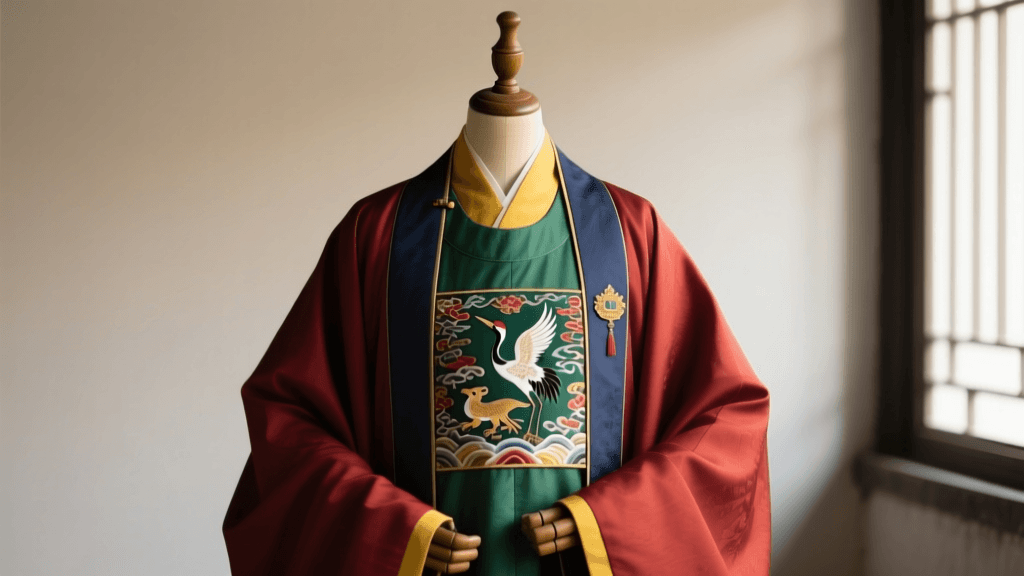
Introduced in 1391 by the Hongwu Emperor, the Buzi (rank badge) was a pair of embroidered or woven squares affixed to the front and back of an official's robe. Measuring roughly 15 to 18 inches square, these badges were masterpieces of textile engineering, often utilizing Kesi (silk tapestry) or intricate gold-thread embroidery. As noted by textile experts at the Victoria and Albert Museum, Chinese silk weaving techniques during this period reached unprecedented levels of complexity, allowing for highly detailed, painterly representations of flora and fauna on a single garment.
The motifs were strictly divided between civil officials, who wore birds to symbolize literary elegance and grace, and military officials, who wore beasts to represent courage and ferocity. The system was rigidly enforced; wearing a badge above one's rank was considered treasonous.
Ming Dynasty Official Rank Badge Chart
| Rank | Civil Official (Birds) | Military Official (Beasts) | Symbolic Meaning |
|---|---|---|---|
| 1st | Red-Crowned Crane (Xianhe) | Lion (Shi) | Longevity, supreme authority, bravery |
| 2nd | Golden Pheasant (Jinji) | Lion (Shi) | Nobility, loyalty, martial prowess |
| 3rd | Peacock (Kongque) | Tiger (Hu) | Beauty, dignity, ferocity |
| 4th | Wild Goose (Yunyan) | Leopard (Bao) | Loyalty, marital fidelity, agility |
| 5th | Silver Pheasant (Yinji) | Bear (Xiong) | Purity, strength, steadfastness |
| 6th | Egret (Lu) | Panther (Pi) | Vigilance, patience, stealth |
| 7th | Mandarin Duck (Xichi) | Panther (Pi) | Fidelity, harmony, courage |
| 8th | Oriole (Huangli) | Rhino (Xi) | Cheerfulness, resilience, armor |
| 9th | Quail (Anchun) | Sea Horse (Haima) | Peace, prosperity, aquatic mastery |
'The rank badge was not merely decorative; it was a bureaucratic tool that allowed the Emperor to instantly recognize the hierarchy of his court from a distance, ensuring that protocol and deference were maintained at all state functions.'
The Hierarchy of Hues: Ming Dynasty Color Codes
Color in Ming Dynasty hanfu was heavily regulated by the Five Elements theory (Wu Xing) and strict imperial decrees. The dyeing process was expensive and labor-intensive, making certain colors natural markers of wealth and status.
- Bright Yellow (Minghuang): The exclusive color of the Emperor, representing the Earth element and the center of the universe. No subject, regardless of rank, was permitted to wear bright yellow. Violators faced severe punishment, including execution.
- Crimson and Scarlet (Feihong): Reserved for high-ranking officials (1st to 4th rank). Crimson represented fire, joy, and imperial favor. These robes were often dyed using expensive safflower or madder root extracts.
- Blue and Green: Designated for mid-to-lower-ranking officials (5th to 9th rank). Blue represented the sky and heavens, while green symbolized wood and growth. These colors were more accessible and commonly worn by scholars and lower bureaucrats.
- Black, White, and Undyed Hemp: The domain of commoners, merchants, and peasants. Early Ming sumptuary laws strictly forbade commoners from wearing silk, restricting them to cotton, hemp, and linen. Though these laws relaxed in the late Ming period as the merchant class grew wealthy, the color restrictions largely remained to maintain visual class distinctions.
The Architecture of the Yuanlingpao
The canvas for these colors and badges was the Yuanlingpao, a round-collared robe with a rich history dating back to the Tang Dynasty but refined during the Ming era. The Ming iteration featured a distinct overlapping front closure secured with fabric ties or jade buttons on the right shoulder. Crucially, the Ming Yuanlingpao featured side slits (kaiqi) that allowed for ease of movement, particularly for officials mounting horses or navigating the expansive halls of the Forbidden City. The sleeves were characteristically wide and long, often extending past the hands to create a draped, elegant silhouette that conveyed a life of scholarly or administrative pursuits rather than manual labor.
Practical Guide: Sourcing and Styling Ming-Style Hanfu Today
The modern hanfu movement has seen a massive resurgence in Ming Dynasty styles, particularly for weddings, graduation ceremonies, and cultural festivals. If you are looking to commission or purchase an authentic Ming-style official robe, here is a practical, actionable guide to ensure historical accuracy and proper fit.
1. Essential Measurements for Custom Tailoring
Ming robes are cut using a traditional flat-patterning technique, meaning the fabric is woven to specific widths and folded rather than darted. When ordering from a specialized hanfu tailor, provide the following precise measurements:
- Shoulder Width: Measure across the back from the edge of one shoulder bone to the other. (Typically 40-48 cm for men).
- Chest Circumference: Measure around the fullest part of the chest. Add 15-20 cm for the traditional ease and drape required in Ming robes.
- Sleeve Length: Measure from the base of the neck, over the shoulder, down to the wrist. For authentic Ming proportions, add an extra 40-50 cm to allow the sleeves to drape over the hands (huixiu).
- Garment Length: Measure from the base of the neck (C7 vertebra) down to the ankle bone. The robe should graze the top of the traditional black court boots.
2. Fabric Selection and Cost Breakdown
The cost of a Ming-style Yuanlingpao varies wildly based on material authenticity and weaving techniques.
- Budget/Ready-to-Wear ($50 - $120 USD): Mass-produced robes made from polyester blends or jacquard cotton. These are suitable for cosplay, stage performances, or casual festival wear. The Buzi badges are usually machine-embroidered or printed.
- Mid-Range/Artisan Silk ($180 - $350 USD): Tailored robes using real mulberry silk brocade or heavy satin. The badges are hand-embroidered using silk floss and metallic threads. Expect a lead time of 15-20 days.
- Premium/Custom Kesi ($500 - $1,500+ USD): Museum-quality replicas utilizing Kesi (cut silk tapestry) or Zhuanghua (cloud brocade) weaving techniques. The badges are woven directly into the fabric or appliqued using gold leaf threads. Timing: Custom weaving and hand-finishing can take 45 to 90 days.
3. Styling and Accessories
To complete the Ming official look, the robe must be paired with the correct headwear and footwear. Civil officials wore the Wushamao (black winged hat), while military officials wore helmets or stiffened caps. The robe should be worn over a white or pale blue inner collar garment (Zhongyi) to create a layered neckline effect. Footwear must consist of black cloth boots with thick, white layered soles, which historically added height and enforced a slow, dignified walking gait.
Conclusion
The sartorial codes of the Ming Dynasty offer a fascinating window into a society where clothing was the ultimate marker of identity, duty, and cosmic order. The Buzi rank badges and strict color hierarchies were not arbitrary fashion choices, but a deeply ingrained visual bureaucracy. Today, as the legacy of these traditions continues to influence later periods and modern revivals, wearing a historically accurate Ming Yuanlingpao is an act of cultural preservation. By understanding the precise measurements, authentic fabrics, and profound symbolism behind every crane, tiger, and crimson thread, modern enthusiasts can honor the magnificent legacy of Chinese textile history.