Ming Hanfu vs Kunqu Opera Xifu: 2026 Performer Guide
The Intersection of History and Theater
In 2026, the global renaissance of traditional Asian performing arts has brought unprecedented attention to the garments worn on stage. For enthusiasts and performers alike, understanding the distinction between historical daily wear and theatrical costuming is essential. Nowhere is this more fascinating than in the relationship between authentic Ming dynasty Hanfu and the stylized stage costumes, known as Xifu, used in Kunqu Opera. Recognized by UNESCO as an Intangible Cultural Heritage of Humanity, Kunqu is often hailed as the 'mother of Chinese operas.' Its aesthetic foundation is deeply rooted in the Ming dynasty (1368–1644), yet its stage garments have evolved into a highly specialized, exaggerated art form that prioritizes movement, character archetypes, and visual storytelling over strict historical accuracy.
Whether you are a theater director sourcing costumes for a 2026 production, a tailor adapting historical patterns for the stage, or a Hanfu enthusiast looking to incorporate theatrical elements into your wardrobe, this guide breaks down the structural, material, and functional differences between Ming Hanfu and Kunqu Xifu.
The Roots of Kunqu: Ming Dynasty Hanfu on Stage
Kunqu originated in the Kunshan region during the Ming dynasty. Because traditional Chinese theater operates on a principle of 'timeless stylization' rather than strict historical realism, the baseline costume design for Kunqu performers was frozen in the fashion of the Ming era. Even if a play is set in the Tang or Song dynasties, the characters will predominantly wear Ming-inspired silhouettes. However, as the Metropolitan Museum of Art notes in its overview of Ming Dynasty culture, the transition from daily court and civilian dress to theatrical garb required significant modifications to ensure visibility and expressiveness under stage lighting and across large distances.
Structural Divergence: Hanfu vs. Xifu
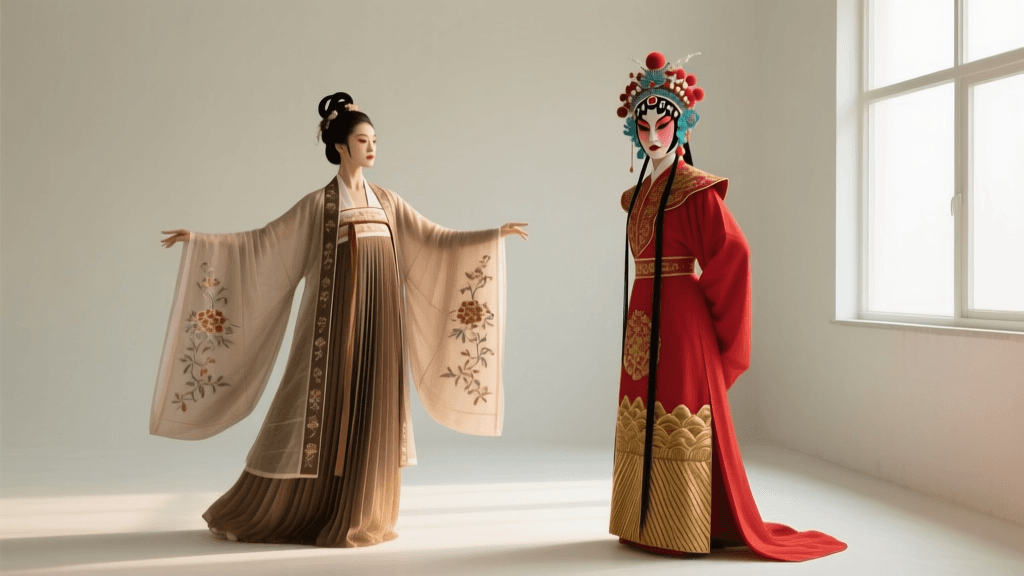
While a high-quality 2026 reproduction of a Ming dynasty Aoqun (jacket and skirt) or Daopao (scholar's robe) focuses on historical drape and accurate proportions, Kunqu Xifu alters these foundations for kinetic performance.
The Water Sleeves (Shuixiu)
The most iconic divergence is the Shuixiu, or 'water sleeves.' Authentic Ming Hanfu sleeves—whether the narrow zhixiu, the curved pipaxiu, or the wide guangxiu—end at the wrist or mid-hand. In Kunqu, performers wear a base garment with standard sleeves, over which a secondary layer of pure white, unlined silk is attached. These water sleeves can extend from 18 inches to over 30 inches past the fingertips. In 2026, professional Kunqu troupes favor a specific 22-momme stretch-silk blend for water sleeves, allowing for the rapid snapping, rippling, and folding techniques required to convey a character's inner emotional turmoil without spoken dialogue.
Collars, Fastenings, and Silhouettes
Historical Ming Hanfu relies on precise flat-cutting techniques, utilizing the natural drape of the fabric to create the jiaoling youren (cross-collar right over left) or the late Ming standing collar (liling). Theatrical Xifu, however, employs structural padding. A Kunqu scholar's robe (xuezi) will often feature lightly padded shoulders and a stiffened inner collar to ensure the garment maintains a commanding, triangular silhouette even when the actor is in rapid motion. Furthermore, while historical Hanfu uses subtle fabric ties or jade buttons, Xifu often utilizes hidden modern snap-fasteners and heavy-duty hooks to allow for rapid costume changes between acts.
Embroidery and Color Symbolism
As detailed in the Victoria and Albert Museum's archives on Chinese textiles, historical Ming embroidery was a marker of social rank, featuring subdued, highly detailed motifs like cranes, clouds, and specific floral patterns. Kunqu Xifu abandons this subtlety for bold, high-contrast symbolism. The stage relies on a strict color code: yellow for royalty, red for loyalty and high status, black for integrity or roughness, and white for treachery or mourning. The embroidery on a Kunqu mang (python robe) uses heavy metallic gold and silver couching threads that catch the light, ensuring the character's status is readable from the back row of a modern 2,000-seat theater.
2026 Material Innovations and Sourcing
The year 2026 has brought remarkable material science advancements to traditional theatrical tailoring. Historically, heavy stage brocades (zhuanghua) were notoriously hot and restrictive. Today, premier costume houses in Suzhou and Hangzhou are utilizing thermoregulating silk-cupro blends for the inner linings of Xifu, reducing performer fatigue during grueling three-hour performances. For martial roles (Wusheng and Wudan), the heavy leather and metal armor pieces (kao) have been largely replaced by 3D-printed flexible resins and lightweight carbon-fiber mesh, painted and embroidered to look indistinguishable from traditional materials under stage lights, but weighing less than a third of the historical counterparts.
Comparative Data: 2026 Market Guide
For independent theater companies and serious collectors, understanding the current market pricing and specifications is vital. Below is a comparative breakdown of sourcing authentic Ming Hanfu versus stage-grade Kunqu Xifu in 2026.
| Feature | Authentic Ming Hanfu (2026 Market) | Kunqu Opera Xifu (Stage Grade) |
|---|---|---|
| Sleeve Structure | Standard historical lengths; no extensions | Base sleeve + detachable white Shuixiu (water sleeves) |
| Collar & Fit | Flat-cut, natural drape, historical fastenings | Padded shoulders, stiffened collars, hidden quick-release snaps |
| Primary Fabrics | 100% Mulberry silk, linen, ramie, silk-satin | Heavy stage brocade, thermoregulating cupro linings, 3D-resin armor |
| Embroidery | Historically accurate, subtle, class-appropriate | High-contrast, metallic couching, symbolic character motifs |
| Avg. Cost (Custom) | $450 - $1,200 USD | $1,500 - $4,500+ USD (depending on armor and headpieces) |
| Lead Time | 4 - 8 weeks | 3 - 6 months (requires specialized theatrical tailors) |
The 'Theatrical Hanfu' Trend in 2026 Streetwear
An intriguing phenomenon in 2026 is the bleed-over of Kunqu Xifu elements into daily Hanfu streetwear and photography. The 'Theatrical Hanfu' trend sees enthusiasts adopting stylized Yunjian (cloud shoulders) and heavily embroidered horse-face skirts (maqun) that mimic the vibrant aesthetics of the stage. While purists maintain a strict separation between historical recreation and theatrical costume, a new wave of avant-garde Hanfu brands are intentionally blending the two. They offer 'stage-inspired' daily wear featuring slightly exaggerated collars, metallic thread accents, and detachable faux-water sleeves designed specifically for viral video content and cosplay photography. When purchasing these hybrid garments, buyers should carefully check the fabric weight; true stage brocade is too stiff for daily transit, so reputable 2026 brands use soft-woven jacquard to mimic the theatrical look while maintaining street-level comfort.
Care and Maintenance for Theatrical Silks
Maintaining Kunqu Xifu requires specialized care that differs vastly from standard Hanfu. The heavy metallic embroidery and structural padding mean these garments cannot be submerged in water. In 2026, the industry standard for cleaning high-end Xifu is eco-friendly liquid CO2 dry cleaning, which removes stage sweat and makeup residue without degrading the metallic threads or warping the 3D-printed armor components. Water sleeves, however, must be detached and hand-washed in cold water with a pH-neutral silk detergent after every performance to prevent the white silk from yellowing. Storage requires wide, padded hangers to support the weight of the padded shoulders, and garments must be kept in breathable cotton garment bags with silica gel packets to protect the dense brocades from humidity and moth damage.
Conclusion
The relationship between Ming Hanfu and Kunqu Xifu is a masterclass in how functional necessity transforms historical dress into high art. As we navigate the performing arts landscape in 2026, respecting the historical roots of the garments while embracing modern material innovations ensures that the breathtaking visual poetry of Kunqu Opera will continue to captivate audiences for generations to come. Whether you are stepping onto the stage or simply admiring the craftsmanship, understanding these distinctions elevates your appreciation of Asia's rich sartorial heritage.