Ming Dynasty Hanfu: Styling Jade Hair Accessories & Ensembles
The Ming Dynasty Aesthetic: Elegance in Every Layer
The resurgence of traditional Chinese clothing, known as the Hanfu movement, has brought centuries of sartorial history back into the modern spotlight. Among the various historical periods, the Ming Dynasty (1368–1644) stands out for its structured silhouettes, intricate weaving techniques, and profound emphasis on modesty and elegance. However, wearing a complete Ming Dynasty Hanfu ensemble extends far beyond simply putting on a skirt and a jacket. The true essence of this historical aesthetic is realized only when the garments are harmonized with authentic hair accessories, particularly those carved from jade.
According to the Metropolitan Museum of Art, the Ming era was a time of immense cultural refinement, where the scholar-official class dictated tastes in art, literature, and dress. Jewelry and hair ornaments were not mere afterthoughts; they were vital indicators of social status, marital status, and moral virtue. In this comprehensive guide, we will explore how to assemble a historically inspired Ming Dynasty Hanfu ensemble, with a special focus on selecting, styling, and sourcing jade hair accessories to achieve a look that is both authentic and breathtaking.
The Foundation: Building the Base Hanfu Ensemble
Before adorning the hair, one must establish the canvas. The quintessential Ming Dynasty women's ensemble is the Aoqun (jacket and skirt combination). Unlike the flowing, wide-sleeved robes of the Tang or Song dynasties, Ming garments are characterized by their structured, dignified tailoring.
The Ao (Jacket)
The Ao is a lined or padded top that typically falls below the waist or to the hips. For formal or semi-formal ensembles, the standing collar (liling) or the cross-collar (jiaoling) is most prevalent. The standing collar is often fastened with intricate metal buttons or traditional knotted toggles, adding a subtle metallic gleam near the face that perfectly complements jade hair ornaments. Sleeves are often cut in the pipa (lute) shape—narrower at the wrist and wider at the elbow—allowing for graceful movement while maintaining a tidy silhouette.
The Mamianqun (Horse-Face Skirt)
The cornerstone of the Ming wardrobe is the Mamianqun, or horse-face skirt. This skirt features two flat, unpleated panels (the 'horse faces') at the front and back, flanked by deeply pleated side panels. The flat panels are often heavily decorated with woven gold or silver threads (zhuanghua or zhi jin techniques), depicting auspicious motifs like dragons, phoenixes, or floral scrolls. The foundation of these exquisite garments relies heavily on traditional silk, a craft recognized by UNESCO as Intangible Cultural Heritage, ensuring the skirt holds its structured pleats while flowing elegantly with every step.
The Crown of Jade: Understanding Hair Accessories
In traditional Chinese culture, jade is far more than a beautiful stone; it is the physical embodiment of Confucian virtues. As noted by the Victoria and Albert Museum, jade has been revered in China for millennia, symbolizing purity, moral integrity, and benevolence. During the Ming Dynasty, jade hair accessories were essential for securing elaborate updos while projecting an aura of refined nobility.
'A gentleman compares his virtue to jade. It is gentle, beneficent, and like humaneness; it is fine and compact, and like wisdom; it is hard, and like righteousness.' — The Book of Rites (Liji)
To style a complete Ming ensemble, one must understand the specific types of hair ornaments used to construct the traditional updo.
| Accessory Type | Chinese Name | Placement | Function & Symbolism |
|---|---|---|---|
| Hairpin | Zan (簪) | Inserted horizontally or diagonally through the bun | Primary structural support to secure the hair; often features a single jade carving (e.g., lotus, ruyi) at the head. |
| Step-Shake | Buyao (步摇) | Front or sides of the updo | Features dangling jade or pearl pendants on metal springs; designed to sway gracefully with the wearer's steps, symbolizing vitality. |
| Hair Crown | Guan (冠) / Diji (狄髻) | Top or back of the head | A wire or jade-studded tiara/cage worn over the hair bun to add volume and denote formal status. |
| Hair Comb | Shu (梳) | Front of the hairline or top of the bun | Decorative half-moon combs, often carved from jade or inlaid with mother-of-pearl, used to smooth and adorn the hair. |
| Hair Stick | Chai (钗) | Sides or back of the bun | A double-pronged pin used for extra grip and decorative balance, often featuring paired jade motifs like butterflies. |
Step-by-Step Guide to Styling a Complete Ming Ensemble
Achieving a historically accurate Ming hairstyle requires volume, which is why modern Hanfu enthusiasts frequently use jiafa (hairpieces or wig pads) to build the foundation. Here is how to assemble the complete look from skin to crown.
Step 1: Dressing and Layering
Begin with a white cotton or silk inner garment (zhongyi) to protect the outer silk layers from body oils and to provide a crisp white collar line. Next, step into the Mamianqun, tying it securely at the natural waist. Finally, slip on the Ao, ensuring the metal collar buttons or toggles are perfectly aligned. The high collar of the Ming Ao frames the face beautifully, setting the stage for the hair ornaments.
Step 2: Building the Hair Base
Pull your natural hair into a high, tight ponytail at the crown of your head. Wrap a foam hair donut or a traditional wire-mesh diji (hair base) around the ponytail to create substantial volume. Wrap your natural hair (and the hairpiece) into a smooth, rounded bun, securing it tightly with U-pins and bobby pins. The Ming aesthetic favors rounded, substantial buns rather than loose, romantic tendrils.
Step 3: Placing the Jade Guan and Zan
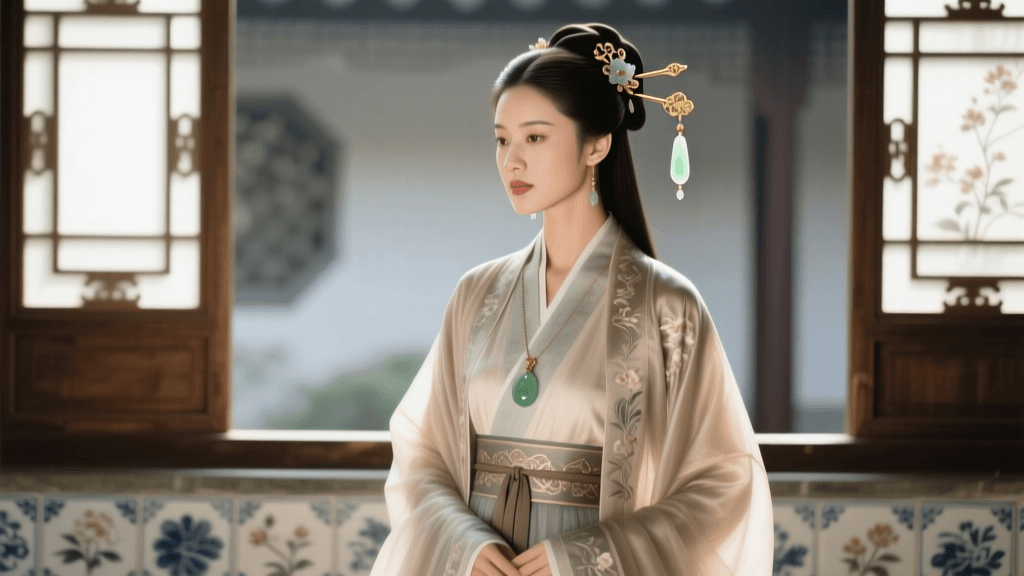
If you are wearing a Guan (hair crown) or a decorative cage, place it over the center of the bun. Take your primary jade Zan (hairpin) and insert it horizontally through the center of the bun and the crown, anchoring the entire structure. The jade head of the pin should rest prominently on one side, acting as the visual anchor of the hairstyle.
Step 4: Adding Movement with Buyao
Insert a Buyao (step-shake hairpin) at a 45-degree angle near the front or side of the bun. The metal base should be hidden within the hair, allowing the jade droplets or pearl strands to dangle freely near the temples. When you walk, the gentle swaying of the Buyao will contrast beautifully with the structured, still lines of the standing collar and the flat panels of the Mamianqun.
Step 5: Finishing Touches
Tuck a jade Shu (comb) into the front of the hairline for an added touch of archaic elegance. Ensure all metal prongs are hidden and that the jade elements catch the light without overwhelming the intricate woven patterns of your silk garments.
Sourcing Authentic Jade and Hanfu Textiles
For enthusiasts looking to invest in a complete ensemble, understanding the market for both textiles and jade is crucial.
Evaluating Jade Quality
When sourcing jade hair accessories, you will primarily encounter two types: Hetian (nephrite) and Xiuyan (serpentine). Hetian jade, particularly the mutton-fat white variety, is the most historically prized and commands a premium price (often hundreds or thousands of dollars for authentic antique or high-grade modern carvings). Xiuyan jade is more translucent, often featuring green or yellowish hues, and is much more affordable (ranging from $30 to $150), making it an excellent choice for everyday Hanfu styling. Always look for natural cooling properties and subtle internal inclusions, which are hallmarks of genuine stone, as opposed to the uniform perfection of glass or resin imitations.
Investing in Ming Textiles
A high-quality, historically accurate Ming Aoqun set made with genuine silk brocade and traditional wooden loom weaving can cost anywhere from $150 to over $800, depending on the complexity of the gold-leaf weaving (zhi jin). When purchasing, look for reputable Hanfu makers who provide detailed breakdowns of their fabric composition and historical references for their patterns. Avoid cheap polyester blends if your goal is to capture the dignified drape and structural integrity that defined Ming Dynasty fashion.
Conclusion
Assembling a complete Ming Dynasty Hanfu ensemble is an exercise in patience, artistry, and historical appreciation. The garments provide the architectural foundation, but it is the jade hair accessories—the zan, the buyao, and the guan—that breathe life and movement into the silhouette. By understanding the cultural weight of jade and the precise mechanics of traditional hair styling, modern wearers can step into a living tapestry of Asian tradition, honoring the elegance and moral philosophy of the Ming era with every step they take.