Ming Dynasty Hanfu Color Codes: Rank, Symbolism & Modern Styling
The Foundation of Ming Sumptuary Laws
The Ming Dynasty (1368–1644) represents a golden era of Han Chinese traditional clothing, characterized by intricate weaving techniques, profound symbolism, and strictly enforced sumptuary laws. Following the expulsion of the Mongol-led Yuan Dynasty, the Hongwu Emperor sought to restore traditional Han Chinese cultural norms, including a highly regulated dress code. Clothing was no longer merely functional or aesthetic; it was a visual language that communicated the wearer's social status, political rank, and moral standing. According to the Metropolitan Museum of Art's Heilbrunn Timeline, the Ming court established exhaustive regulations dictating which colors, fabrics, and motifs were permissible for every stratum of society, from the Emperor down to the common merchant.
For modern hanfu enthusiasts and couples planning traditional Chinese weddings, understanding these historical color codes is essential. It allows for the selection of garments that are not only visually stunning but also historically grounded and culturally respectful. This guide decodes the Ming Dynasty color hierarchy and provides actionable advice for sourcing and styling authentic garments today.
The Imperial Palette: Yellow, Red, and the Forbidden Hues
At the apex of the Ming color hierarchy was bright yellow, a hue exclusively reserved for the Emperor and the highest echelons of the imperial family. The use of safflower and pagoda tree buds to create vibrant yellows was heavily taxed and strictly controlled. Wearing bright yellow without imperial consent was considered an act of treason.
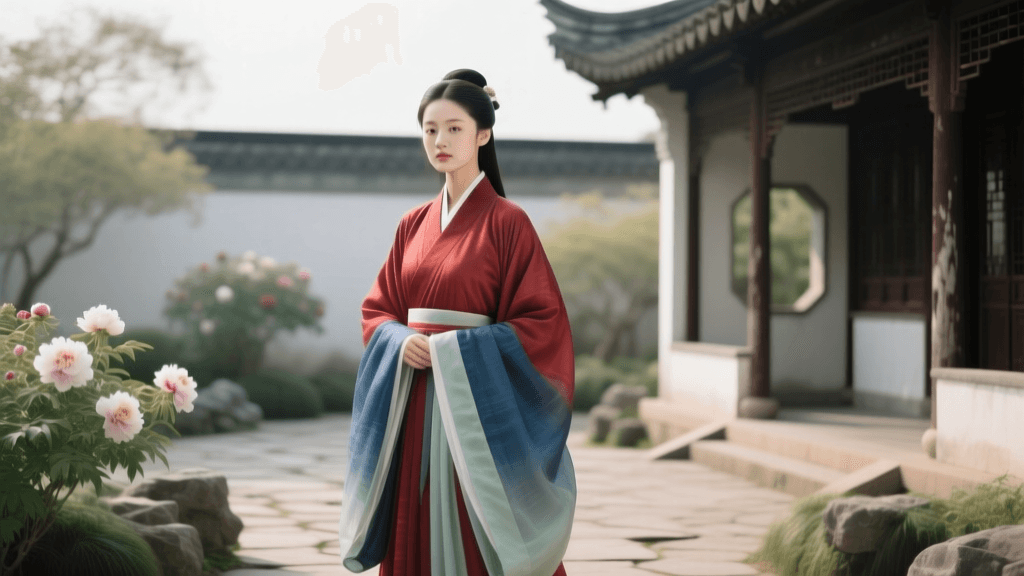
Red, specifically deep crimson and vermilion, was the color of supreme nobility, high-ranking officials, and auspicious ceremonies. It symbolized fire, vitality, and the divine right to rule. During the Ming era, the 'Mangfu' (python robe) and 'Feiyufu' (flying fish robe) were often dyed in rich reds and bestowed by the Emperor as marks of extreme favor. Conversely, commoners were largely restricted to 'plain' colors—undyed hemp, light blues, browns, and muted greens. They were expressly forbidden from wearing deep crimson, bright yellow, or dark purple, which were reserved for the elite.
Decoding the Buzi: Rank Badges and Official Colors
While color set the baseline for social standing, the 'Buzi' (Mandarin squares or rank badges) provided granular detail regarding an official's exact rank within the imperial bureaucracy. As detailed by the Victoria and Albert Museum, these intricately embroidered squares were affixed to the chest and back of an official's robe. Civil officials wore badges featuring birds, symbolizing literary grace and administrative prowess, while military officials wore beasts, representing courage and martial strength.
The color of the official's robe, combined with the Buzi, created a comprehensive uniform system. High-ranking officials (Ranks 1 to 4) typically wore deep red or crimson robes. Mid-level officials (Ranks 5 to 7) were assigned green or blue robes, while lower-ranking officials (Ranks 8 and 9) wore green or pale blue. The University of Washington Silk Road Project notes that the dyes required for these deep, colorfast reds and blues—such as madder root and high-grade indigo—were expensive, further reinforcing the economic barriers of the sumptuary laws.
Ming Dynasty Official Rank, Buzi, and Color Matrix
| Rank | Civil Official Buzi (Bird) | Military Official Buzi (Beast) | Permitted Robe Colors |
|---|---|---|---|
| 1st Rank | Crane (Xianhe) | Qilin (Mythical Beast) | Deep Crimson, Scarlet |
| 2nd Rank | Golden Pheasant (Jinji) | Lion (Shizi) | Deep Crimson, Scarlet |
| 3rd Rank | Peacock (Kongque) | Leopard (Bao) | Crimson, Dark Red |
| 4th Rank | Wild Goose (Yunyan) | Tiger (Hu) | Crimson, Dark Red |
| 5th Rank | Silver Pheasant (Baihan) | Bear (Xiong) | Blue, Azure |
| 6th Rank | Egret (Bailu) | Panther (Biao) | Blue, Azure |
| 7th Rank | Mandarin Duck (Xichi) | Rhinoceros (Xi) | Green, Blue-Green |
| 8th Rank | Oriole (Huangli) | Rhinoceros (Xi) | Green, Pale Blue |
| 9th Rank | Quail (Anchun) | Sea Horse (Haima) | Green, Pale Blue |
Natural Dyes and Their Symbolic Weight
The Ming Dynasty relied entirely on natural dyes, and the extraction process imbued the colors with philosophical meaning aligned with the Five Elements (Wu Xing) theory.
- Indigo (Blue/Wood): Extracted from the indigo plant, blue represented the East, spring, and scholarly growth. It was the most common color for scholars and mid-tier officials.
- Safflower & Madder (Red/Fire): Representing the South, summer, and prosperity. Achieving a deep, colorfast crimson required multiple dye baths and a mordant like alum, making red fabrics highly expensive and symbolic of wealth.
- Pagoda Tree Buds (Yellow/Earth): Representing the Center and imperial authority. The bright yellow was reserved strictly for the throne.
- Gallnut & Acorn (Black/Water): Representing the North and winter. Black and deep navy were often worn by scholars and judges, symbolizing solemnity, fairness, and the depths of wisdom.
- Mulberry & Lotus (White/Metal): Representing the West and autumn. White was primarily associated with mourning and was strictly avoided in festive or court attire.
Practical Guide: Commissioning Authentic Ming Hanfu Today
For modern practitioners, historical accuracy must be balanced with contemporary sourcing. Whether you are commissioning a 'Daopao' (scholar's robe) for a graduation ceremony, a 'Mangfu' for a groom, or a 'Fengguan Xiapei' (phoenix crown and cloud scarf) ensemble for a bride, here is how to navigate the market.
Fabric Sourcing and Costs
Authenticity begins with the textile. Avoid cheap, shiny polyester satins that misrepresent the dignified drape of Ming garments.
- Zhuanghua Silk Brocade: The pinnacle of Ming weaving, featuring discontinuous weft patterns. Cost: $150 to $350+ per meter. Ideal for Buzi badges, Mangfu python robes, and bridal Xiapei scarves.
- Heavy Silk Crepe / Matte Silk: Excellent for solid-colored Daopao or Aoqun (jacket and skirt) sets. It dyes beautifully and drapes with historical accuracy. Cost: $40 to $80 per meter.
- High-Grade Cotton-Linen Blends: For commoner-style attire or undergarments (Zhongyi). Cost: $15 to $25 per meter.
Pro Tip: A standard Ming Daopao requires approximately 4 to 5 meters of fabric (assuming a width of 140cm), while a pleated Mamianqun (horse-face skirt) requires 3 to 4 meters depending on the pleat density.
Traditional Measurements and Tailoring Timelines
Ming hanfu relies on flat pattern cutting, meaning the garment is constructed from flat geometric panels without Western-style darts or tailored waistlines. The fit is achieved through wrapping, tying, and the natural drape of the fabric.
- Tongxiu (Total Sleeve Span): For formal Ming robes, the sleeves should extend beyond the fingertips. A formal 'Pipa' sleeve or wide sleeve requires a Tongxiu measurement of 180cm to 220cm. Measure from wrist to wrist with arms outstretched, then add the desired overhang.
- Yichang (Garment Length): Measured from the prominent vertebra at the base of the neck down to the ankle bone. For men's Daopao, this is typically 125cm to 135cm. For women's Ao (jackets), it ranges from 70cm (waist-length) to 110cm (knee-length).
- Timelines: If commissioning custom hand-embroidered Buzi badges, expect a lead time of 6 to 10 weeks. Machine-embroidered badges can be sourced in 1 to 2 weeks. Full bespoke tailoring from a specialized Hanfu atelier typically takes 3 to 5 weeks. Always order bridal Fengguan Xiapei sets at least 4 months in advance due to the intricate metalwork and beadwork required for the crown.
'The regulations on dress are not merely for adornment, but to distinguish the noble from the base, to clarify the hierarchy, and to bring order to the realm.' — Paraphrased from the Ming Shi (History of Ming), Treatise on Carriages and Clothing.
Conclusion
The color codes of the Ming Dynasty offer a fascinating window into a society where every thread and hue carried profound philosophical and political weight. By understanding the strict sumptuary laws, the symbolism of natural dyes, and the intricate language of the Buzi rank badges, modern wearers can approach the Hanfu revival with deeper cultural literacy. Whether you are selecting a deep crimson Mangfu for a wedding or a serene blue Daopao for a tea ceremony, honoring these historical color matrices ensures that the garments you wear are not just beautiful costumes, but living continuations of a rich, sartorial heritage.