Ming Dynasty Hanfu Color Codes: Symbolism, Rank & Modern Styling
Decoding the Ming Dynasty: Color, Rank, and the Wu Xing
When the Ming Dynasty (1368–1644) overthrew the Mongol-led Yuan Dynasty, the Hongwu Emperor initiated a massive cultural renaissance aimed at restoring traditional Han Chinese customs. Central to this restoration was the implementation of strict sumptuary laws that dictated exactly who could wear what. Clothing was no longer just a matter of personal taste or weather protection; it was a highly regulated visual language. In Ming Dynasty China, the colors of your Hanfu immediately communicated your social rank, your profession, and your alignment with the cosmic order.
To understand Ming color codes, one must understand the Wu Xing (Five Elements) theory, which links colors to natural elements, directions, and seasons. As noted by historians, the imperial court used these colors to legitimize their rule, claiming the mandate of heaven through visual harmony. The Metropolitan Museum of Art's Heilbrunn Timeline highlights how Ming court robes and textiles were deeply embedded in this cosmological framework, using specific dyes to reflect the wearer's status and the empire's stability.
The Wu Xing Color Matrix and Imperial Rank
The foundation of Ming color symbolism rests on the Five Elements. Each element corresponds to a specific color, and wearing the wrong color could be interpreted as a challenge to the cosmic and political hierarchy.
| Element | Color | Direction | Season | Ming Dynasty Association & Rank |
|---|---|---|---|---|
| Earth | Bright Yellow | Center | Late Summer | The Emperor and immediate royal family. Strictly forbidden to commoners. |
| Fire | Red / Crimson | South | Summer | High-ranking officials, joyous occasions, and bridal wear. |
| Wood | Green / Blue | East | Spring | Scholars, mid-level officials, and youth (symbolizing growth and vitality). |
| Metal | White | West | Autumn | Mourning attire, purity, and lower-ranking civil servants. |
| Water | Black / Dark | North | Winter | Scholar-officials' formal headwear and lower-tier administrative robes. |
Bright yellow was the ultimate status symbol. According to Smithsonian Magazine, yellow's association with the earth element and the center of the universe made it the exclusive domain of the Emperor, a rule so strictly enforced that unauthorized use was punishable by death.
Sumptuary Laws: The Buzi and Prohibited Dyes
Beyond base colors, the Ming government regulated patterns and accessories. The most famous of these was the Buzi (Mandarin Square), a decorative badge sewn onto the front and back of an official's robe. The Victoria and Albert Museum notes that these embroidered squares featured birds for civil officials and beasts for military officers, with the specific animal denoting the exact rank from one to nine.
What Commoners Could Not Wear
- Bright Yellow & Dark Purple: Reserved exclusively for the imperial family and top-tier nobility.
- Dragon Motifs: Five-clawed dragons were for the Emperor; four-clawed mang (pythons) were for high nobles. Commoners were restricted to floral, geometric, or auspicious beast motifs like deer or cranes.
- Forbidden Fabrics: Silk brocades interwoven with gold thread were heavily taxed and restricted. Commoners were legally bound to wear cotton, hemp, or plain silk in muted, pale shades like light blue, pale pink, or undyed off-white.
Modern Application: Dressing by the Code Today
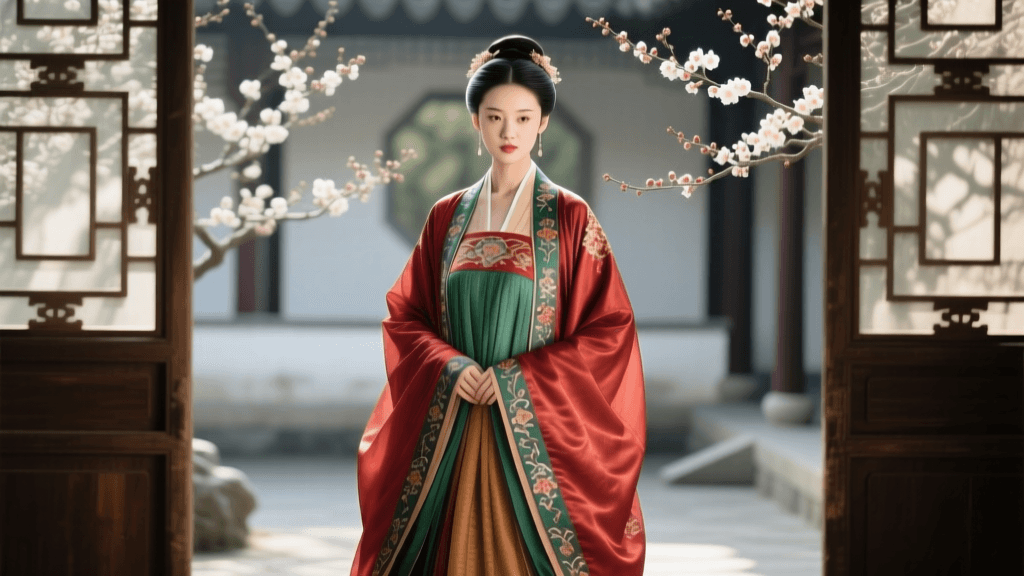
Today, the Hanfu revival movement has brought Ming-style garments—particularly the Mamianqun (horse-face skirt) and Aoqun (cross-collar jacket and skirt)—back into mainstream fashion. While modern wearers are not bound by imperial sumptuary laws, utilizing historical color codes adds profound cultural depth to your wardrobe, especially for significant life events.
1. The Traditional Wedding (Red & Gold)
For weddings, the Ming code dictates crimson red (Fire) paired with gold embroidery. Red wards off evil and symbolizes prosperity. Actionable Advice: Look for a red Mamianqun featuring phoenix or peony motifs. Cost: High-quality silk brocade skirts range from $150 to $400 USD. Brands like Ming Huatang offer authentic silk weaves, while Shisan Yu provides budget-friendly polyester jacquard alternatives for $50 to $80.
2. Academic & Coming-of-Age Ceremonies (Blue & Green)
Green and blue (Wood) represent spring, growth, and scholarly pursuit. This is the ideal palette for graduations, coming-of-age ceremonies, or academic conferences. Actionable Advice: Pair a pale blue Pifeng (open-front overcoat) with a white inner Ao (jacket) and a jade-green skirt. Cost: A complete three-piece set in breathable cotton-linen blends will cost between $90 and $140 USD.
3. Mourning or Solemn Remembrance (White & Black)
White (Metal) is the traditional color of mourning and solemnity in Chinese culture, representing autumn and the setting sun. Actionable Advice: For solemn ancestral worship or quiet reflection, opt for unadorned white hemp-textured Hanfu or deep black robes without bright embroidery.
Practical Sizing and Measurement Guide
Buying authentic Ming-style Hanfu requires precise measurements, as traditional garments do not use modern S/M/L sizing. When ordering from specialized Taobao makers or international Hanfu boutiques, you must provide the following:
- Bust (Xiong Wei): Measure around the fullest part of your chest. Add 4-6 cm for the overlapping cross-collar of the Ao.
- Waist (Yao Wei): Measure your natural waist. The Mamianqun sits higher than modern skirts, usually at the narrowest part of the torso, not the hips.
- Skirt Length (Qun Chang): The golden rule for a Mamianqun is: Height - 30cm. For example, if you are 165cm tall, order a 135cm skirt length so it rests perfectly just above the ankle, preventing tripping while maintaining modesty.
Sourcing and Care: Timing and Textiles
If you are sourcing authentic Ming-style Hanfu directly from Chinese artisans via platforms like Taobao, be prepared for the reality of traditional craftsmanship. Timing: Custom-woven silk brocade and hand-embroidered Buzi patches are often made-to-order. Expect shipping and production times to range from 15 to 45 days. Always order at least two months before a major event like a wedding. Care Instructions: Authentic mulberry silk and metallic gold threads cannot be machine washed. Dry clean only. If you purchase modern polyester-jacquard blends for daily wear, use a delicate cold-water cycle and hang dry away from direct sunlight to prevent the vibrant crimson and azure dyes from fading.
"To wear Hanfu is not merely to put on old clothes; it is to drape oneself in the philosophy, astronomy, and social fabric of the ancestors. Every color tells a story of the earth, the heavens, and one's place within them."
By understanding the Ming Dynasty's strict color codes and rank symbolism, modern enthusiasts can curate a Hanfu wardrobe that is not only visually stunning but historically resonant. Whether you are donning the crimson of a bride or the scholarly blue of a student, you are participating in a living, breathing tradition that spans centuries.