The Haori and Sukajan: Japanese Garments in Global Pop Culture
The Intersection of Tradition and Global Pop Culture
When we examine the global impact of Asian sartorial heritage, few cultural exports have bridged the gap between ancient tradition and modern pop culture as seamlessly as Japanese fashion. From the neon-lit streets of Harajuku to the high-fashion runways of Paris and the vibrant cosplay aisles of global anime conventions, traditional Japanese garments have been continuously reimagined. While the kimono remains the most recognized symbol of Japanese textile heritage, it is the haori (traditional jacket) and the sukajan (souvenir jacket) that have truly conquered global streetwear, hip-hop fashion, and anime-inspired media. This article explores the journey of these two iconic garments through the lens of global pop culture and provides actionable, detailed advice on how to source, size, and style them for the modern wardrobe.
The Haori: From Samurai Armor to Anime Icon
Historically, the haori was worn over the kimono as a protective layer against the elements and, during the Sengoku period, as a lightweight armor overlay for samurai. By the Edo period, it had evolved into a canvas for subtle luxury, adorned with intricate family crests (mon) and hidden linings featuring elaborate dyeing techniques. Today, the haori's T-shaped silhouette and open-front drape have made it a favorite among global fashion designers and streetwear enthusiasts alike.
The global fascination with the kimono and haori silhouette was masterfully documented in the Victoria and Albert Museum's 'Kimono: Kyoto to Catwalk' exhibition, which highlighted how Western and global fashion houses have continuously borrowed from Japanese structural aesthetics. However, the most explosive recent catalyst for the haori's global popularity is undoubtedly the anime and manga industry.
The Anime Effect: Demon Slayer and Beyond
The blockbuster anime series Demon Slayer: Kimetsu no Yaiba triggered a worldwide phenomenon that directly impacted traditional garment sales. The protagonist, Tanjiro Kamado, wears a distinctive black-and-green ichimatsu (checkerboard) haori, while his companion Zenitsu sports a bright yellow triangle pattern. Following the series' global streaming success, searches for 'anime haori' and 'traditional Japanese jacket' spiked by over 300% on global e-commerce platforms. Cosplayers and streetwear fans alike began integrating these traditional patterns into daily wear, pairing them with modern denim and sneakers.
Actionable Guide: Sourcing and Sizing a Haori
If you are looking to add an authentic haori to your wardrobe, understanding traditional Japanese measurements is crucial, as they differ vastly from Western sizing.
- Yuki (Center Back to Wrist): Unlike Western jackets measured by shoulder width, haori are measured from the center back seam to the edge of the sleeve. For a modern, oversized streetwear look, measure from your C7 vertebra (base of the neck) to your wrist, and add 5 to 8 centimeters. A standard men's vintage haori usually has a yuki of 78-82 cm.
- Mihaba (Width): This is the total width of the garment laid flat. For a comfortable open-front drape over a modern t-shirt or hoodie, look for a mihaba of at least 100-110 cm.
- Fabric and Cost: Vintage polyester haori from the 1970s are highly durable, machine washable, and cost between $30 and $60 USD. Authentic vintage silk haori with hand-painted shibori or yuzen linings range from $120 to $300 USD. Modern, artisan-crafted silk haori from Kyoto can exceed $600 USD.
The Sukajan: The Souvenir Jacket that Conquered Streetwear
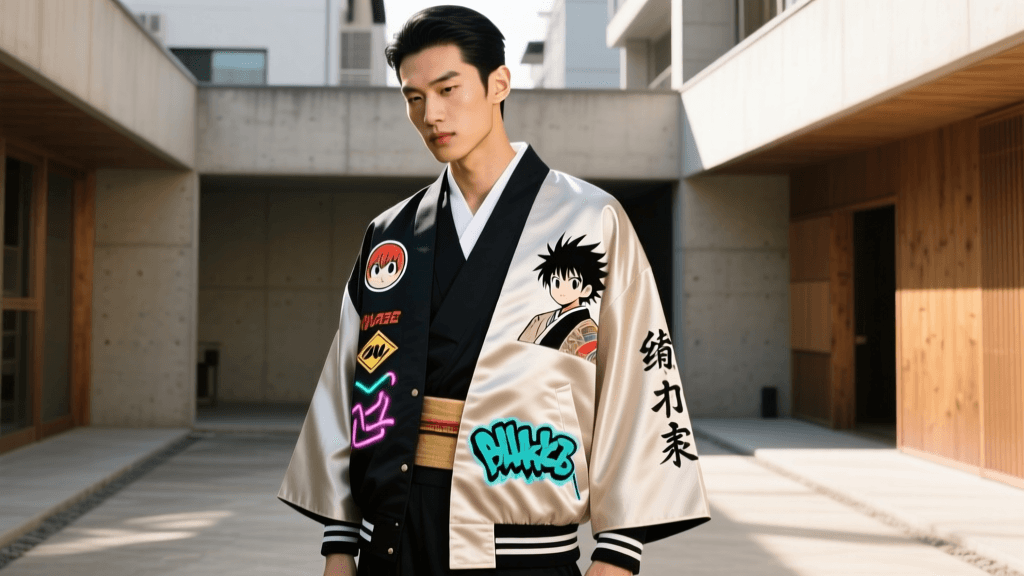
While the haori represents centuries of unbroken tradition, the sukajan (Yokosuka jumper) is a product of cross-cultural friction and post-war globalization. Originating in the port city of Yokosuka after World War II, American military personnel sought unique souvenirs to take back home. Local Japanese artisans, utilizing traditional embroidery techniques originally reserved for kimonos and obi belts, began stitching intricate designs of dragons, tigers, eagles, and maps of Japan onto Western-style baseball jackets made from surplus parachute silk and rayon.
The Kyoto Costume Institute Digital Archives frequently highlights this era as a pivotal moment in Japanese fashion history, where traditional craftsmanship met Western utility, birthing an entirely new sartorial category. The sukajan eventually became a symbol of rebellion in Japanese cinema, frequently worn by yakuza and delinquent characters in 1970s films, before being reclaimed by high fashion and global musicians.
Media, Music, and the Streetwear Revival
In global pop culture, the sukajan has been worn by everyone from Drake and A$AP Rocky to characters in the hit video game franchise Yakuza (Like a Dragon). High-end fashion houses like Saint Laurent and Gucci have released their own luxury iterations, cementing the souvenir jacket as a permanent fixture in global streetwear. The juxtaposition of the hyper-masculine military silhouette with the delicate, shimmering floral and dragon embroidery creates a visual tension that media stylists and music video directors love to exploit.
Actionable Guide: Sizing and Buying a Sukajan
Buying a vintage sukajan requires careful attention to material degradation and sizing anomalies.
- Sizing Discrepancies: Vintage Japanese sizing runs significantly smaller than modern Western sizing. A vintage tag reading 'L' will often fit like a modern 'M' or even 'S'. Always rely on pit-to-pit measurements. For a relaxed, modern streetwear fit, aim for a pit-to-pit measurement of 22 to 24 inches (55-60 cm).
- Material Matters: Early 1950s jackets were made from acetate or parachute silk, offering a matte, luxurious drape. The 1960s and 70s saw the rise of rayon (artificial silk), which provides the iconic high-shine finish associated with classic sukajan but is highly prone to shrinking if exposed to water. Modern reproductions often use polyester blends for durability.
- Cost Breakdown: Modern mass-produced reproductions cost between $80 and $150 USD. Authentic 1960s rayon vintage pieces in good condition range from $300 to $800 USD. Rare, pristine 1950s silk or reversible acetate pieces can command upwards of $1,500 to $3,000 USD on the collector's market.
Comparison Chart: Haori vs. Sukajan
| Feature | Haori (Traditional Jacket) | Sukajan (Souvenir Jacket) |
|---|---|---|
| Origin Era | Muromachi / Edo Period (14th-19th Century) | Post-WWII (Late 1940s-1950s) |
| Primary Fabric | Silk, Polyester, Cotton, Linen | Rayon, Acetate, Silk, Polyester |
| Pop Culture Anchor | Anime (Demon Slayer), Haute Couture | Hip-Hop, Video Games (Yakuza), Rock |
| Average Vintage Cost | $50 - $250 USD | $150 - $800 USD |
| Best Modern Pairing | Wide-leg trousers, plain white tee, sneakers | Slim denim, boots, minimalist streetwear |
Care, Maintenance, and Cultural Preservation
Owning these garments comes with the responsibility of proper textile care. Never machine wash a vintage silk haori or a rayon sukajan. Rayon will shrink and warp irreversibly when exposed to water and agitation, while water spots will permanently stain vintage silk. Always seek a dry cleaner who specializes in vintage or theatrical garments. For storage, haori should be folded along their natural seams and wrapped in acid-free tatoushi paper to allow the silk to breathe and prevent moisture buildup. Sukajan should be hung on wide, padded wooden hangers to support the heavy embroidery and maintain the shoulder structure.
As global consumers, it is also vital to approach these garments with cultural appreciation rather than mere appropriation. The Japan Agency for Cultural Affairs actively works to preserve traditional dyeing and weaving techniques, many of which are designated as Important Intangible Cultural Properties. When purchasing a haori, consider sourcing from reputable vintage dealers in Kyoto or Tokyo who support local artisans, or invest in modern pieces from certified Nishijin weavers. By understanding the deep historical roots of the haori and the fascinating cross-cultural birth of the sukajan, we do more than just wear a trendy jacket; we participate in the ongoing, global dialogue of Asian textile heritage.