Ming Dynasty Hanfu Color Codes and Rank Badges Explained
The Sartorial Laws of the Ming Dynasty
The Ming Dynasty (1368–1644) represents a golden era of Han Chinese traditional clothing, widely celebrated today as Hanfu. Following the overthrow of the Mongol-led Yuan Dynasty, the Hongwu Emperor sought to restore Han cultural identity and social order. To achieve this, the imperial court instituted rigorous sumptuary laws that dictated exactly what fabrics, colors, and motifs citizens could wear based on their social status, profession, and official rank. Clothing was not merely a matter of personal expression; it was a highly regulated visual language of power, hierarchy, and cosmic harmony.
For modern Hanfu enthusiasts, understanding these historical color codes and rank badges—known as Buzi—is essential. It allows collectors and wearers to appreciate the profound symbolism woven into every thread and to make informed, culturally respectful choices when purchasing and styling Ming-inspired garments today.
The Imperial Color Palette: Who Could Wear What?
In Ming Dynasty China, color was deeply tied to the Five Elements theory (Wu Xing) and strictly regulated by the state. The Britannica archives on Chinese dress note that the Ming government went to great lengths to reserve specific hues exclusively for the imperial family and high-ranking bureaucrats. Commoners and merchants, regardless of their wealth, were legally restricted to dull, undyed, or muted colors like plain white, hemp-brown, and pale blue, though these laws began to fracture during the economically booming late Ming period.
Ming Dynasty Color Codes and Rank Restrictions
| Color | Symbolism | Authorized Wearers | Modern Hanfu Application |
|---|---|---|---|
| Bright Yellow | Earth, Center, Imperial Power | Emperor only (strictly forbidden for others) | Avoid for everyday wear; reserve for theatrical or imperial cosplay. |
| Scarlet / Red | Fire, South, Joy, High Authority | High-ranking officials (Rank 1 to 4) | Highly popular for weddings, festivals, and formal Daopao robes. |
| Purple | Nobility, Spiritual Awareness | Senior officials and imperial relatives | Excellent for elegant Pifeng (cloaks) and formal Mamianqun. |
| Green / Blue | Wood, East, Growth, Intellect | Mid-to-lower ranking officials (Rank 5 to 9) | Versatile for daily wear, scholarly aesthetics, and spring events. |
| White / Hemp | Metal, West, Purity, Mourning | Commoners, scholars in mourning, undergarments | Used for inner layers (Zhongyi) or minimalist, elegant Song/Ming styles. |
Buzi (Mandarin Squares): Decoding the Animal Rank Badges
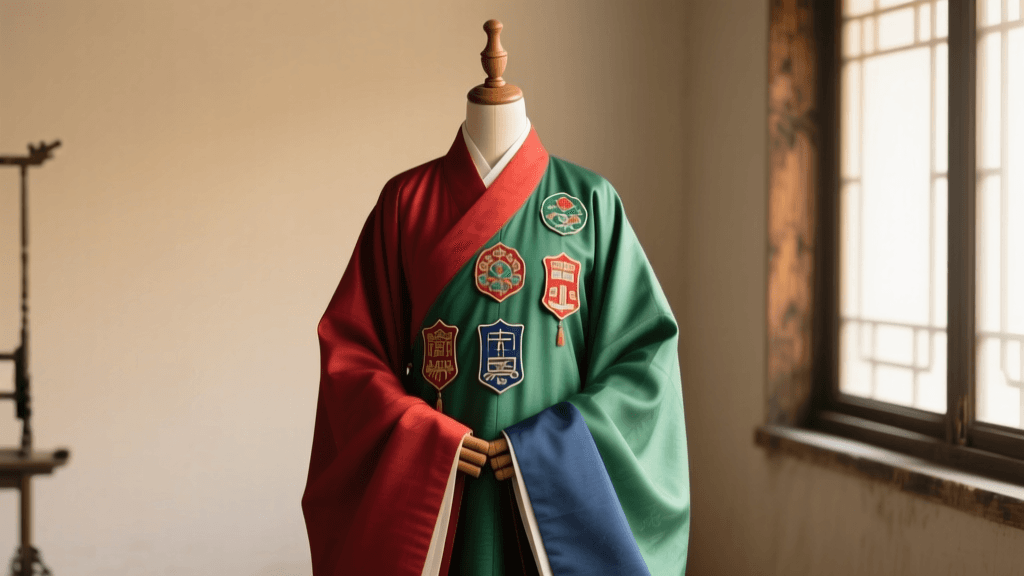
While color indicated general status, the exact rank of a Ming official was displayed via the Buzi (Mandarin Square), a meticulously embroidered badge worn on the chest and back of the official's outer robe (Bushan). According to the Victoria and Albert Museum's extensive archives on Chinese rank badges, the Ming system refined earlier traditions by assigning specific birds to civil officials (representing literary elegance and intellect) and mythical or fierce beasts to military officials (representing courage and martial prowess).
The Metropolitan Museum of Art's Heilbrunn Timeline highlights that these textiles were masterpieces of silk embroidery, often utilizing couching techniques and gold-wrapped threads to catch the light in dimly lit court halls.
Civil vs. Military Officials: The 9-Rank System
The Ming bureaucracy was divided into nine primary ranks, with the First Rank being the highest. Below is a structured guide to the Civil and Military Buzi motifs. Modern Hanfu makers frequently reproduce these badges on ceremonial jackets and scholar robes.
| Rank | Civil Official (Birds) | Military Official (Beasts) |
|---|---|---|
| 1st Rank | Red-Crowned Crane (Immortality, longevity) | Qilin (Mythical chimerical beast, supreme benevolence) |
| 2nd Rank | Golden Pheasant (Good fortune, duty) | Lion (Bravery, protection) |
| 3rd Rank | Peacock (Beauty, dignity, rank) | Leopard (Agility, ferocity) |
| 4th Rank | Wild Goose (Loyalty, marital fidelity) | Tiger (Courage, martial power) |
| 5th Rank | Silver Pheasant (Peace, refinement) | Asiatic Black Bear (Strength, endurance) |
| 6th Rank | Egret (Patience, purity) | Panther (Fierceness, strategy) |
| 7th Rank | Mandarin Duck (Loyalty, harmony) | Rhinoceros (Armor, defense) |
| 8th Rank | Quail (Harvest, stability) | Rhinoceros (Shared with 7th) |
| 9th Rank | Paradise Flycatcher (Longevity, grace) | Sea Horse (Mythical water horse, naval power) |
'The regulations of dress are the boundaries of the state. When the boundaries blur, the empire trembles.' — Paraphrased from the History of Ming (Ming Shi), reflecting the court's obsession with sartorial hierarchy.
Modern Hanfu Revival: Buying and Wearing Rank-Inspired Garments
Today, the Hanfu movement has revived Ming Dynasty silhouettes, particularly the Daopao (a pleated, side-slit scholar's robe), the Yesa (a structured, military-inspired tunic), and the ubiquitous Mamianqun (horse-face skirt). While modern wearers are not bound by Ming sumptuary laws, understanding the historical weight of these garments elevates the wearing experience and helps buyers avoid unintended cultural faux pas.
Actionable Buying Guide: Costs, Brands, and Timing
The modern Hanfu market operates heavily on a pre-sale (Yushou) model through platforms like Taobao and Weidian. Here is what you need to know before investing in Ming-style garments:
- Entry-Level ($50 - $120 USD): Brands like Shisanyu and Lanzhiting offer polyester jacquard and blended cotton Mamianqun and basic Daopao. These are durable, machine-washable (on gentle), and perfect for beginners or travel. Expect to wait 2 to 4 weeks for shipping.
- Mid-Tier ($150 - $350 USD): Brands like Zhiyi and Chang'an Shiyi provide historically accurate patterns, better draping, and woven brocade motifs. Garments often feature accurate Ming collar proportions and authentic pleating structures.
- High-End Bespoke ($500 - $1,500+ USD): Minghuatang is the gold standard for Ming revival. They use authentic silk, real gold-leaf thread wrapping, and traditional Yunjin (cloud brocade) weaving. Timing: Pre-sales for Minghuatang can last 60 to 120 days due to the hand-woven nature of the textiles.
Crucial Measurements for Ming Silhouettes
Ming Dynasty robes are characterized by their generous, sweeping cuts and elongated sleeves. When ordering from Chinese makers, you must provide specific measurements to ensure the historical silhouette is maintained:
- Chest & Waist: Unlike Western tailoring, Hanfu is not darted or fitted to the body. Provide your actual measurements, but expect the garment to have 10-15 cm of ease for proper cross-collar overlapping.
- Height & Skirt Length: A Mamianqun should sit at the natural waist and fall exactly to the ankle bone. Provide your height and desired skirt length (usually 95cm to 105cm for average heights).
- Arm Span (Wingspan): Ming scholar robes (Daopao) feature 'Pipa' or wide sleeves designed to extend past the fingertips by 10 to 15 cm. This excess fabric is meant to be folded back elegantly at the wrists. If a maker asks for sleeve length, measure from the center back of your neck to your wrist, then add 15 cm for the traditional drape.
Fabric Care and Styling Etiquette
If you invest in silk brocade or garments featuring embroidered Buzi badges, proper care is paramount. Never machine-wash silk brocade. Dry clean only, or gently spot clean with a damp cloth and mild silk detergent. Store Mamianqun by hanging them from the waistband to preserve the sharp, knife-like pleats, which are historically ironed using heavy stones and steam.
When styling, remember that Ming clothing is inherently layered. A proper outfit requires a white cotton or silk Zhongyi (inner garment) with a visible white collar band peeking out from the outer robe. This inner layer protects the expensive outer silk from body oils and provides the crisp, structured neckline that defines the Ming aesthetic.
Conclusion
The color codes and rank badges of the Ming Dynasty are far more than historical trivia; they are a testament to an era where clothing was a profound reflection of philosophy, governance, and art. By understanding the symbolism of the Buzi and the strict hierarchy of the imperial color palette, modern Hanfu enthusiasts can curate wardrobes that are not only visually stunning but deeply respectful of their cultural origins. Whether you are purchasing an entry-level jacquard Mamianqun or commissioning a bespoke silk Daopao, you are participating in the living, breathing revival of one of Asia's most magnificent sartorial traditions.