Ming Hanfu Reconstruction: 3D Drape Analysis Guide 2026
The Evolution of Chinese Fashion History Education in 2026
The landscape of Chinese fashion history education has undergone a radical transformation by 2026. No longer confined to static museum displays or two-dimensional pattern drafting, academic research into traditional Asian garments now relies heavily on advanced digital twin technologies. University programs across Asia and the globe are integrating 3D fabric drape analysis into their core curricula, allowing students and historians to reconstruct historical garments with unprecedented physical accuracy. This shift is not merely a technological novelty; it is a fundamental reimagining of how we preserve, study, and understand the sartorial heritage of the Ming Dynasty and beyond.
At the heart of this academic renaissance is the Xin Zhongshi (新中式), or 'new Chinese style,' movement. While the commercial fashion industry has rapidly adopted Xin Zhongshi aesthetics for modern streetwear and haute couture, the academic sector has responded by demanding rigorous historical authenticity. Students and researchers in 2026 are no longer satisfied with theatrical approximations or costume-grade replicas. Instead, they utilize advanced physics engines to understand how historical textiles behaved in motion, how they were tailored to accommodate the human form, and how regional climates influenced textile choices. This intersection of ancient weaving traditions and cutting-edge software defines the modern study of Asian traditions.
Core Methodologies in Academic Garment Reconstruction
Fabric drape analysis is the scientific study of how a textile folds, hangs, and moves under its own weight and external forces. For Ming Dynasty garments—which frequently utilized heavy silk damasks, intricate brocades, and stiff ramies—the drape coefficient dictates the entire silhouette. A garment's historical accuracy cannot be judged by its pattern alone; it must be evaluated by how the fabric interacts with gravity. In 2026, academic labs utilize specialized software to simulate these physical properties, inputting exact data regarding a fabric's tensile strength, shear stiffness, and bending resistance.
Researchers frequently cross-reference physical artifacts with digital archives, such as the Victoria and Albert Museum's Asian Collections, to gather empirical data on surviving textiles. By combining high-resolution macro photography of historical weaves with digital material calibration, scholars can recreate the exact weight and stiffness of a 15th-century silk damask. This methodology allows historians to test hypotheses about garment construction that would be impossible to verify without physically dismantling priceless museum artifacts.
Comparative Analysis of 3D Reconstruction Software in 2026
University fashion history departments rely on a suite of digital tools to achieve these reconstructions. Below is a comparison of the primary platforms utilized in academic research labs today:
| Software Platform | Primary Academic Use | Drape Engine Accuracy (2026) | Avg. University Lab Cost |
|---|---|---|---|
| CLO3D | Historical pattern drafting & physical stitching simulation | High (Advanced physical material mapping) | $1,500 / seat / year |
| Marvelous Designer | Concept visualization & historical animation sequences | Medium (Visual prioritization over physical exactness) | $900 / seat / year |
| Blender (Cloth Sim) | Open-source research, rendering, and VR integration | Variable (Requires manual node tuning and physics baking) | Free (Open Source) |
According to the CLO Virtual Fashion platform, their 2026 engine updates have specifically introduced algorithmic improvements for simulating traditional Asian textile structures, including the complex overlapping pleats of historical skirts and the stiff, structured collars of formal court wear. This level of specialized support has made CLO3D the undisputed standard in university-level Chinese fashion history programs.
Step-by-Step Academic Reconstruction of the Ming Dynasty Aoqun
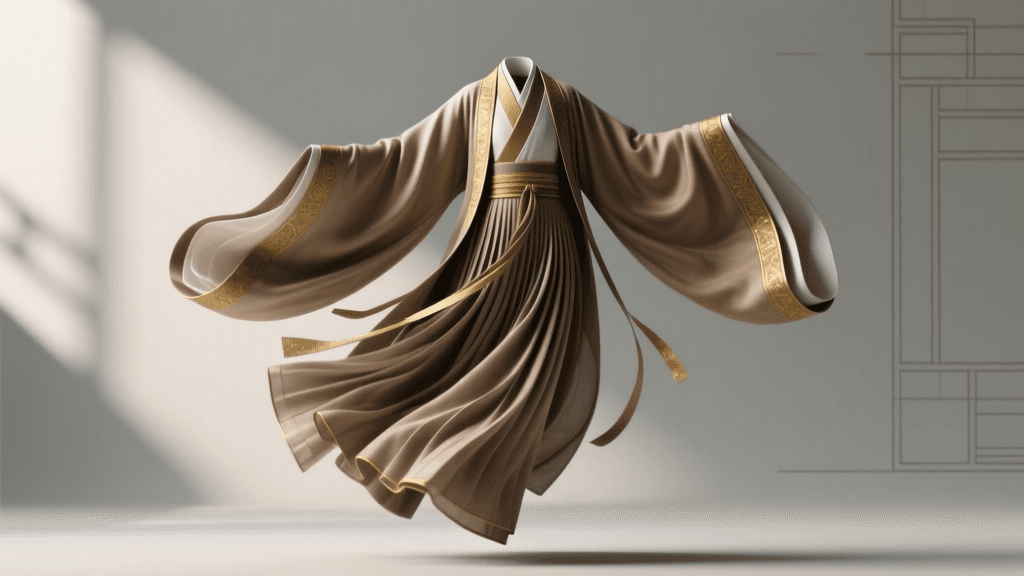
To understand the practical application of these methodologies, we must examine the reconstruction of the iconic Ming Dynasty Aoqun (袄裙), a two-piece ensemble consisting of a lined jacket (ao) and a pleated skirt (qun). The following steps outline the standard academic protocol for digital reconstruction in 2026.
Step 1: Sourcing Historical Measurements and Artifacts
The foundation of any academic reconstruction is empirical data. Researchers begin by gathering surviving garments, tomb inventories, and historical portraiture. For primary historical data, institutions rely on open-access repositories like the Metropolitan Museum of Art's Asian Art Department, which provides high-resolution imagery and dimensional data of surviving Ming-era textiles. Students learn to extract critical measurements, such as the exact width of historical loom outputs (typically around 60 to 70 centimeters for Ming silk looms), which directly dictates the placement of seams and the geometry of the pattern pieces.
Step 2: Digital Material Calibration
Once the 2D patterns are drafted based on historical loom widths, the digital materials must be calibrated. A modern lightweight silk chiffon will drape entirely differently than a historical Zhangzhou velvet or a heavily starched ramie. Researchers use Kawabata Evaluation System (KES) data to input precise physical values into the 3D software. This includes setting the bending stiffness (which determines how sharply the fabric folds at the pleats) and the shear resistance (which dictates how the fabric warps when pulled diagonally). In 2026, university labs maintain extensive digital libraries of KES-tested historical textile equivalents, allowing students to apply a 'Ming Silk Damask' material preset with a single click.
Step 3: Virtual Stitching and Gravity Simulation
The most complex element of the Aoqun is the Mamianqun (horse-face skirt). This skirt features flat, unpleated front and back panels with heavily pleated sides. In the 3D environment, students must virtually stitch the overlapping panels and apply historical pleating techniques, such as the use of internal stabilizing threads or starching. When the gravity simulation is activated, the software calculates how the heavy silk folds stack upon one another. If the digital fabric is too light, the pleats will splay out inaccurately; if the shear stiffness is too high, the skirt will look like rigid cardboard. Achieving the perfect historical drape requires iterative testing, mirroring the physical prototyping process of a master tailor.
Essential Tools and Resources for 2026 Researchers
Beyond software, the physical hardware present in a 2026 fashion history lab is crucial for bridging the gap between the physical artifact and the digital twin. Modern academic research requires a suite of specialized scanning and analysis tools:
- Handheld 3D Scanners (e.g., Artec Leo): Used to capture the exact topography and surface wear of surviving garments without requiring physical contact, preserving fragile historical fibers while generating precise 3D meshes for digital archiving.
- Spectrophotometers: Utilized to analyze the faded dyes of excavated textiles. By measuring the exact light absorption of degraded fibers, researchers can digitally restore the vibrant original colors of Ming Dynasty garments in their 3D simulations.
- Digital Microscopes with AI Weave Analysis: These tools scan the warp and weft density of historical fabrics, automatically generating the complex normal and displacement maps required to render realistic textile textures in the 3D environment.
Furthermore, academic collaboration has become increasingly global. Virtual reality (VR) review sessions allow historians in Beijing, textile conservators in London, and fashion students in New York to stand around a virtual mannequin wearing a digitally reconstructed Ming garment, examining the drape and stitch work in real-time from thousands of miles away.
The Future of Digital Heritage in Asian Traditions
The integration of 3D fabric drape analysis into Chinese fashion history education represents a monumental leap forward for the preservation of Asian traditions. By treating historical garments not merely as static objects of art, but as dynamic, engineered structures, researchers in 2026 are uncovering lost tailoring techniques and gaining a profound respect for the artisans of the past. As the Xin Zhongshi movement continues to influence global fashion, the rigorous academic frameworks established in these university labs ensure that the commercialization of traditional Chinese clothing remains anchored in deep, verifiable historical truth. For students and scholars alike, mastering these digital tools is no longer optional; it is the essential key to unlocking the sartorial secrets of the Silk Road and the imperial courts of Asia.