Ming Dynasty Hanfu: Decoding Official Rank Badges & Colors
The Sartorial Hierarchy of the Ming Dynasty
When the Ming Dynasty (1368–1644) overthrew the Mongol-led Yuan Dynasty, the founding Hongwu Emperor sought to restore traditional Han Chinese cultural identity. A critical component of this cultural renaissance was the implementation of a highly structured, deeply symbolic sartorial system. Clothing was no longer merely a matter of personal expression or regional climate adaptation; it became a rigid, state-enforced visual language. Through the meticulous use of color codes, exclusive textile patterns, and the famous buzi (rank badges), the Ming government ensured that a citizen's exact social status, political rank, and military authority were instantly recognizable from a distance.
For modern enthusiasts, historians, and Hanfu revivalists, understanding these codes is essential. It transforms the act of wearing traditional garments from simple cosplay into a profound engagement with historical semiotics. According to the Metropolitan Museum of Art's Heilbrunn Timeline of Art History, the Ming era represented an unprecedented refinement in silk weaving and textile regulation, where the loom was as much a tool of statecraft as it was of artistry.
The Language of Color: Strict Sumptuary Laws
In Ming Dynasty China, color was heavily regulated by sumptuary laws. The dyeing process was expensive, and certain pigments—like those required for bright scarlets or deep imperial yellows—were tightly controlled by the state. Wearing a color above your designated rank was not just a fashion faux pas; it was considered an act of treasonous insubordination.
The Encyclopedia Britannica's comprehensive guide to Chinese Dress notes that these color restrictions were designed to maintain cosmic and social harmony, aligning human hierarchy with the Five Elements (Wu Xing) theory.
| Social Strata | Official Color | Symbolic Meaning & Restrictions |
|---|---|---|
| Emperor & Crown Prince | Bright Yellow (Ming Huang) | Exclusive to the imperial family. Symbolizes the center of the universe, the earth element, and absolute authority. |
| Ranks 1 to 4 (High Officials) | Scarlet / Vermillion (Hong) | Represents fire, prosperity, and high imperial favor. Strictly forbidden for lower ranks and commoners. |
| Ranks 5 to 7 (Mid Officials) | Cyan / Blue-Green (Qing) | Associated with wood, growth, and scholarly virtue. Standard attire for mid-level court assemblies. |
| Ranks 8 to 9 (Low Officials) | Green / Dark Blue (Lv / Lan) | Represents foundational administrative duties. Often crafted from lower-grade silk or cotton blends. |
| Commoners & Merchants | White, Undyed, or Pale Pastels | Sumptuary laws explicitly banned commoners from wearing bright reds, yellows, or deep purples to prevent class blurring. |
Imperial Gifts: Mang, Feiyu, and Douniu Robes
Before addressing the standard rank badges, it is crucial to understand the special imperial赐服 (granted robes). The Emperor frequently bestowed highly exclusive garments upon favored officials, military generals, and foreign dignitaries. These included the Mang (python) robe, featuring a four-clawed dragon; the Feiyu (flying fish) robe, depicting a mythical creature with a dragon's head and fish's tail; and the Douniu (bullfight) robe. These garments were woven with metallic gold threads and ranked just below the Emperor's five-clawed Long (dragon) robe in prestige. Wearing a granted Feiyu robe was a visible testament to direct imperial favor, often carrying more immediate social weight than one's official bureaucratic rank.
Buzi (Rank Badges): Wearing Your Status on Your Chest
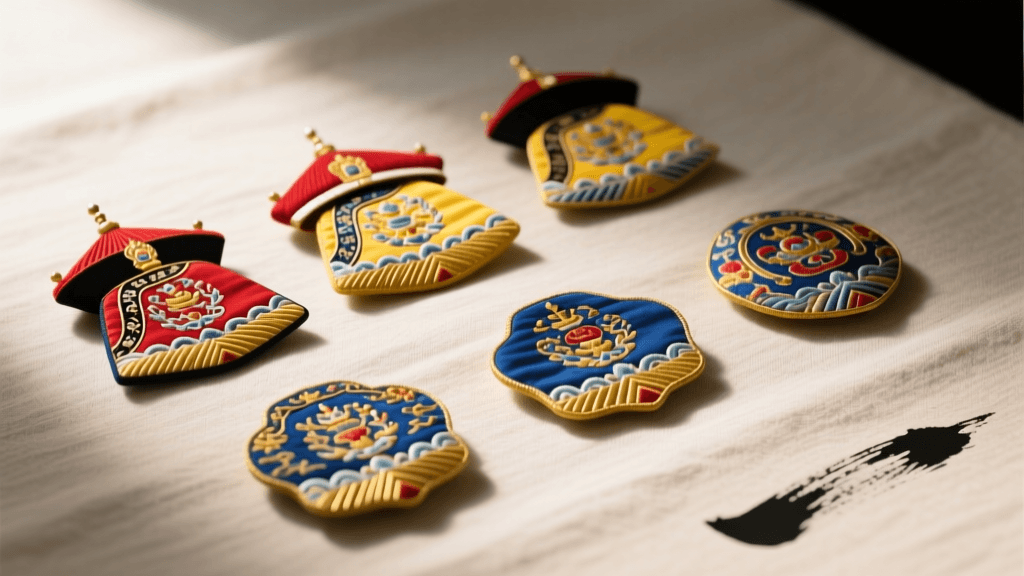
Introduced formally in 1391, the buzi (rank badge) was a square or slightly rectangular piece of embroidered or woven fabric attached to the front and back of an official's round-collared robe (Yuanlingpao) or formal jacket. Unlike the Qing Dynasty badges which were often appliquéd onto the garment later, Ming badges were frequently woven directly into the fabric of the robe itself, requiring immense foresight and loom programming.
Civil vs. Military Motifs
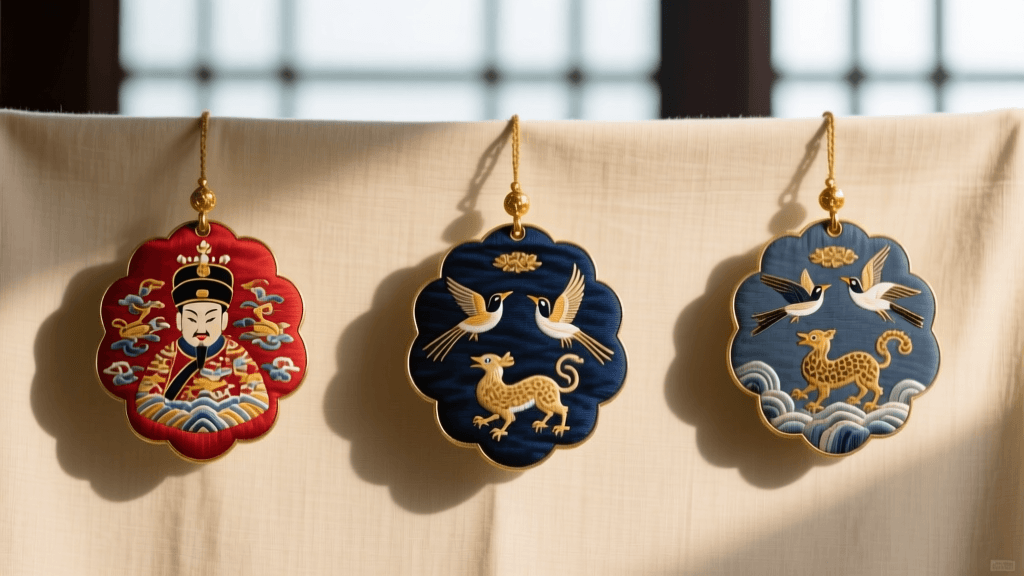
The symbolism of the badges was rooted in the traditional Chinese dichotomy of civil (wen) and military (wu) prowess. Civil officials were represented by birds, symbolizing elegance, literary grace, and the heavens. Military officials were represented by beasts, symbolizing strength, courage, and the earth.
| Rank | Civil Official (Bird Motif) | Military Official (Beast Motif) |
|---|---|---|
| Rank 1 | Crane (Xianhe) | Qilin (Mythical Chimera) |
| Rank 2 | Golden Pheasant (Jinji) | Lion (Shi) |
| Rank 3 | Silver Pheasant (Yinji) | Leopard (Bao) |
| Rank 4 | Cloud Goose (Yunyan) | Tiger (Hu) |
| Rank 5 | Silver Pheasant / Egret | Bear (Xiong) |
| Rank 6 | Egret (Silu) | Panther (Biao) |
| Rank 7 | Mandarin Duck (Xichi) | Rhinoceros (Xi) |
| Rank 8 | Quail (Anchun) | Rhinoceros (Xi) |
| Rank 9 | Paradise Flycatcher (Lianshou) | Sea Horse (Haima) |
Dimensions, Craftsmanship, and Kesi Tapestry
Authentic Ming Dynasty buzi typically measured between 35cm and 40cm square. The most prestigious badges were created using the Kesi (cut silk) tapestry technique. Kesi weaving is incredibly labor-intensive; the weft threads are woven only where the specific color is needed, creating a carved, three-dimensional effect with tiny slits between color blocks. A single high-ranking Kesi badge could take a master artisan several months to complete, utilizing peacock feather threads and spun gold.
Women's Hanfu and the Reflection of Status
While women did not hold bureaucratic office and therefore did not wear the square buzi badges, their clothing was still deeply tied to the rank and color code system. A woman's formal attire, particularly her Fengguan Xiapei (phoenix crown and cloud scarf), reflected the rank of her husband or son. High-ranking noblewomen were permitted to wear deeper shades of crimson and blue, and their Xiapei (embroidered stoles) featured specific motifs like dragons or phoenixes depending on their exact court title. Commoner women, even on their wedding day, were technically restricted from true imperial motifs, though the Ming era saw a rise in the 'borrowing' of noble attire for brides, a tradition that echoes in modern Chinese wedding wear.
Modern Revival: Sourcing and Wearing Ming-Style Hanfu Today
For contemporary Hanfu enthusiasts looking to accurately recreate or wear Ming Dynasty styles, understanding these historical codes is vital for making informed purchasing and tailoring decisions. The modern Hanfu market offers a wide spectrum of reproductions, from budget-friendly machine-embroidered sets to museum-grade hand-woven replicas.
Garment Specifications and Measurements
If you are commissioning a custom Ming-style Aoqun (a lined jacket paired with a pleated skirt) or a formal Yuanlingpao (round-collar robe) with a badge, precise measurements are key to historical accuracy:
- Standing Collar (Li Ling): The iconic Ming standing collar should measure exactly 4cm to 6cm in height, sitting snugly against the neck without choking, fastened by metal or jade toggle buttons.
- Sleeve Width: Formal Ming sleeves (Pipa sleeves) are voluminous. The cuff opening should be narrow (around 15-20cm), but the sleeve body should billow out to a width of 40cm to 60cm at the elbow to accommodate the draping of the fabric.
- Mamian Skirt (Horse-Face Skirt): For an authentic drape, the flat front and back panels (the 'horse faces') should be 25-30cm wide. The side pleats should be sharp and deep, typically measuring 3cm to 5cm per fold. The waistband should be a sturdy 8-10cm wide cotton or linen blend to grip the torso securely.
- Buzi Placement: If adding a rank badge to a modern robe, ensure it is centered precisely on the chest and upper back, measuring no larger than 38cm x 38cm to maintain proportional harmony with the garment's seams.
Cost Breakdown and Sourcing Timeline
When budgeting for Ming-style garments featuring rank badges or auspicious motifs, expect the following market rates and timelines:
- Machine-Embroidered Aoqun Sets: Priced between $80 and $180 USD. These utilize computerized embroidery for the motifs. They are excellent for daily wear, photography, and casual cultural events. Production and shipping from specialized Chinese ateliers typically take 2 to 4 weeks.
- Jacquard Woven Silk Robes: Priced between $250 and $500 USD. The motifs are woven directly into the silk damask fabric using modern jacquard looms, mimicking the historical integration of the pattern into the textile. Expect a 4 to 6 week lead time.
- Hand-Woven Kesi Tapestry Badges: Priced from $800 to over $3,000 USD. These are commissioned from heritage artisans in Suzhou. Because Kesi is woven by hand using raw silk and sometimes metallic threads, a single badge can take 3 to 6 months to complete. This is an investment piece meant for serious collectors or high-end ceremonial wear.
Conclusion
The clothing of the Ming Dynasty was a masterpiece of semiotic engineering. Every thread, hue, and woven beast served a distinct purpose in maintaining the social fabric of the empire. By studying the strict color codes and the intricate symbolism of the buzi rank badges, we gain a profound appreciation for the intellectual and artistic rigor of traditional Chinese textile arts. Whether you are a historian analyzing museum artifacts or a modern enthusiast commissioning a bespoke Mamian skirt, respecting these ancient codes ensures that the legacy of Ming Dynasty Hanfu continues to be worn with accuracy, dignity, and deep cultural reverence.