Decoding Imperial Chinese Rank Badges and Color Codes
The Visual Hierarchy of Imperial China
For over two millennia, traditional Chinese clothing served as far more than mere protection from the elements; it was a highly regulated, wearable database of social standing, political power, and cosmic alignment. Nowhere was this more evident than in the strict sumptuary laws governing the Ming (1368–1644) and Qing (1644–1911) dynasties. In these eras, a single glance at an official's attire could reveal their exact rank, their branch of government, and their proximity to the Emperor. According to the Metropolitan Museum of Art's Heilbrunn Timeline of Art History, the Ming dynasty formalized these visual codes to restore Han Chinese cultural dominance, which the subsequent Manchu-led Qing dynasty later adapted and expanded into one of the most complex sartorial systems in human history.
Sumptuary Laws: The Language of Color
Color in imperial China was not a matter of personal preference; it was a matter of law, deeply rooted in the philosophical concepts of Yin and Yang and the Five Elements (Wu Xing). The Emperor, as the Son of Heaven, claimed exclusive rights to specific hues that represented the center of the universe.
Imperial Yellows and the Forbidden Hues
During the Qing dynasty, the color code was rigidly enforced. 'Ming Yellow' (a bright, luminous lemon-yellow) was strictly reserved for the Emperor's dragon robes (longpao). The Crown Prince was permitted 'Apricot Yellow', while other high-ranking imperial family members were restricted to 'Golden Yellow'. Any commoner or lower official caught wearing these shades faced severe punishment, often including execution. As noted by the Victoria and Albert Museum (V&A) Asian Collections, the dyeing process for these imperial yellows utilized the flowers of the pagoda tree (Sophora japonica), requiring immense labor and resources to achieve the colorfast brilliance demanded by the court.
Officialdom: Reds, Blues, and Blacks
Below the imperial family, color denoted the broad strokes of an official's status. High-ranking civil and military officials often wore deep reds or rich purples, colors that historically signified nobility and high favor. Mid-level officials were assigned shades of blue and green, while lower-ranking bureaucrats and local magistrates frequently wore black or dark brown surcoats. Commoners, merchants, and peasants were legally restricted to undyed hemp, rough cotton, or muted earth tones, ensuring that the social hierarchy was visible from the palace gates to the furthest provincial villages.
Mandarin Squares (Buzi): Wearable Resumes
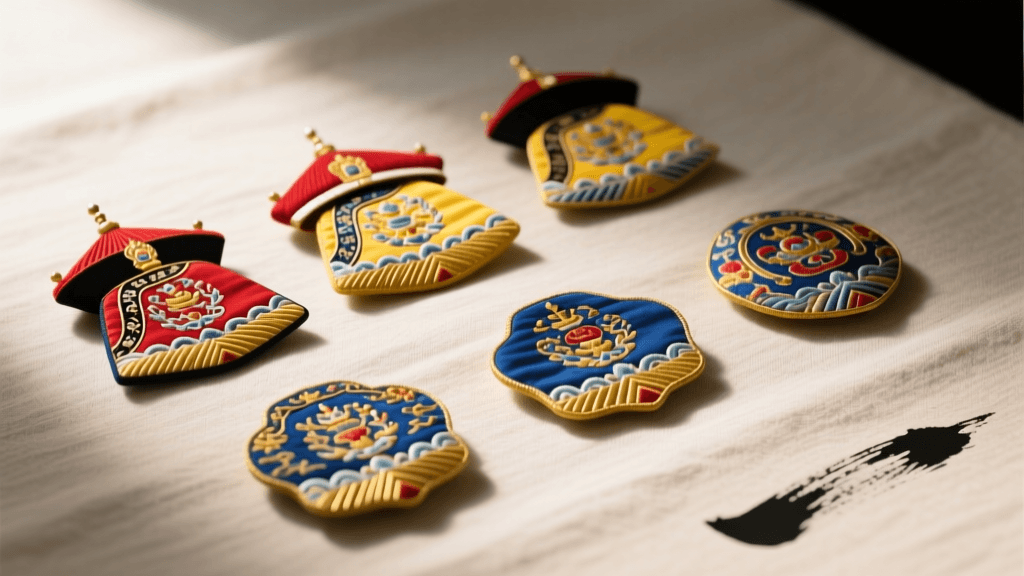
While color indicated broad status, the exact rank of an official was communicated through the buzi, commonly known in the West as 'Mandarin Squares'. First introduced by the Hongwu Emperor in 1391 during the Ming dynasty, these intricately embroidered badges were sewn onto the front and back of the official's surcoat (bufu). The Metropolitan Museum of Art's Qing Dynasty archives highlight how the Qing adapted these squares, adding a distinctive black border and a red sun motif to differentiate them from their Ming predecessors.
The symbolism of the buzi was deeply poetic. Civil officials were represented by birds, symbolizing elegance, literary refinement, and the Confucian ideal of the scholar-gentleman. Military officials were represented by beasts, symbolizing courage, strength, and martial prowess. Crucially, the animal or bird on the badge was always depicted looking toward or reaching for a red sun, symbolizing the official's unwavering loyalty to the Emperor, the 'Sun' of the empire.
Qing Dynasty Rank Chart: Civil and Military
Below is the definitive guide to the nine ranks of the Qing dynasty civil and military hierarchy as depicted on Mandarin squares:
| Rank | Civil Official (Bird) | Military Official (Beast) |
|---|---|---|
| 1st | Red-Crowned Crane (Xianhe) | Lion (Shi) |
| 2nd | Golden Pheasant (Jinji) | Lion (Shi) |
| 3rd | Peacock (Kongque) | Tiger (Hu) |
| 4th | Wild Goose (Yan) | Tiger (Hu) |
| 5th | Silver Pheasant (Baihan) | Bear (Xiong) |
| 6th | Egret (Sizhu) | Leopard (Bao) |
| 7th | Mandarin Duck (Xichi) | Rhinoceros (Xi) |
| 8th | Quail (Anchun) | Rhinoceros (Xi) |
| 9th | Paradise Flycatcher (Lianshou) | Sea Horse (Haima) |
'The Sea Horse of the 9th military rank was not the small marine creature we know today, but a mythical, galloping horse that could traverse the oceans, representing the farthest reaches of the Emperor's naval and border patrols.'
Embroidery Techniques: Kesi and Suzhou Silk
The creation of a buzi was a masterclass in textile engineering. The most prized squares were woven using the kesi (cut silk) tapestry technique, where weft threads are woven only where needed to create the pattern, resulting in a fabric that looks identical on both sides. More common, yet still exquisite, were squares embroidered using the Suzhou tradition, featuring the 'Peking knot' (seed stitch) for dense, textured backgrounds, and gold couching, where gold-wrapped threads were laid on the surface and stitched down with fine silk. The use of real gold and silver threads meant that these garments were not just symbolic; they were literal repositories of wealth.
Collector's Guide: Authenticating and Pricing Buzi Today
For modern collectors, museum curators, and enthusiasts of Asian textile history, acquiring an authentic Mandarin square is a thrilling pursuit. However, the market is flooded with 20th-century theatrical replicas and modern tourist-trade copies. Here is actionable advice for identifying, valuing, and conserving these historical artifacts.
Measurements and Material Analysis
When evaluating a buzi, start with the tape measure. Authentic Qing dynasty Mandarin squares almost universally measure exactly 11 x 11 inches (approx. 28 x 28 cm). Ming dynasty squares, which are exceedingly rare, were often larger, borderless, and integrated directly into the robe's weaving. If the piece you are examining measures 8 x 8 inches or features a zipper, it is a modern theatrical costume piece.
- The Backing: Authentic 19th-century squares were often backed with coarse hemp or rough cotton to provide structural rigidity against the heavy silk and metallic threads. Modern replicas frequently use cheap polyester or synthetic felt.
- The Dyes: Examine the colors under UV light or a magnifying loupe. Pre-1880s squares utilized natural dyes (indigo, safflower, pagoda tree). The introduction of synthetic aniline dyes in the late 19th century resulted in harsher, more vibrant purples and magentas that tend to fade unevenly compared to organic dyes.
- Metallic Threads: Authentic gold couching utilized strips of gold leaf applied to animal intestine or paper, wrapped around a silk core. Replicas use synthetic metallic yarns that lack the subtle, warm luster of real gold leaf.
Market Pricing and Valuation
The cost of acquiring an authentic rank badge varies wildly based on rank, condition, and technique. Because civil officials vastly outnumbered military officials in the Qing bureaucracy, civil badges (especially the 4th through 8th ranks) are more common.
- Common Authentic Squares (6th-9th Civil Ranks): Expect to pay between $300 and $800 at reputable auction houses for pieces in good condition with minor fading.
- High-Rank and Kesi Squares (1st-3rd Civil Ranks): Red-crowned cranes and peacocks, especially those woven in kesi or featuring heavy gold couching, routinely fetch $1,500 to $4,500.
- Imperial Badges: Dragon badges (worn by the Emperor and immediate royal family) are exceptionally rare and can command upwards of $15,000 to $50,000 depending on provenance.
- Modern Replicas: High-quality, hand-embroidered modern reproductions from Suzhou cost between $150 and $400. These are excellent for display or theatrical use but hold no historical investment value.
Conservation and Display
If you are fortunate enough to acquire an authentic 19th-century buzi, proper conservation is non-negotiable. Silk is highly susceptible to photo-degradation and acid burns. Never frame a silk textile using standard glass or acidic matting boards. Instead, invest in UV-filtering Optium Museum Acrylic, which is anti-static and prevents the delicate gold threads from pulling away from the fabric. Mount the square using a hand-stitched, tension-free support on an acid-free, lignin-free cotton rag board. Keep the framed piece in a climate-controlled environment with a relative humidity of 50% and away from direct sunlight to ensure the survival of these magnificent codes of imperial power for generations to come.