Ming Dynasty Hanfu: Decoding Rank Colors and Buzi Motifs
The Wearable Resume: Ming Dynasty Sumptuary Laws
When the Hongwu Emperor established the Ming Dynasty in 1368, one of his primary objectives was to eradicate the sartorial influences of the preceding Mongol-led Yuan Dynasty and restore traditional Han Chinese identity. This cultural reset resulted in some of the most rigorous and meticulously documented sumptuary laws in Chinese history. In the Ming court, clothing was never merely a matter of aesthetic preference; it was a highly regulated, wearable resume. Every thread, color, and motif on an official's Hanfu was dictated by the state, serving as an immediate visual indicator of the wearer's rank, department, and proximity to the Emperor. For modern Hanfu enthusiasts, collectors, and historical reenactors, understanding these codes is essential for accurately recreating or appreciating Ming-style traditional garments.
Decoding the Color Hierarchy of the Ming Court
Color was the first and most immediate indicator of an official's status. The Ming court strictly regulated the dyeing and wearing of specific hues, reserving the most vibrant and expensive pigments for the highest echelons of power.
- Bright Yellow (Ming Huang): Exclusively reserved for the Emperor and the imperial family. The use of yellow dragon motifs and bright yellow silk was a capital offense for anyone outside the royal bloodline.
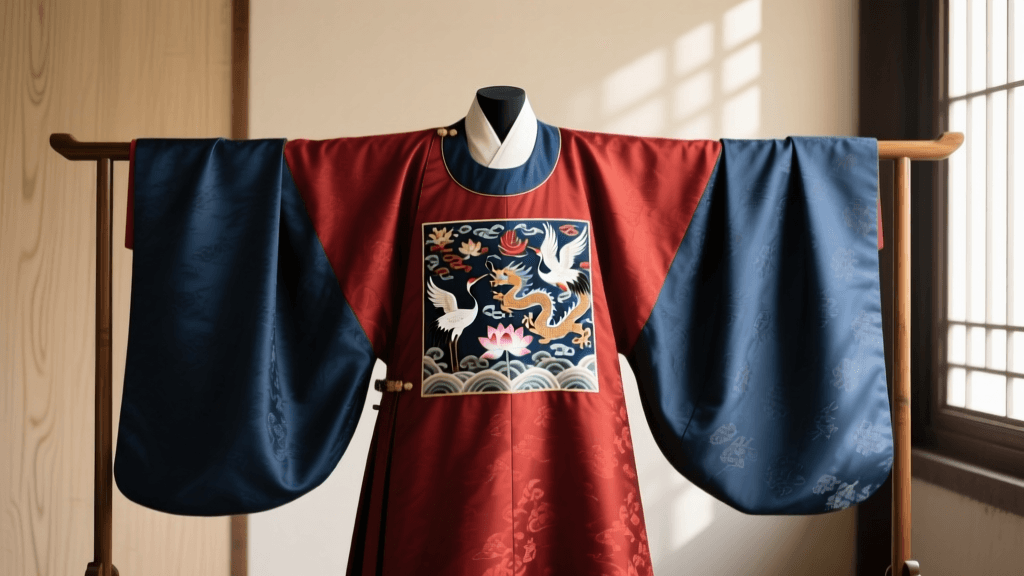
- Scarlet / Vermilion (Fei Se): Worn by high-ranking officials from the 1st to the 4th ranks. Achieving a true, colorfast scarlet required expensive safflower and madder root dyes, making it a luxury that visually reinforced the authority of top ministers and generals.
- Cyan / Deep Blue (Qing Se): Designated for mid-level officials of the 5th to 7th ranks. This color represented stability, scholarship, and the bureaucratic backbone of the empire.
- Green (Lv Se): Assigned to lower-tier officials of the 8th and 9th ranks, often local magistrates or junior clerks entering the civil service.
While these laws were strictly enforced in the early Ming period, the late Ming era saw a boom in commercial wealth. Wealthy merchants and their families frequently flouted these sumptuary laws, wearing forbidden colors and luxurious silks, a phenomenon that historians often cite as evidence of the era's shifting social dynamics.
Buzi (Mandarin Squares): Animals of Authority
While color indicated broad rank brackets, the exact rank of an official was displayed via the Buzi (补子), commonly known in the West as Mandarin Squares. These intricately woven or embroidered badges were affixed to the chest and back of the official's outer robe (Bu Fu). According to Britannica, the Ming Dynasty formalized the Buzi system, using birds for civil officials to symbolize literary grace and elegance, and beasts for military officials to represent courage and martial prowess.
The Complete Ming Dynasty Buzi Rank Chart
| Rank | Civil Official (Bird Motif) | Military Official (Beast Motif) | Symbolic Meaning |
|---|---|---|---|
| 1st | Crane (仙鹤) | Lion (狮子) | Longevity, purity, and supreme authority. |
| 2nd | Golden Pheasant (锦鸡) | Lion (狮子) | Cultural refinement and bravery. |
| 3rd | Peacock (孔雀) | Tiger (虎) | Beauty, dignity, and fierce protection. |
| 4th | Cloud Goose (云雁) | Tiger (虎) | Loyalty, teamwork, and martial strength. |
| 5th | Silver Pheasant (白鹇) | Bear (熊) | Integrity, calmness, and raw power. |
| 6th | Egret (鹭鸶) | Panther (豹) | Purity, patience, and agility. |
| 7th | Mandarin Duck (鸂鶒) | Panther (豹) | Fidelity, harmony, and strategic cunning. |
| 8th | Quail (鹌鹑) | Rhinoceros (犀牛) | Peace, humility, and impenetrable defense. |
| 9th | Paradise Flycatcher (练鹊) | Sea Horse (海马) | Vigilance, good tidings, and naval/maritime prowess. |
Modern Collector's Guide: Sourcing Ming-Style Hanfu
The modern Hanfu revival movement has seen an explosion of interest in Ming Dynasty garments, particularly the Daopao (道袍 - a formal, pleated robe with side slits and inner flaps) and the Mamianqun (马面裙 - horse-face skirt). For those looking to purchase authentic, historically informed Ming-style Hanfu, understanding fabric types and market pricing is crucial.
Fabrics and Price Tiers
- Entry-Level / Mass Market ($80 - $180): Brands like Shisanyu offer machine-embroidered Buzi and polyester-blend damasks. These are excellent for casual wear, photography, and beginners. The drape is heavier, and the motifs are standardized.
- Mid-Tier / Boutique ($300 - $800): Specialized ateliers like Ming Huatang or Tingyue use genuine silk brocades, including Song Brocade (宋锦) and Zhuanghua (妆花 - a complex tapestry-like weaving technique). The Buzi motifs are historically accurate, often replicated directly from museum artifacts.
- Museum-Grade / Custom ($1,500 - $5,000+): For serious collectors, custom commissions using authentic Nanjing Yunjin (Cloud Brocade) are the pinnacle of Ming sartorial arts. As noted by The Metropolitan Museum of Art, Ming textile arts represent a zenith of Chinese weaving technology. Yunjin requires specialized looms and two weavers working in tandem, making it incredibly expensive and highly prized.
Tailoring, Measurements, and the Perfect Fit
Unlike modern Western tailoring, which focuses on the contour of the body, traditional Ming Hanfu relies on flat cutting and fabric drape. When ordering a custom Daopao or Yesa (a pleated robe with flying fish motifs, often bestowed as an imperial favor), you must understand specific traditional measurements.
'The elegance of Ming Hanfu lies not in how tightly it hugs the form, but in the sweeping geometry of the sleeves and the dignified volume of the pleats.' — Historical Textile Conservator
Crucial Measurements for Buyers
- Tongxiu (通袖长 - Total Sleeve Span): This is the measurement from fingertip to fingertip with arms outstretched. For formal Ming robes, the Tongxiu should be significantly longer than your actual arm span, typically ranging from 220cm to 250cm. This creates the iconic, pooling sleeve effect.
- Huiwan (回腕 - Returning Wrist): A specific sleeve style where the excess fabric is designed to fold back over the hands, resting exactly at the wrist when the arms are relaxed. Ensure your tailor understands if you want standard Tongxiu or Huiwan proportions.
- Collar Alignment: A non-negotiable rule in Hanfu is Jiaoling Youren (交领右衽) — the left side of the collar must always cross over the right side. The right-over-left configuration is strictly reserved for the deceased in traditional Chinese culture.
Caring for Brocade and Silk
Ming-style garments, particularly those woven with metallic threads or delicate silks, require specialized care to maintain their structural integrity and vibrant colors.
- Avoid Water Washing: Never submerge Zhuanghua or Yunjin brocades in water. The metallic threads (often made of gilt paper or silver wire wrapped around a silk core) will tarnish, and the water will cause the silk warp threads to shrink unevenly, destroying the weave.
- Spot Cleaning and Airing: Use a soft, dry brush to remove dust. For stains, consult a professional textile conservator. After wearing, hang the garment in a shaded, well-ventilated area to allow natural body oils and moisture to dissipate.
- Storage: Store heavy robes flat or rolled on acid-free tissue paper to prevent shoulder creasing and stress on the woven Buzi patches. Never hang heavy silk brocades on wire hangers, as the weight of the fabric will distort the warp threads over time.
Conclusion
The clothing of the Ming Dynasty is a masterclass in visual communication. Through a strict adherence to color codes and the intricate symbolism of the Buzi, the empire maintained a visible hierarchy that blended political power with profound cultural symbolism. Today, as the Hanfu movement continues to grow globally, as documented by Smithsonian Magazine, modern wearers are not just putting on historical costumes; they are reviving a deeply symbolic art form. Whether you are investing in a custom-woven Cloud Brocade robe or carefully selecting a mass-market replica for a cultural festival, understanding the rank, color, and motifs of the Ming era elevates the experience from mere fashion to a profound engagement with Asian heritage.