Decoding Ming Dynasty Hanfu Rank Badges and Colors
Introduction to Ming Dynasty Sartorial Hierarchy
In the rich tapestry of Asian traditional garments, few systems are as rigorously codified and visually striking as the Ming Dynasty (1368–1644) Hanfu court dress codes. Following the expulsion of the Mongol-led Yuan Dynasty, the Hongwu Emperor sought to restore Han Chinese cultural dominance. A critical component of this cultural renaissance was the establishment of strict sumptuary laws that dictated exactly what colors, fabrics, and motifs a person could wear based on their social and bureaucratic rank. Clothing was no longer merely functional or aesthetic; it was a wearable legal document, a visual resume of one's status, and a profound expression of cosmic order.
For modern collectors, historians, and Hanfu re-enactors, understanding the symbolism, rank badges (buzi), and color codes of the Ming era is essential. It provides a window into a society where a misplaced stitch or an unauthorized dye could result in severe punishment. This guide decodes the intricate language of Ming official dress, offering actionable insights for identifying, collecting, and accurately reproducing these magnificent textiles.
The Language of Color: Ming Court Dress Codes
Color in Ming Dynasty Hanfu was heavily regulated by the state. The imperial monopoly on specific dyes ensured that the visual hierarchy of the court was unmistakable from a distance. According to the Metropolitan Museum of Art's Heilbrunn Timeline of Art History, the Ming court refined the use of color to reflect Confucian ideals of harmony and strict social stratification.
- Imperial Yellow (Ming Huang): Reserved exclusively for the Emperor, the Empress, and the Crown Prince. This vibrant, saffron-like yellow was derived from the pagoda tree bud and symbolized the center of the universe and the earth element in Chinese cosmology.
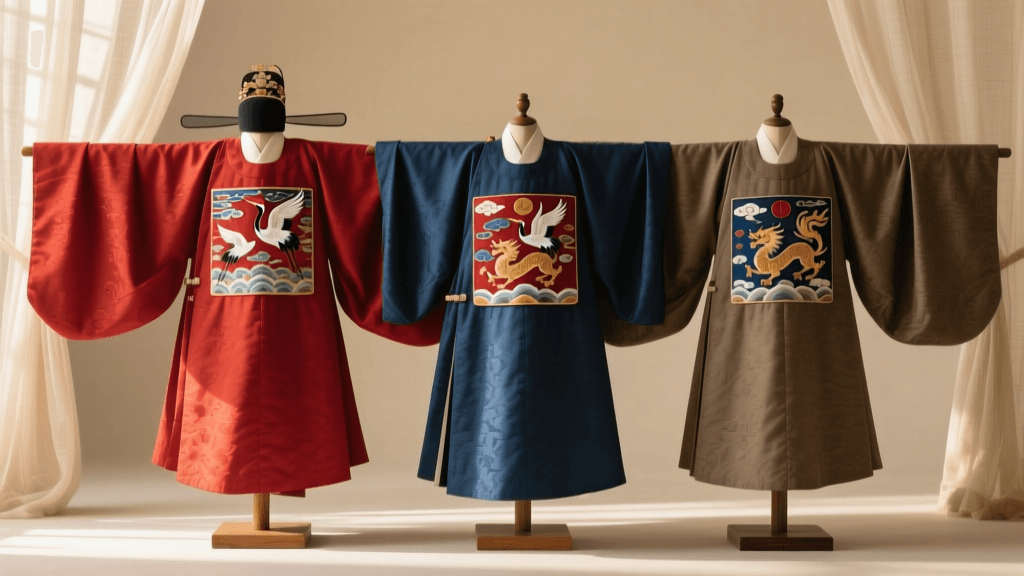
- Crimson and Scarlet (Da Hong): Worn by high-ranking civil and military officials (Ranks 1 to 4). Red symbolized fire, summer, and supreme yang energy, reflecting the authority and vitality of the upper echelons of government.
- Blue and Green (Qing and Lu): Designated for mid-to-lower-ranking officials (Ranks 5 to 9). These colors represented wood, spring, and growth, aligning with the administrative and scholarly duties of the lower bureaucracy.
- White and Black: Generally avoided in court settings as white was associated with mourning and the metal element, while black was often worn by commoners, scholars in mourning, or lower-level clerks.
Actionable Advice for Re-enactors: If you are commissioning a modern Hanfu reproduction for a historical event or theatrical production, avoid using Imperial Yellow unless you are portraying the Emperor. For a generic high-ranking Ming official, a deep crimson silk robe (often decorated with python or flying fish motifs, depending on imperial favor) is the most historically accurate and visually commanding choice.
Buzi: The Architecture of Rank Badges
The most iconic element of Ming official dress is the buzi, or rank badge. Instituted in 1391 by the Hongwu Emperor, these large, square patches were sewn onto the front and back of the official's round-collar robe (yuanlingpao). Unlike the later Qing Dynasty badges, which were split in half to accommodate the front-opening Manchurian coat, Ming badges were woven or embroidered as single, unbroken squares.
The imagery on the badges was deeply symbolic. Civil officials wore birds, representing elegance, literary refinement, and the heavens. Military officials wore beasts, symbolizing courage, strength, and the earth. At the center or top of the badge, the animal was almost always depicted looking up at a stylized sun, representing the Emperor as the source of all light and authority.
Table: Ming Dynasty Civil and Military Buzi Ranks
| Rank | Civil Official (Birds) | Military Official (Beasts) | Symbolic Meaning |
|---|---|---|---|
| 1st | Red-Crowned Crane | Qilin (Mythical Chimera) | Longevity, supreme virtue, and divine protection. |
| 2nd | Golden Pheasant | Lion | Regal authority, bravery, and command over the military. |
| 3rd | Peacock | Leopard | Cultural refinement, speed, and martial agility. |
| 4th | Wild Goose | Tiger | Loyalty, migration (service to the state), and raw power. |
| 5th | Silver Pheasant | Bear | Resilience, uprightness, and steadfast defense. |
| 6th | Egret | Panther | Purity, scholarly detachment, and stealth. |
| 7th | Mandarin Duck | Rhinoceros | Fidelity, marital harmony, and impenetrable armor. |
| 8th | Quail | Rhinoceros (or Sea Horse) | Peace, stability, and agricultural prosperity. |
| 9th | Paradise Flycatcher | Sea Horse (Mythical) | Swiftness, reach of the empire, and naval prowess. |
The Art of Kesi and Embroidery Techniques
The creation of a Ming Dynasty buzi was a monumental task, often requiring hundreds of hours of labor by master artisans in the imperial workshops of Suzhou and Hangzhou. The most prized badges were created using the kesi (cut silk) tapestry technique. As noted in expert textile analyses by the Encyclopaedia Britannica, kesi involves weaving colored silk weft threads only where the pattern requires them, creating tiny slits between color fields that resemble cut fabric. This technique allowed for incredibly detailed, painterly gradients that embroidery alone could not achieve.
Embroidered badges were also common, utilizing techniques like dajian (long and short stitches) to create realistic feather textures. Metallic threads were frequently incorporated, not by using solid gold wire, but by wrapping incredibly thin strips of gold foil around a silk core, giving the badges a luminous, three-dimensional quality that caught the candlelight of the imperial court.
Actionable Guide for Collectors and Re-enactors
Whether you are an antique textile collector or a Hanfu enthusiast seeking museum-quality reproductions, understanding the physical specifications and market realities of Ming buzi is crucial.
1. Identifying Authentic Ming vs. Qing Badges
Many buyers mistakenly purchase Qing Dynasty (1644–1911) badges believing them to be Ming. Use these metrics to verify provenance:
- Measurements: Ming badges are significantly larger, typically measuring between 35 cm to 40 cm square (approx. 15.5 inches). Qing badges are smaller, usually around 28 cm to 30 cm square.
- Borders: Authentic Ming badges rarely feature a woven border; the design extends to the very edge of the fabric. Qing badges almost always feature a distinct border, often of gold thread or a geometric pattern.
- Construction: Ming badges were woven as a single piece and sewn onto a closed-front robe. Qing badges were woven in two halves to accommodate the front-opening Manchurian surcoat.
2. Market Costs and Sourcing
Antique Ming Dynasty kesi badges are exceptionally rare due to the fragility of silk and the destruction of many imperial garments during dynastic transitions. When they do appear at auction houses like Sotheby's or Christie's, prices typically range from $15,000 to over $60,000 USD, depending on the condition, the rarity of the rank (1st rank cranes are most common in survival, while lower ranks are rarer due to poorer preservation conditions), and the presence of original gold thread.
For re-enactors, commissioning a modern, museum-quality reproduction is the most practical route. Expect to pay between $300 and $800 USD for a hand-embroidered or hand-woven kesi reproduction from specialized ateliers in Suzhou. Ensure the artisan uses natural mulberry silk and traditional metallic threads rather than modern synthetic lurex, which lacks the historical drape and luster.
3. Preservation and Care
If you are fortunate enough to own an antique Ming textile fragment or badge, strict conservation protocols are mandatory:
- Storage: Never hang antique silk badges. The weight of the fabric will cause the ancient silk fibers to snap. Store them flat in archival-quality, acid-free boxes lined with unbuffered tissue paper.
- Climate Control: Maintain a relative humidity (RH) of 45% to 55%. Fluctuations in humidity will cause the metallic gold-wrapped threads to expand and contract at a different rate than the silk core, leading to irreversible tearing.
- Light Exposure: Keep UV exposure below 50 lux. The organic dyes used in the Ming era, such as indigo and safflower, are highly fugitive and will fade rapidly under direct sunlight or harsh gallery lighting.
Conclusion
The rank badges and color codes of the Ming Dynasty represent a pinnacle of Asian textile artistry and bureaucratic symbolism. They transformed the human body into a canvas of statecraft, where every hue and every feathered motif communicated a precise message about power, duty, and cosmic alignment. By studying these garments through the lens of their original measurements, materials, and strict sumptuary laws, we gain a profound appreciation for the artisans who wove them and the officials who wore them. For modern enthusiasts and collectors, preserving the accuracy of these traditions ensures that the vibrant legacy of Ming Hanfu continues to educate and inspire.
'The dress of the Ming court was not merely a reflection of wealth, but a rigid architectural framework of the state itself, woven into the very silk that draped its servants.' — The Metropolitan Museum of Art, Asian Textile Collections.