Ming Dynasty Hanfu: Decoding Color Codes & Rank Symbolism
The Visual Language of Power in Ming Dynasty Hanfu
When the Hongwu Emperor established the Ming Dynasty (1368–1644) after the fall of the Mongol-led Yuan Dynasty, one of his first priorities was the restoration of traditional Han Chinese cultural identity. This cultural renaissance was most visibly codified through a rigorous, highly structured system of sartorial laws. Ming Dynasty Hanfu was not merely a matter of aesthetic preference; it was a complex visual language. Every thread, color, and motif was strictly regulated by sumptuary laws to communicate the wearer's social rank, political office, and proximity to the imperial throne.
According to The Metropolitan Museum of Art, the Ming era represented a golden age for Chinese silk weaving and textile production, allowing the imperial court to enforce these elaborate dress codes on a massive scale. For modern Hanfu enthusiasts, historians, and costume designers, understanding these historical color codes and rank symbols is essential for achieving true historical accuracy and appreciating the profound symbolism woven into the fabric of traditional Chinese clothing.
The Imperial Palette: Color Codes and Sumptuary Laws
Color in the Ming Dynasty was heavily restricted. The right to wear certain hues was a privilege granted by the state, and violating these color codes was considered an act of treason or severe social overreach. The hierarchy of color was deeply rooted in the Chinese philosophical system of the Five Elements (Wu Xing) and cosmological associations.
Imperial and High-Rank Colors
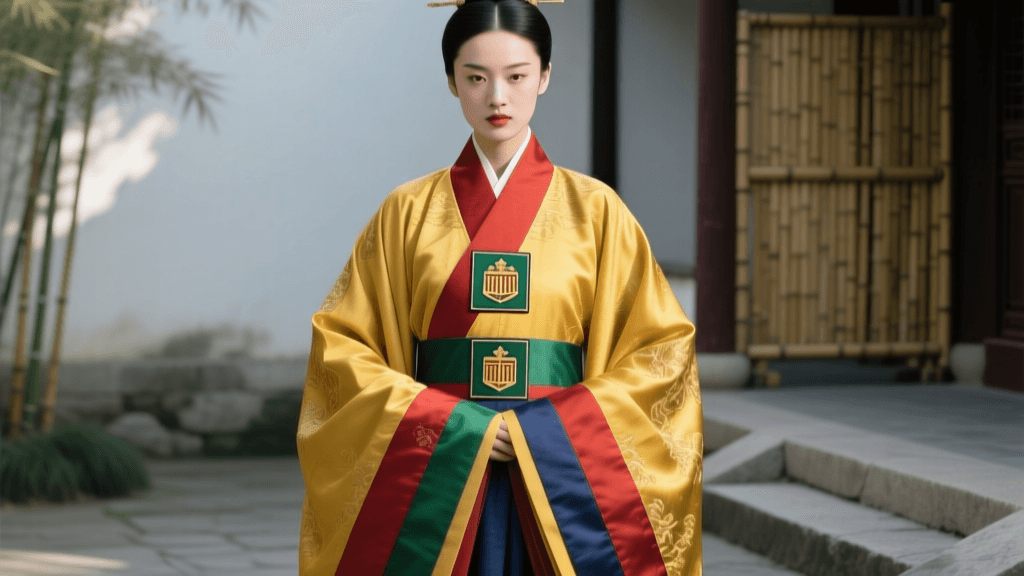
- Bright Yellow (Ming Huang): Reserved exclusively for the Emperor, the Empress, and the Empress Dowager. Yellow represented the center of the universe and the earth element. Commoners and even high-ranking officials were strictly forbidden from using this shade.
- Crimson and Scarlet (Da Hong): Worn by high-ranking civil and military officials (typically ranks 1 through 4) for court assemblies and formal state functions. Red symbolized fire, joy, and auspiciousness.
- Deep Blue and Green: Designated for mid-to-lower-ranking officials (ranks 5 through 9). These colors represented wood and water, symbolizing growth, scholarship, and administrative duty.
Restrictions on Commoners
The common populace, including wealthy merchants who could easily afford luxurious silks, were legally restricted to muted, pale, or 'impure' colors. Shades like pale pink, light green, off-white, and dull brown were acceptable. Furthermore, commoners were barred from wearing garments woven with gold thread, metallic brocades, or certain high-grade silks like zhijin (gold-woven silk).
'The dress of the common people shall not use the colors of bright yellow, willow green, or ginger brown, nor shall they use gold thread or embroidered motifs reserved for the court.'
— Excerpt from the Sumptuary Laws of the Hongwu Emperor, History of Ming (Ming Shi)
Decoding the Buzi (Mandarin Squares) by Rank
In 1391, the Ming court formalized the use of the Buzi, known in the West as 'Mandarin Squares.' These were large, intricately embroidered badges affixed to the front and back of an official's outer robe (Bufu). As noted by the Victoria and Albert Museum, these textiles were masterpieces of embroidery that allowed instant recognition of an official's exact grade and whether they served in the civil or military administration.
Civil officials were represented by birds, symbolizing elegance, literary achievement, and grace. Military officials were represented by mythical and real beasts, symbolizing courage, ferocity, and martial prowess.
| Rank | Civil Official (Birds) | Military Official (Beasts) |
|---|---|---|
| 1st Rank | Crane (Xianhe) | Qilin (Mythical Chimera) |
| 2nd Rank | Golden Pheasant (Jinji) | Lion (Shi) |
| 3rd Rank | Peacock (Kongque) | Leopard (Bao) |
| 4th Rank | Wild Goose (Yan) | Tiger (Hu) |
| 5th Rank | Silver Pheasant (Baihan) | Asiatic Black Bear (Xiong) |
| 6th Rank | Egret (Silu) | Panther (Biao) |
| 7th Rank | Mandarin Duck (Xichi) | Rhinoceros (Xi) |
| 8th Rank | Quail (Anchun) | Rhinoceros (Xi) |
| 9th Rank | Paradise Flycatcher (Lianshou) | Sea Horse (Haima - Mythical) |
Special Imperial Bestowals: Mang, Feiyu, and Douniu
Beyond the standard Buzi, the Ming Emperor occasionally bestowed special robes upon favored officials, military heroes, or allied foreign leaders. These robes featured specific, highly regulated mythical creatures that blurred the line between imperial and official dress:
- Mang (Python): A dragon-like creature with four claws (the imperial dragon had five). The Mang robe was the highest honor an official could receive.
- Feiyu (Flying Fish): A mythical creature with a dragon's head, fish's tail, and wings. Often granted to military commanders and members of the imperial secret police (the Jinyiwei).
- Douniu (Bullfight): A mythical beast resembling a horned dragon, granted to lower-tier officials who had rendered exceptional service.
Wearing these motifs without imperial authorization was punishable by severe penalties, including exile or death, highlighting the immense power clothing held in Ming society.
Actionable Guide: Sourcing and Wearing Historically Accurate Ming Hanfu Today
For modern practitioners of the Hanfu movement, historical reenactors, and cultural enthusiasts, recreating Ming Dynasty clothing requires attention to specific measurements, fabrics, and tailoring techniques. Here is a practical guide to acquiring and wearing authentic Ming-style garments.
1. Essential Garments and Measurements
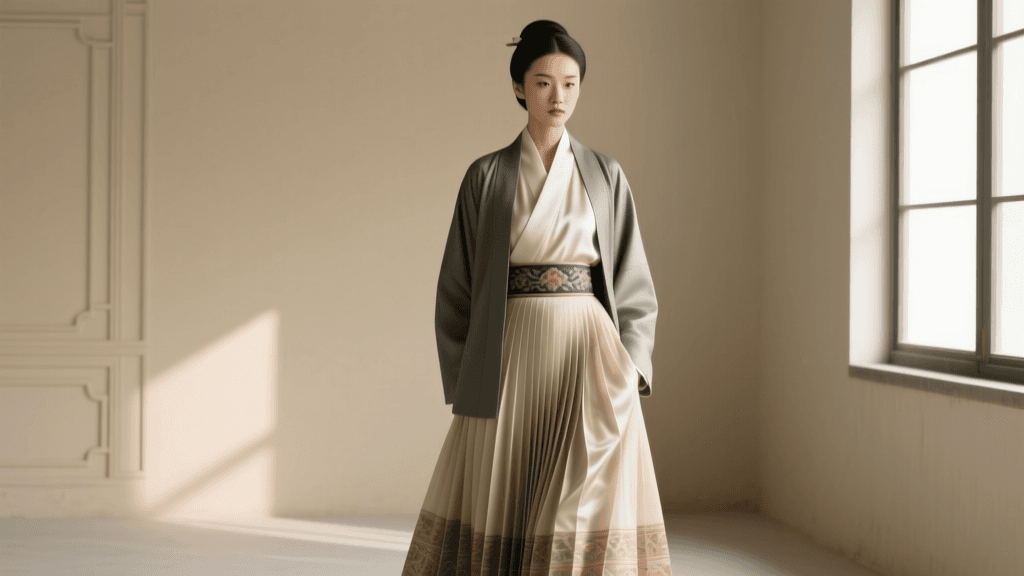
The quintessential Ming silhouette for women often pairs a Mamianqun (horse-face skirt) with a Pifeng (parallel-collar outer jacket) or an Ao (lined upper garment). For men, the Daopao (scholar's robe) or Yisan (a pleated robe with historical military roots) are prominent.
- Mamianqun Length: Historically, these skirts grazed the ankle or the top of the foot to hide the shoes. When ordering custom, measure from your natural waist to 2 cm above the floor. Standard off-the-rack lengths are usually 100 cm to 105 cm.
- Sleeve Proportions: Ming formal sleeves (Pipa sleeves) are curved and tapered at the wrist but exceptionally long. The sleeve hem should extend 10 to 15 cm past the fingertips when the arms are relaxed at the sides. This allows for the traditional 'cupping hands' greeting gesture.
- Cross-Collar Alignment: For garments with a cross-collar (Jiaoling Youren), the left side must always cross over the right side. The collar should sit snugly against the nape of the neck, with the front overlap aligning precisely with the center of the torso.
2. Sourcing, Fabrics, and Cost Considerations
The cost of Ming Hanfu varies wildly based on material authenticity and manufacturing methods. When budgeting for your wardrobe, consider the following tiers:
- Entry-Level / Off-the-Rack ($45 - $120 USD): Made from synthetic brocades, polyester blends, or basic cotton. The Buzi or woven patterns are often machine-embroidered or digitally printed. These are excellent for casual wear, photography, and beginners. Lead time is usually immediate from e-commerce platforms.
- Mid-Tier / Semi-Custom ($150 - $350 USD): Features genuine silk blends, linen-cotton mixes, and higher-quality machine embroidery. Skirts will have proper heat-set pleats that do not fall out during washing. Expect a 2 to 4-week production time if ordering from specialized Hanfu boutiques.
- Museum-Grade / Bespoke ($500 - $1,500+ USD): Utilizes 100% mulberry silk, Zhangzhou velvet, or traditional Yunjin (cloud brocade). Motifs like the Mang or Buzi are hand-embroidered using traditional silk floss and metallic gold-wrapped threads. Natural plant dyes (like indigo or safflower) may be used. Timing: Hand-embroidery of a single Mandarin square can take 4 to 8 weeks. Full bespoke orders require 2 to 4 months.
3. Dyeing and Color Accuracy for Modern Buyers
If you are commissioning a custom piece and wish to adhere strictly to historical color codes, avoid modern 'neon' or highly saturated chemical dyes. Historical Ming reds were derived from safflower and madder root, yielding a slightly deeper, more organic crimson. Ming blues were achieved through multiple dips in fermented indigo vats, resulting in rich, complex navy and azure tones. When communicating with a tailor or dyer, request 'traditional plant-dyed' (caomu ran) fabrics to achieve the correct historical luster and depth.
Conclusion
The sartorial codes of the Ming Dynasty represent one of the most sophisticated systems of visual communication in global fashion history. By understanding the strict boundaries of imperial yellow, the hierarchical language of the Buzi, and the precise tailoring of the Mamianqun and Daopao, modern wearers can do more than simply put on a beautiful garment. They can step into a living tapestry of Chinese history, wearing the profound symbolism, philosophical ideals, and artistic triumphs of a bygone era.