Ming Court Fashion: The Mamianqun Evolution and Style Guide
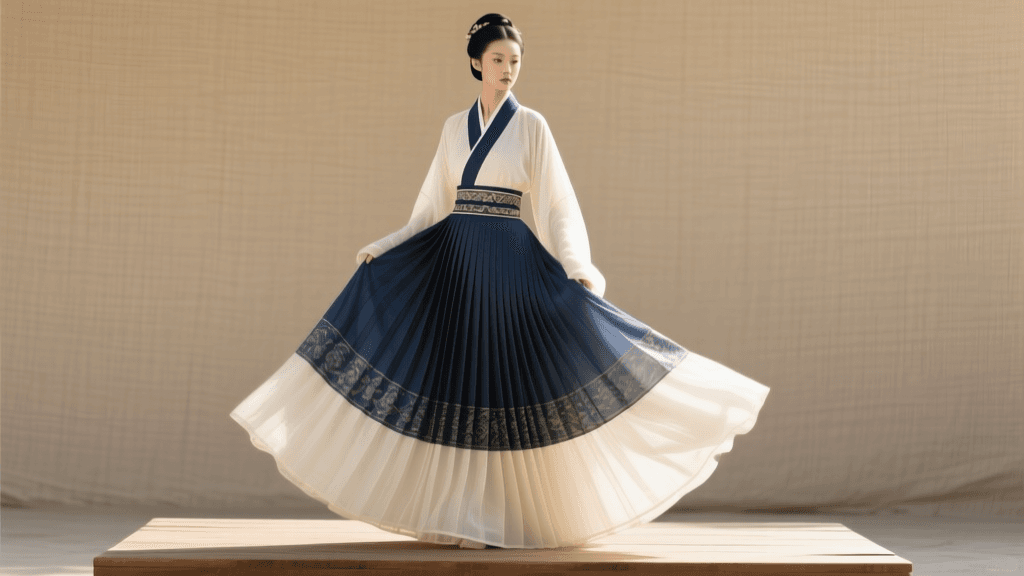
The Mamianqun (马面裙), commonly translated as the 'horse-face skirt,' is one of the most iconic garments in the history of Chinese fashion. While it has recently exploded in popularity within the modern Hanfu revival movement, its roots are deeply entrenched in the dynastic evolution of China, culminating as a staple of Ming Dynasty (1368–1644) court fashion. Understanding the Mamianqun requires a journey through nomadic practicality, imperial sumptuary laws, and exquisite textile craftsmanship.
The Origins and Dynasty Evolution of the Mamianqun
Contrary to popular belief, the Mamianqun did not originate in the Ming Dynasty. Its structural predecessors emerged during the Song (960–1279) and Liao/Jin dynasties. The design was heavily influenced by the equestrian needs of nomadic tribes from the northern steppes. The flat front and back panels allowed for modesty and ease of movement, while the deep side pleats accommodated the wide stance required for horseback riding. As BBC Travel noted in their coverage of the modern Hanfu movement, contemporary enthusiasts often look back to these cross-cultural exchanges to understand the fluidity of ancient Asian fashion.
However, it was during the Ming Dynasty that the Mamianqun transitioned from practical equestrian gear to a highly regulated symbol of courtly elegance and social hierarchy. The Ming court implemented strict sumptuary laws that dictated the colors, fabrics, and motifs permissible for different social classes. Noblewomen and court consorts wore heavily brocaded Mamianqun skirts, often paired with the Ao (a structured, long-sleeved jacket), creating the quintessential Ming silhouette that is still replicated today.
Anatomy of the Ming Court Horse-Face Skirt
To appreciate the Mamianqun, one must understand its unique architectural construction. Unlike Western gathered skirts, the Mamianqun is a wrap skirt composed of two overlapping pieces of fabric. The anatomy includes:
- Quntou (裙头): The waistband, traditionally made of white or contrasting cotton/silk, designed to be durable and grip the undergarments.
- Mamian (马面): The flat, unpleated panels at the front and back. These panels serve as the primary canvas for the skirt's most elaborate embroidery and brocade motifs.
- Zhe (褶): The deep, knife-like pleats on the left and right sides that remain hidden when standing still but fan out beautifully during movement.
- Lan (襕): Decorative borders woven or embroidered along the bottom hem and sometimes the knees, featuring auspicious motifs.
Evolution of the Mamianqun: Song vs. Ming Dynasty
| Feature | Song Dynasty (960–1279) | Ming Dynasty (1368–1644) |
|---|---|---|
| Primary Use | Practical, equestrian, everyday wear | Courtly, ceremonial, high-society fashion |
| Pleat Style | Shallow, scattered, or accordion pleats | Deep, structured, parallel knife pleats |
| Decoration | Subtle embroidery, plain woven fabrics | Heavy Zhuanghua brocade, gold thread, Lan borders |
| Waistband | Often matching the skirt fabric | Contrasting white or sturdy cotton for grip |
Court Symbolism and Textile Craftsmanship
The Ming Dynasty was a golden age for Chinese textile production, particularly in the Jiangnan region (modern-day Suzhou and Hangzhou). Court Mamianqun skirts were masterpieces of the loom, utilizing advanced techniques like Zhuanghua (妆花 - a complex brocade weaving technique using colored silk and gold threads) and Kesi (刻丝 - silk tapestry). According to The Metropolitan Museum of Art's Heilbrunn Timeline of Art History, Ming textiles were highly prized across Eurasia, showcasing an unprecedented level of technical sophistication and aesthetic refinement.
Kesi, or 'cut silk,' is a technique where the weft threads are turned back before crossing the entire width of the fabric, creating sharp, unbroken color boundaries that resemble carved paintings. A single Kesi Mamianqun could take a master artisan several months to complete, making it a prized possession in a noblewoman's trousseau.
Motifs on the flat Mamian panels were never merely decorative; they were deeply symbolic. Court women wore skirts featuring the Mang (a four-clawed python-like dragon) or phoenixes to denote imperial proximity. Commoners who could afford silk were restricted to floral and botanical motifs, such as the peony (symbolizing wealth and honor), the lotus (purity), or the plum blossom (resilience). The Lan borders often featured continuous landscapes or auspicious clouds, grounding the wearer in the cosmological order of the universe.
Practical Guide: Buying, Sizing, and Costs for Modern Wearers
As highlighted by Vogue, the modern Hanfu movement has transformed the Mamianqun from a museum artifact into a staple of contemporary street fashion and formalwear. If you are looking to purchase an authentic or historically inspired Mamianqun, precise sizing and fabric selection are crucial.
Measurements and Sizing
Unlike modern zippered skirts, the Mamianqun is a one-size-fits-most wrap garment, but the length and waist placement require careful calculation:
- Waist Measurement: Measure the exact circumference where you intend to tie the skirt. For traditional Ming styling, this is the natural waist (the narrowest part of the torso, above the navel). Add 10-15 cm to this measurement to ensure the overlapping panels provide full coverage without gaping.
- Length Measurement: Measure from your natural waist down to your ankle bone or the floor (depending on whether you will wear traditional cloud-toe shoes). Standard modern lengths range from 100 cm (ankle-grazing) to 115 cm (floor-length).
- The 'Drop' Test: Ensure the front and back Mamian panels are wide enough to cover your hips completely when standing with your feet shoulder-width apart. A standard panel width should be at least 35-40 cm.
Cost, Timing, and Fabric Guide
The price of a Mamianqun varies wildly based on the weaving technique and materials used. Seasonal timing is also vital for fabric selection. Here is a practical breakdown for modern buyers:
- Budget Tier ($30 - $60 USD): Made from polyester jacquard or synthetic blends. These are machine-washable, hold their pleats well, and are excellent for daily wear, travel, and beginners. The patterns are printed or machine-woven. Best for all-season wear.
- Mid-Tier ($70 - $150 USD): Crafted from cotton-linen blends, rayon, or basic silk blends. These offer better breathability for spring and summer wear and feature higher-quality machine brocade. Pleats may require occasional steaming to maintain their sharpness.
- High-End / Authentic ($250 - $800+ USD): Woven from 100% mulberry silk, real gold-wrapped threads, or authentic Zhuanghua brocade. These are investment pieces, often handmade or woven on traditional wooden drawlooms in Nanjing or Suzhou. Thick silk brocades and wool-blends are ideal for autumn and winter court-style events. They require professional dry cleaning and careful storage.
How to Wear and Style the Mamianqun
Tying a Mamianqun correctly is essential to maintaining its structural integrity and historical accuracy. The skirt relies entirely on tension and the friction of the waistband to stay in place.
Step-by-Step Tying Instructions
- Positioning: Hold the skirt behind you with the waistband at your natural waist. The two flat panels should be on your left and right sides initially.
- The First Wrap: Pull the right side of the skirt across your front, ensuring the flat panel is centered on your stomach. Tie the left ribbon (attached to the inner layer) to the right ribbon on your outside.
- The Second Wrap: Pull the left side across your front, overlapping the first layer. The second flat panel should now perfectly align over the first one on your stomach. Tie the remaining right ribbon to the left ribbon.
- Adjusting the Pleats: Reach down and gently fan out the side pleats so they sit flush against your hips. Ensure the back panel is centered and flat.
Modern and Traditional Pairings
For a historically accurate Ming Dynasty court look, pair the Mamianqun with a Pipa-sleeved Ao (a jacket with curved sleeves resembling a lute) or a Yuanling Shan (round-collar robe). Tuck the top into the skirt to highlight the elaborate waistband and upper pleats.
For modern, everyday styling, the Mamianqun is incredibly versatile. It pairs beautifully with a crisp white button-down shirt, a tailored blazer, or a simple silk camisole. The juxtaposition of a structured modern blouse with the flowing, pleated volume of the horse-face skirt creates a striking silhouette that bridges centuries of Asian fashion evolution. When wearing it with modern shoes, opt for pointed-toe heels or sleek ankle boots to complement the sharp lines of the side pleats.
Conclusion
The Mamianqun is far more than a beautiful garment; it is a textile archive of Chinese history. From its nomadic, equestrian origins to its elevated status in the Ming imperial court, the horse-face skirt represents the dynamic evolution of Asian traditions. Today, as a new generation reclaims and reinterprets these dynastic silhouettes, the Mamianqun continues to stride gracefully through time, proving that true court fashion is, ultimately, timeless.