Evolution of Ming Court Fashion: The Mamianqun Guide
The Evolution of Court Dress: From Song Restraint to Ming Opulence
The Ming Dynasty (1368–1644) represents a pivotal era in the history of traditional Chinese clothing, marking a deliberate and opulent return to Han Chinese cultural identity following the Mongol-led Yuan Dynasty. While the preceding Song Dynasty favored minimalist aesthetics, slender silhouettes, and subdued colors, the Ming court embraced structural grandeur, rich textiles, and rigid sartorial hierarchies. As noted by The Metropolitan Museum of Art, the Ming era was characterized by a massive resurgence in traditional Chinese arts, silk weaving, and the enforcement of strict social hierarchies that were visually codified through court dress.
For modern Hanfu enthusiasts and historians alike, understanding Ming court fashion is essential. It is the direct ancestor of many garments seen in today's Hanfu revival movement, most notably the Aoqun (jacket and skirt ensemble) and the globally recognized Mamianqun (horse-face skirt). The transition from the inner-court seclusion of earlier dynasties to the highly visible, heavily brocaded outer garments of the Ming era reflects a society obsessed with order, ritual, and the visual projection of imperial power.
Sumptuary Laws and the Textile Hierarchy
Ming court fashion was not merely about aesthetics; it was a legal instrument. The Hongwu Emperor instituted exhaustive sumptuary laws that dictated exactly which fabrics, colors, and motifs could be worn by specific ranks of officials and nobility. The most famous of these regulatory garments were the bestowed robes, featuring mythical creature motifs that denoted imperial favor and military or civil rank.
Below is a structured comparison of the elite bestowed garments that defined the upper echelons of Ming court fashion:
| Garment Name | English Translation | Authorized Wearers | Defining Motif & Features |
|---|---|---|---|
| Mangfu | Python Robe | High-ranking nobles, imperial relatives, favored ministers | Four-clawed dragon (python); often featured cloud and wave borders. |
| Feiyufu | Flying Fish Robe | Imperial guards (Jinyiwei), mid-to-high military officials | Dragon-like creature with fish tail and wings; denoted martial authority. |
| Douniufu | Dipper Bull Robe | Lower-ranking officials, bestowed for specific merits | Hornless dragon with curled snout; a step below the Flying Fish. |
| Qilinfu | Qilin Robe | Dukes, high-ranking military commanders | Chimerical beast with dragon head, deer body, and ox tail; symbolized benevolence. |
These motifs were woven directly into the silk using complex kessi (silk tapestry) or gold-thread brocade techniques, making the garments incredibly heavy, valuable, and strictly regulated.
Anatomy of the Ming Elite Ensemble: Aoqun and Mamianqun
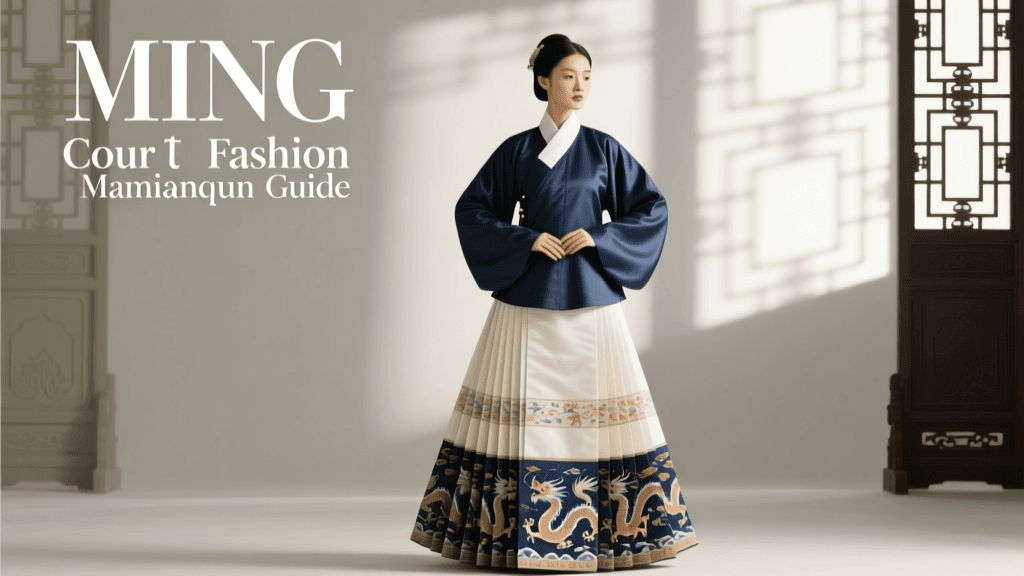
While official court robes (like the round-collar Yuanlingpao) were reserved for state affairs, the daily elite and court-adjacent fashion for women—and informal wear for men—centered on the Aoqun. This two-piece ensemble consists of the Ao (a lined, long-sleeved jacket) and the Mamianqun (horse-face skirt).
The Ao (Jacket)
Unlike the thin, unlined Shan of the Tang and Song dynasties, the Ming Ao was heavily lined and structured. It typically featured a standing collar (Liling) fastened with intricate metal or jade buttons, or a round collar (Yuanling). The sleeves were often cut in the Pipa (lute) shape—narrow at the wrist and sweeping wide at the elbow—allowing for graceful movement while retaining warmth.
The Mamianqun (Horse-Face Skirt)
The crowning achievement of Ming lower-body fashion is the Mamianqun. The skirt is constructed from two overlapping panels of fabric. The front and back feature flat, unpleated panels (the 'horse faces'), while the sides are heavily pleated. This ingenious design allowed for modesty and structural elegance when standing still, but provided ample room for walking, riding, and navigating the expansive courtyards of the Forbidden City. The flat panels were typically adorned with elaborate woven borders (Lan) featuring auspicious motifs like lotuses, peonies, or mythical beasts.
Practical Guide: Sourcing Ming-Style Hanfu Today
The modern Hanfu revival has seen an explosion of interest in Ming Dynasty silhouettes, particularly the Mamianqun, which has even crossed over into mainstream global fashion. According to Smithsonian Magazine, the Hanfu movement has evolved from a niche historical hobby into a multi-billion-dollar industry, with Ming-style garments leading the charge due to their wintertime practicality and regal aesthetics. If you are looking to build an authentic Ming-style wardrobe, here is your actionable buyer's guide.
Top Brands and Price Tiers
- Entry-Level ($50 - $120 USD): Brands like Zhongzheng Hanfu and Chuandai offer machine-washable polyester blends. These are excellent for beginners, cosplay, or daily winter wear. Skirts usually feature printed rather than woven motifs.
- Mid-Tier ($150 - $350 USD): Shanyu and Luqiongying specialize in historically accurate cuts with woven jacquard fabrics. Expect genuine metal buttons, proper Pipa sleeve shaping, and woven gold/silver threads.
- Premium / Bespoke ($500 - $1,500+ USD): Minghuatang is the gold standard for museum-grade replication. They use authentic silk brocades, real gold-leaf threads, and hand-finished seams. These are investment pieces meant for formal events and collecting.
Crucial Measurements for Ordering
Ordering Hanfu requires different metrics than modern Western clothing. Keep these formulas in mind:
- Skirt Length: Measure from your natural waist to the floor, then subtract 2 to 3 centimeters. A traditional Ming skirt should graze the top of the shoe, not drag on the floor (which ruins the pleats and hems).
- Skirt Waist: The Mamianqun relies on a wrap-around tie system, not a zipper. Your skirt waist measurement should be your actual waist circumference plus 35 to 40 centimeters to ensure the flat front and back panels overlap correctly without exposing the side pleats.
- Jacket Sleeve Length: For authentic Pipa sleeves, measure from the base of your neck, over the shoulder, down to your knuckles. The sleeves should extend past the hands when arms are resting at your sides.
Timing Your Purchases
The Hanfu market operates heavily on a pre-order (Yushou) model. Brands release design prototypes, and production only begins once orders are placed. Actionable tip: Order winter Ming Aoqun sets in July or August. If you wait until November, you will face 60-to-90-day shipping queues from Taobao-based merchants, missing the winter season entirely.
Styling, Tying, and Maintenance
How to Tie the Mamianqun
Tying a horse-face skirt can be daunting for beginners. Follow this sequence:
- Step into the skirt and pull it up to your natural waist (above the navel).
- Ensure the flat 'horse face' panel is centered on your front.
- Wrap the left side ties around your back to the right side, pulling firmly to secure the overlap.
- Wrap the right side ties around your back to the left side.
- Tie a secure double knot at your left hip, tucking the excess ribbon into the waistband for a clean silhouette.
Garment Care and Maintenance
Ming-style garments, particularly those featuring woven metallic threads or silk brocade, require meticulous care. Never machine wash a mid-tier or premium Mamianqun. The agitation will destroy the knife-pleats and cause the metallic threads to fray. Instead, spot clean minor stains with a damp cloth and mild silk detergent. For deep cleaning, take the garment to a professional dry cleaner and explicitly point out the metallic brocade elements. When storing, hang the skirt on a clip-hanger with felt pads to prevent rust marks on the silk, and store the Ao jacket folded with acid-free tissue paper to maintain the collar's stiff structure.
By understanding the historical weight of Ming court fashion and applying modern, precise purchasing strategies, collectors and enthusiasts can authentically resurrect the opulence of China's most structurally magnificent dynasty.