Ming Dynasty Court Fashion: Evolution and Modern Hanfu Guide
The Dawn of Ming Court Fashion: Reclaiming Han Identity
The Ming Dynasty (1368–1644) represents a pivotal and deeply transformative era in Chinese sartorial history. Following nearly a century of Mongol rule under the Yuan Dynasty, the founding Hongwu Emperor, Zhu Yuanzhang, sought to restore traditional Han Chinese cultural and political dominance. This restoration was not merely political; it was intensely visual. The emperor enacted strict sumptuary laws designed to re-establish a visual hierarchy that reflected Confucian ideals of order, propriety, and cosmic harmony. According to the Metropolitan Museum of Art, the Ming era saw unprecedented advancements in silk weaving and textile production, which directly fueled a highly regulated and opulent court wardrobe.
Ming court fashion was codified in the Da Ming Hui Dian (Collected Statutes of the Great Ming), a comprehensive legal code that dictated exactly what colors, fabrics, motifs, and silhouettes were permitted for every rank of the imperial family, civil officials, and military generals. Unlike the flowing, unrestrained silhouettes of the preceding Tang Dynasty, Ming court dress favored structured, modest, and heavily layered garments that conveyed dignity and authority.
Key Garments of the Ming Imperial Wardrobe
The Mang Pao (Python Robe)
For court officials, the Mang Pao was the ultimate symbol of imperial favor. While the five-clawed dragon was strictly reserved for the Emperor, high-ranking officials were granted the privilege of wearing the mang (a mythical python-like creature with four claws). These robes were often woven using the complex zhijin (gold-woven) technique, incorporating threads of real gold and silver into heavy silk damasks. The structural evolution of the Mang Pao during the Ming era introduced wider sleeves and a more rigid, A-line silhouette that would influence official dress well into the subsequent Qing Dynasty.
The Aoqun (Jacket and Skirt Ensemble)
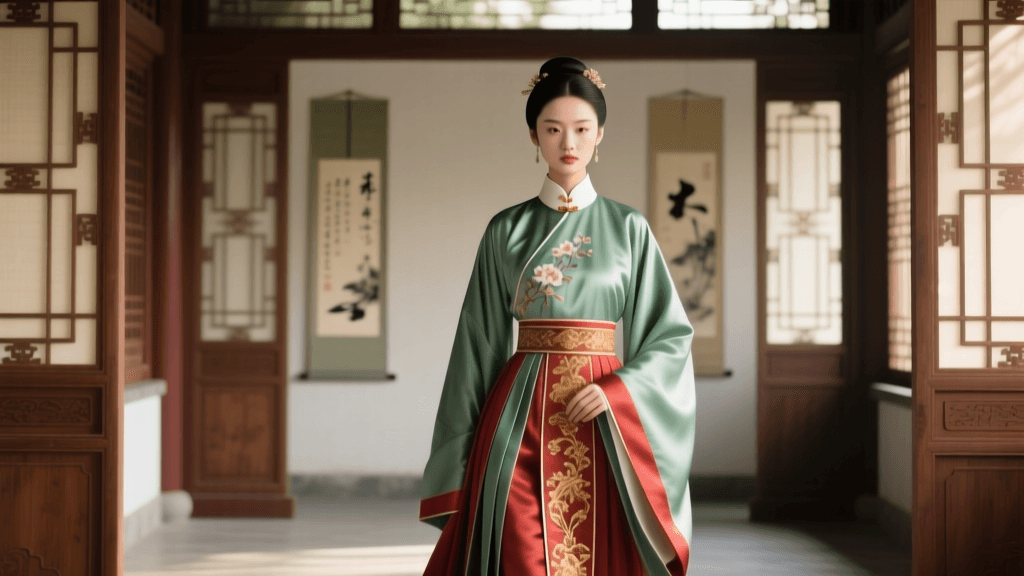
For women of the imperial court and aristocratic families, the defining formal ensemble was the Aoqun, consisting of an ao (a lined, long-sleeved jacket) worn over a skirt. The mid-to-late Ming period experienced a climatic event known as the Little Ice Age, which drastically influenced fashion evolution. To combat the severe cold, the ao evolved to feature a high stand collar (liling) secured with intricate metal or jade buttons, and the sleeves widened into the iconic pipa (lute) shape—narrow at the shoulder, flaring at the elbow, and tapering tightly at the wrist to trap body heat.
The Mamianqun (Horse-Face Skirt)
The crown jewel of Ming women's fashion was the Mamianqun, or 'horse-face' skirt. As detailed by textile experts at the Victoria and Albert Museum, the structural complexity of Ming garments was highly engineered. The Mamianqun is a wrap skirt constructed from two overlapping pieces of fabric. It features two flat, unpleated panels at the front and back (the 'horse faces'), flanked by deeply pleated side panels. The flat panels were often heavily embroidered with auspicious motifs, while the pleats allowed for ease of movement. This design was not only practical for riding and walking but also carried deep philosophical symbolism: the flat, unyielding front panel represented honesty and straightforwardness in one's moral character.
Dynasty Comparison: Tang vs. Song vs. Ming Court Silhouettes
Understanding the evolution of Hanfu requires comparing the structural shifts across China's major dynasties. The following table highlights the distinct court silhouettes that define each era's approach to traditional dress.
| Feature | Tang Dynasty (618–907) | Song Dynasty (960–1279) | Ming Dynasty (1368–1644) |
|---|---|---|---|
| Silhouette | Voluptuous, wide, and flowing | Slender, narrow, and understated | Structured, A-line, and heavily layered |
| Waistline | Very high, tied just under the bust | Natural waist, often elongating the torso | Natural to high waist, emphasizing the jacket's hem |
| Sleeves | Broad, open, and dramatically trailing | Narrow, fitted, and practical | Flared 'Pipa' sleeves with tight, buttoned cuffs |
| Collar Style | Low, open, exposing the décolletage | Cross-collared, modest and closed | High stand-collars (late Ming) with metal toggles |
| Skirt Style | Wrap-around, heavily pleated chiffon | Straight, subtly pleated, one-piece | Mamianqun (flat front/back panels, pleated sides) |
Practical Guide: Sourcing and Wearing Modern Ming Hanfu
The modern Hanfu revival movement (Hanfu Yundong) has seen an explosion of interest in Ming Dynasty garments, largely because Ming textiles are the most abundant and well-preserved in Chinese tombs, providing exact blueprints for modern reproduction. If you are looking to purchase, size, and wear authentic Ming-style Hanfu today, precision is paramount.
Sizing and Measurements for the Mamianqun
Unlike modern Western skirts that rely on zippers and elastic, the Mamianqun is a wrap skirt held up entirely by waist ties and fabric tension. Incorrect measurements will result in the skirt slipping or the front panels gaping open.
- Waist Measurement: Measure your natural waist (where you intend the skirt to sit, usually just above the navel). You must add 4 to 6 centimeters to this measurement to account for the necessary overlap of the wrap panels. Without this overlap, the 'horse face' panels will not align correctly.
- Skirt Length: Measure from your natural waist down to your ankle bone. Subtract 2 to 3 centimeters to ensure the hem clears the ground when wearing flat shoes. A standard modern Ming skirt length is typically between 95cm and 105cm, depending on height.
- Jacket (Ao) Sizing: Ming jackets are designed with positive ease. Your bust measurement should be at least 10-15cm smaller than the garment's stated bust measurement to allow for the thick, structured silhouette and winter layering.
Budgeting for Authentic Replicas
The cost of modern Ming Hanfu varies wildly based on fabric authenticity, weaving techniques, and brand reputation.
- Entry-Level ($40 - $90 USD): Brands like Shisan Yu or Lan Ruo Yu offer machine-embroidered polyester or polyester-cotton blend Mamianqun. These are excellent for beginners and casual wear, though they lack the drape of pure silk.
- Mid-Range ($100 - $250 USD): Brands such as Zhi Xing Hanfu utilize genuine mulberry silk, silk-cotton blends, and traditional zhuanghua (brocade) weaving techniques. The pleats are heat-set with industrial precision, and the motifs are historically accurate.
- Museum-Grade / High-End ($300 - $1,500+ USD): The brand Ming Hua Tang is widely considered the gold standard for Ming reproductions. They utilize authentic gold-thread weaving (zhijin), hand-finished details, and heavyweight silks that perfectly mimic the stiffness and opulence of excavated Ming court artifacts.
Care, Timing, and Pleat Maintenance
Ming Hanfu is heavily structured, and maintaining the sharp, knife-like pleats of the Mamianqun requires specific care. Never machine-wash a high-quality silk or brocade Mamianqun. For daily wear polyester skirts, hand wash in cold water with a neutral pH detergent. When drying, the skirt must be hung using a multi-clip hanger. Clip the waistband evenly and use your fingers to pinch the pleats back into their original folds while the fabric is damp. Allow it to air dry completely before wearing. For storage, never fold the skirt horizontally across the pleats; roll it loosely from the hem to the waist, or hang it vertically in a breathable garment bag.
Conclusion
The evolution of Ming Dynasty court fashion is a masterclass in how clothing reflects political ideology, climatic shifts, and technological advancements in textile production. From the rigid sumptuary laws of the Mang Pao to the ingenious structural engineering of the Mamianqun, Ming garments offer a profound connection to China's rich sartorial heritage. Today, armed with accurate historical data and a thriving market of dedicated reproduction brands, modern enthusiasts can experience the dignity, warmth, and unparalleled elegance of Ming court fashion in their daily lives.