Integrating Traditional Chinese Couture Elements Into Runway Design
The Global Ascendance of Chinese Aesthetics in Haute Couture
The intersection of Eastern heritage and Western haute couture has evolved from superficial exoticism into a profound dialogue of craftsmanship, structure, and textile innovation. For decades, international runways have borrowed from Asian traditions, but the modern approach demands authenticity, deep historical understanding, and direct collaboration with master artisans. The watershed moment for this shift was arguably the Metropolitan Museum of Art's landmark 2015 exhibition, China: Through the Looking Glass, which meticulously documented how Chinese aesthetics have shaped Western fashion design for centuries. Today, integrating traditional Chinese elements into contemporary runway collections requires a nuanced understanding of historical silhouettes, regional embroidery techniques, and ethical sourcing practices.
Deconstructing Traditional Silhouettes for the Modern Runway
Translating historical garments into modern couture is not about creating costumes; it is about deconstructing foundational elements and rebuilding them through a contemporary lens. Two silhouettes have heavily influenced recent international runway collections: the Mamianqun and the structural elements of the Qipao.
The Mamianqun (Horse-Face Skirt)
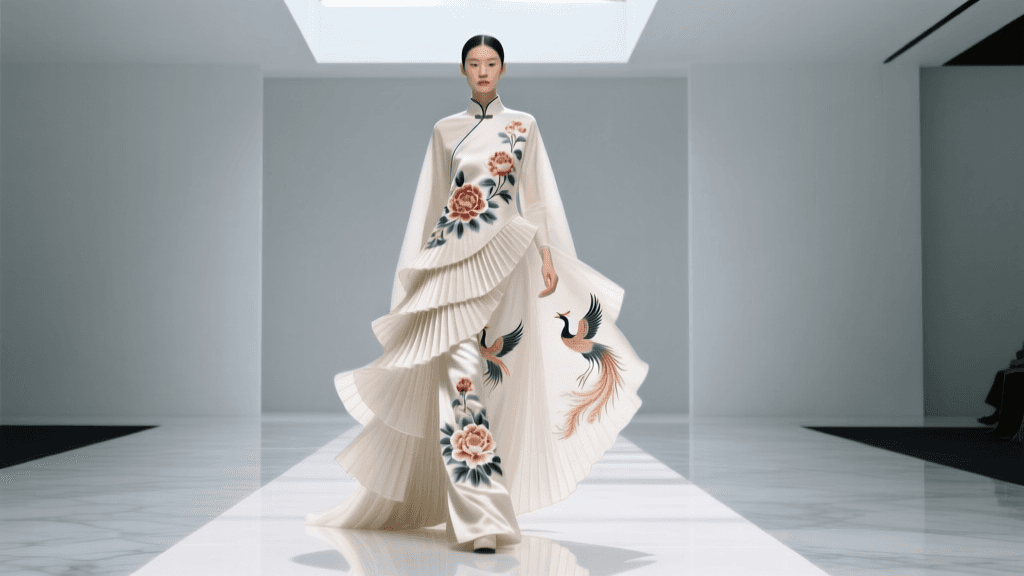
The Mamianqun, or horse-face skirt, is a masterpiece of structural engineering that dates back to the Song and Ming dynasties. It consists of four flat panels (two overlapping in the front, two in the back) with deep, structured pleats on the sides. For modern couture designers, the Mamianqun offers a brilliant alternative to the standard Western A-line or gathered skirt. To adapt this for the runway, designers often manipulate the pleat depth and fabric weight. While traditional Mamianqun utilized heavy silks or woven brocades with a rigid waistband (typically 4 to 6 inches wide), contemporary interpretations might use lightweight wool crepes, structured taffetas, or even technical synthetics. The side pleats, traditionally 1.5 to 2 inches deep, can be exaggerated to 4 inches to create dramatic volume that expands only when the model is in motion, offering a striking visual effect on the catwalk.
The Pankou (Frog Fasteners) and Mandarin Collar
The Mandarin collar (standing collar) and Pankou (knotted frog fasteners) are iconic elements of the Qipao and Qing dynasty court dress. In international couture, these elements are frequently detached from their original context and applied to modern outerwear, tailored blazers, and avant-garde gowns. The Pankou, traditionally made from silk bias tape filled with cotton or copper wire for rigidity, can be scaled up dramatically. Designers are now creating oversized, sculptural Pankou fasteners from leather, molded resin, or metallic hardware, transforming a functional closure into the central architectural focal point of a garment.
The Art of Chinese Embroidery in Couture
Chinese embroidery is renowned globally for its technical complexity, vibrant color palettes, and symbolic motifs. The foundation of this art form relies on centuries of silk production. As recognized by UNESCO's Intangible Cultural Heritage list regarding sericulture and silk craftsmanship, the meticulous process of rearing silkworms and spinning threads provides the essential medium for China's diverse embroidery schools. For haute couture, the 'Four Famous Embroideries' of China offer distinct textures and techniques that can elevate a runway collection from standard to spectacular.
- Suzhou Embroidery (Su Xiu): Known for its delicate, photorealistic quality and the use of incredibly fine silk threads (sometimes split into 1/32nd of a single strand). It is ideal for subtle, tonal shading and intricate floral or aquatic motifs.
- Sichuan Embroidery (Shu Xiu): Characterized by bold colors, strict geometric patterns, and a focus on auspicious symbols like dragons and phoenixes. It uses a unique 'halo' stitching technique that creates a three-dimensional, textured surface.
- Cantonese Embroidery (Yue Xiu): Famous for its vibrant, contrasting colors and the use of metallic gold and silver threads. It is highly durable and visually striking from a distance, making it perfect for dramatic evening wear and runway finale pieces.
Sourcing and Production: A Practical Guide for Designers
Integrating authentic Chinese embroidery into a runway collection requires careful planning, significant budget allocation, and an understanding of regional specializations. Below is a comparative guide to help designers choose the right technique for their specific couture needs.
| Embroidery Style | Estimated Cost (USD / sq meter) | Lead Time | Thread Characteristics | Best Runway Application |
|---|---|---|---|---|
| Suzhou (Su Xiu) | $1,200 - $3,500+ | 6 - 12 Months | Ultra-fine silk, highly split, matte to slight sheen | Bridal couture, delicate bodices, sheer organza overlays |
| Sichuan (Shu Xiu) | $800 - $2,000 | 4 - 8 Months | Thicker silk, textured, vibrant dyes | Structured outerwear, heavy brocade panels, avant-garde textiles |
| Cantonese (Yue Xiu) | $900 - $2,500 | 4 - 9 Months | Silk mixed with metallic gold/silver threads | Finale gowns, dramatic capes, high-visibility evening wear |
Actionable Advice for Emerging Couturiers
For independent designers and emerging couture houses looking to collaborate with Chinese artisans, navigating the logistics of international production can be daunting. Here are practical steps to ensure a successful integration of these traditional techniques into your runway collection:
1. Establish Direct Artisan Relationships
Bypass generic manufacturing agents and seek out specialized embroidery cooperatives in Suzhou (Jiangsu Province) or Chengdu (Sichuan Province). Many master embroiderers operate in small, family-run studios or government-supported heritage centers. When reaching out, provide highly detailed technical flats, Pantone color references, and fabric swatches. Artisans need to see the base fabric to determine the appropriate needle size and thread tension.
2. Budget for 'Haute Couture' Timelines
Authentic hand-embroidery cannot be rushed without sacrificing quality. A single 12-inch by 12-inch panel of high-density Suzhou embroidery can take one master artisan over 100 hours to complete. Factor a minimum of 6 to 9 months into your production calendar for the embroidery phase alone, excluding the time required for shipping the base fabric to China and returning the finished panels to your atelier for final garment construction.
3. Respect Intellectual Property and Cultural Heritage
When utilizing traditional motifs, understand their cultural significance. For example, the five-clawed dragon was historically reserved for the Emperor, while the phoenix represents the Empress. While these rules are not legally binding in modern fashion, using them with an understanding of their historical weight adds depth to your collection's narrative. Furthermore, if you commission a master artisan to create a bespoke, original pattern based on traditional techniques, ensure you negotiate clear intellectual property rights regarding the reproduction of that specific motif in future ready-to-wear lines.
Historical Context and Material Sourcing
The success of any embroidered garment relies heavily on the quality of the base textile. Historically, the global dominance of Chinese fashion was built on the monopoly of silk production. As detailed in the Metropolitan Museum of Art's Heilbrunn Timeline of Art History essay on Chinese Silk, the evolution of sericulture allowed for the creation of diverse weaves, from lightweight gauzes to heavy damasks. For modern runway designers, sourcing authentic Chinese silk brocades (Zhuanghua) or Song brocades (Songjin) from heritage mills in Nanjing or Hangzhou provides the necessary structural integrity to support heavy metallic embroidery. These textiles often feature woven metallic threads that complement the surface embroidery, creating a multi-dimensional interplay of light on the runway.
Conclusion: The Future of Sino-Western Couture
The integration of Chinese fashion elements into international couture has matured into a sophisticated exchange of technical mastery and artistic vision. By moving beyond superficial motifs and embracing the structural ingenuity of the Mamianqun, the architectural brilliance of the Pankou, and the unparalleled dedication of regional embroidery schools, designers can create collections that are not only visually breathtaking but deeply rooted in global textile history. As the fashion industry continues to prioritize craftsmanship and sustainability, the slow, deliberate, and highly skilled traditions of Chinese garment-making offer a vital blueprint for the future of authentic, high-end runway design.