Mindful Kitsuke: Kimono Dressing As Zen Meditation 2026
The Intersection of Zen and Textiles in 2026
In the hyper-connected, digital-first wellness landscape of 2026, practitioners are increasingly seeking 'analog grounding'—tactile, somatic experiences that pull the mind away from screens and anchor it in the physical body. One of the most profound yet underutilized practices in this space is Kitsuke (着物付け), the traditional Japanese art of wearing a kimono. Far from being a mere historical fashion statement or a costume for festivals, the meticulous, layered process of dressing in traditional Japanese garments is now widely recognized by wellness experts as a powerful form of moving Zen meditation.
The philosophy of Zen emphasizes that enlightenment and mindfulness are not found solely in seated Zazen (meditation), but in the deliberate execution of everyday actions. As noted by the San Francisco Zen Center, mindfulness in Zen extends to everyday actions, transforming mundane routines like sweeping, cooking, and dressing into profound spiritual practices. When you engage in mindful Kitsuke, you are not just putting on clothes; you are constructing a sanctuary of fabric, aligning your spine, regulating your breath, and practicing deep presence.
The Philosophy of Mindful Dress: Restriction as Liberation
Modern Western clothing is designed for convenience, speed, and unrestricted movement. Stretch fabrics, zippers, and elastic waistbands allow us to dress in seconds, but they also encourage slouching, shallow breathing, and a rushed mindset. The kimono operates on an entirely different paradigm. The structural complexity of the kimono, which requires precise folding, wrapping, and tying rather than buttons or zippers, demands a deliberate pace, as detailed in the Encyclopedia Britannica's overview of the kimono.
This physical restriction is the gateway to mindfulness. The straight seams of the kimono naturally encourage an upright posture, aligning the cervical and lumbar spine. The Datejime (the under-belt used to secure the inner layers) sits gently against the diaphragm, providing continuous biofeedback. If your breathing becomes shallow or erratic, you feel the pressure; to remain comfortable, you must engage in deep, diaphragmatic belly breathing. Thus, the garment itself becomes a meditation teacher, constantly guiding you back to your breath.
Selecting Your Mindful Garment: A 2026 Guide
While a heavy, multi-layered silk Uchikake is beautiful, it is not practical for daily meditation. For a morning mindfulness routine in 2026, practitioners favor garments that offer sensory grounding, breathability, and ease of care. Below is a comparison of the most effective traditional garments for Zen practice.
| Garment Type | Primary Fabric | Best Zen Application | 2026 Avg. Cost (USD) |
|---|---|---|---|
| Samue | Woven Cotton / Hemp | Active mindfulness, Soji (sweeping), gardening | $85 - $160 |
| Yukata | Shijira-ori Cotton | Summer breathwork, seated Zazen, evening wind-down | $60 - $130 |
| Komono | Modern Washable Silk | Walking meditation, tea ceremony, formal mindfulness | $180 - $320 |
| Jinbei | Slub Cotton | Casual morning stretching, light breathwork | $45 - $90 |
The Samue (作務衣) is particularly noteworthy. Originally designed as the work clothes for Zen Buddhist monks, the Samue consists of a wrap-around jacket and loose, ankle-cinched trousers. In 2026, high-quality Samue made from organic Japanese hemp and indigo-dyed cotton are highly sought after for 'active mindfulness'—the practice of maintaining a meditative state while performing physical chores like Soji (temple cleaning) or preparing meals.
The Step-by-Step Meditative Kitsuke Routine
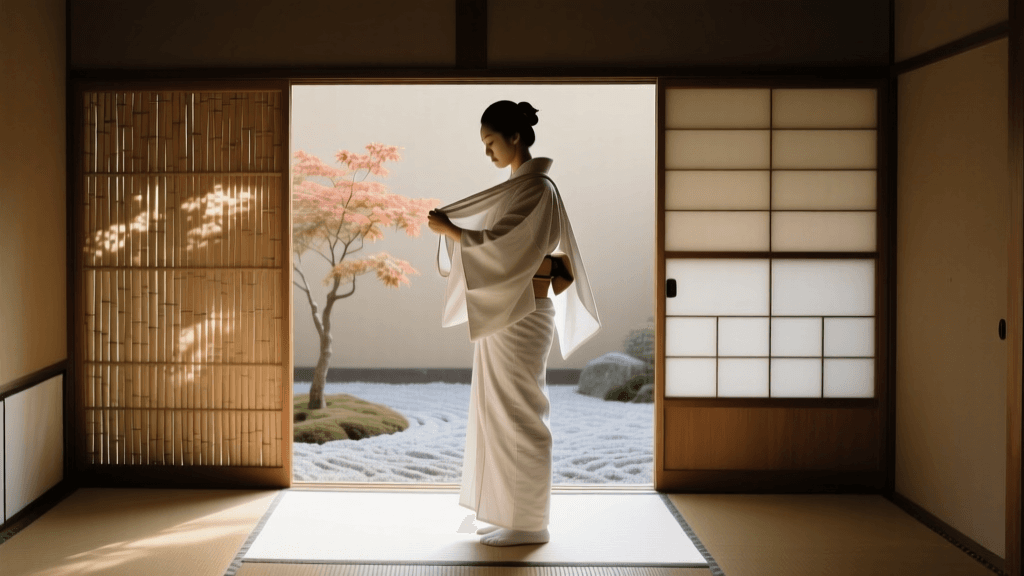
To transform dressing into a meditation, you must strip away the anxiety of 'getting it right' for an audience and focus entirely on the internal somatic experience. Dedicate 20 to 30 minutes to this routine, ideally in a quiet room with natural light and a subtle scent of Hinoki or sandalwood incense.
Step 1: Centering and the Base (The Juban)
Begin in Seiza (kneeling posture) or a comfortable cross-legged position. Take ten deep breaths, feeling the expansion of your ribs. Pick up the Juban (the undergarment). As you slip your arms through the sleeves, focus on the sensation of the fabric gliding over your skin. The preservation and sensory experience of traditional Japanese textiles, such as the tactile nature of woven cottons, are championed by institutions like the Tokyo National Museum, which highlights the deep connection between material craft and cultural spirituality. Feel the texture. Wrap the left side over the right (always left over right for the living), and tie the Datejime. As you pull the knot, exhale fully, letting the belt secure your core and your mind simultaneously.
Step 2: The Drape and Alignment (The Kimono)
Don the main garment. This is where posture becomes paramount. Roll your shoulders back and let them drop. The back seam of the kimono should run perfectly straight down your spine. If it twists, your posture is misaligned. Adjusting the kimono requires you to physically correct your skeletal alignment. When you create the Ohashori (the fold at the waist), do so with slow, deliberate hand movements. Treat the folding of the fabric like the folding of a prayer flag—each crease is an act of intention.
Step 3: The Anchor (Tying the Kaku Obi)
The Kaku Obi is a stiff, woven cotton or silk belt, traditionally worn by men but increasingly adopted in gender-neutral Zen practice for its excellent structural support. Wrapping the obi is the climax of the meditative dress. You must wrap it tightly enough to support the lower back, but loosely enough to allow the diaphragm to expand.
'The knot of the obi is not merely a fastener; it is the physical manifestation of your centered breath and focused intention. If your mind wanders, the knot will slip.'
As you weave the fabric and pull the final knot (often a simple Kata-ryu or square knot), synchronize the final pull with a long, slow exhalation. The tension of the knot locks in your physical posture and your mental focus.
Sensory Grounding in a Digital Age
Why does this matter so much in 2026? We are experiencing an epidemic of sensory deprivation, where our primary interactions are with smooth, temperature-neutral glass screens. Mindful Kitsuke engages all five senses in a highly calibrated way:
- Touch: The contrasting textures of the smooth silk Nagajuban against the nubby, textured weave of a Shijira-ori cotton kimono provide complex tactile feedback that grounds the nervous system.
- Sound: The subtle 'swish' (known as kinu-zure) of silk layers rubbing together acts as a natural white noise, signaling to the brain that it is time to transition into a state of calm.
- Proprioception: The weight of the obi and the restriction of the hem narrow your stride, forcing you to walk slower, more deliberately, and with a lowered center of gravity. This physical deceleration directly slows the heart rate.
Integrating Kitsuke into Your Modern Life
You do not need to wear a kimono all day to reap the benefits. Many practitioners in 2026 utilize 'Micro-Kitsuke' sessions. This involves spending 15 minutes mindfully dressing in a Yukata or Samue immediately upon waking, wearing it during your morning tea, journaling, or seated meditation, and then mindfully undressing and folding the garments. The act of folding the kimono back into its precise, rectangular geometry is the closing ritual of the meditation, teaching the practitioner the Zen concept of Mushin (no-mind) and the beauty of returning things to their natural, ordered state.
By embracing the art of mindful Kitsuke, you are doing more than preserving an ancient Asian tradition. You are reclaiming your bodily autonomy, slowing down your perception of time, and wrapping yourself in a wearable sanctuary of peace. In a world that constantly demands you to move faster, the kimono gently, but firmly, commands you to stop, breathe, and simply be.