Mindful Kitsuke: Kimono Dressing As Zen Meditation In 2026
In an era defined by digital saturation and rapid consumption, the year 2026 has seen a profound cultural pivot toward 'slow living' and tactile grounding. Among the most compelling practices to emerge from this movement is mindful kitsuke—the intentional, meditative art of kimono dressing. Far from being a mere fashion statement or a rigid historical reenactment, kitsuke is increasingly recognized by wellness practitioners and cultural preservationists as a moving meditation. By aligning the physical body with the structural elegance of traditional Japanese garments, practitioners are finding a sanctuary of mental clarity.
The Zen Philosophy of Samu and Mindful Dressing
In Zen Buddhism, the concept of samu (work practice) dictates that everyday tasks are not obstacles to spiritual practice but the practice itself. Sweeping the temple grounds, preparing tea, and dressing are all opportunities to cultivate zanshin (a state of relaxed, continuous alertness). When applied to the kimono, the act of dressing requires a sequence of deliberate, unhurried movements that demand absolute presence.
As taught in global mindfulness traditions, anchoring the mind to physical sensations prevents the mental time-travel that causes anxiety. According to the teachings outlined by Plum Village, mindfulness in daily actions—such as walking or dressing—transforms mundane routines into profound moments of peace. When a practitioner ties the koshihimo (cotton under-ties) of a kimono, the focus shifts entirely to the tension of the fabric, the rhythm of the breath, and the alignment of the spine.
'The way you fold your garments is the way you fold your mind. In the precise geometry of the kimono, there is no room for the chaotic rush of the outside world.'
The Sensory Architecture of the Kimono
To understand mindful kitsuke, one must appreciate the unique sensory feedback provided by the garment. Unlike Western tailoring, which cuts fabric to the contours of the body, the kimono is constructed from straight, rectangular bolts of fabric (tanmono). As detailed by the Metropolitan Museum of Art, the kimono's structure relies on wrapping, folding, and tying, creating a dynamic relationship between the body and the textile.
Grounding Through Tactile Feedback
The sensory experience of dressing is multi-layered, providing continuous tactile feedback that anchors the practitioner in the present moment:
- The Weight of Silk: A high-quality Oshima Tsumugi (pongee silk) kimono carries a distinct, grounding weight that settles over the shoulders, encouraging an upright, dignified posture.
- The Friction of Cotton: The koshihimo ties are made of unbleached cotton. The slight friction against the silk requires a gentle, mindful pull, teaching the practitioner to apply exactly the right amount of force—neither too aggressive nor too passive.
- The Sound of Movement: The subtle rustle of the juban (undergarment) against the main kimono creates an acoustic feedback loop, allowing the wearer to monitor the smoothness of their movements.
Step-by-Step Mindful Kitsuke: A Meditative Sequence
Transitioning from a rushed morning routine to a meditative practice requires a shift in intention. Here is how the traditional steps of kitsuke are adapted for Zen mindfulness in 2026.
1. The Preparation (Junbi)
Before touching the garment, the practitioner engages in three minutes of seated breathing. The kimono is laid out flat, its geometric perfection serving as a visual mandala. The act of smoothing the fabric with an open palm is the first physical connection, acknowledging the labor of the weavers, dyers, and artisans who brought the textile to life.
2. The Alignment (Chakuyou)
Slipping into the kimono is done in sync with the breath. Inhaling, the garment is lifted; exhaling, it is draped over the shoulders. The practitioner aligns the back center seam (se-ita) with their own spine. This is a moment of profound physical centering. If the seam is off by even an inch, the entire garment will pull unevenly. This physical alignment becomes a metaphor for mental alignment—adjusting one's internal posture before stepping into the world.
3. The Obi Tie (Musubi) as Focus
The obi (sash) is the anchor of the kimono. Tying a traditional taiko musubi (drum knot) requires complex spatial reasoning and fine motor skills. In a mindful practice, the obi is not tied while looking in a mirror. Instead, the practitioner relies on proprioception and muscle memory, tying the knot behind the back through pure tactile sensation. This forces the brain out of its visual-dominant, screen-addicted state and into deep somatic awareness.
2026 Mindful Kitsuke Retreats and Workshops
As the intersection of wellness and traditional arts expands, specialized retreats have emerged across Japan and internationally. These programs combine Zen temple stays with intensive, mindful dressing instruction. Below is a comparison of the leading retreat formats available in 2026.
| Retreat Format | Primary Location | Duration | 2026 Average Cost | Focus Area |
|---|---|---|---|---|
| Temple Immersion | Kyoto (Daitoku-ji) | 3 Days | ¥85,000 ($580 USD) | Zazen meditation & foundational kitsuke |
| Sensory Textile Retreat | Kanazawa | 5 Days | ¥140,000 ($950 USD) | Silk weaving, dyeing, and mindful draping |
| Urban Digital Detox | Tokyo (Yanaka) | Weekend | ¥45,000 ($310 USD) | Slow fashion, vintage curation, and daily wear |
| Virtual Somatic Course | Online (Global) | 4 Weeks | $195 USD | Breathwork synchronization with dressing |
The Neuroscience of Tactile Mindfulness
The psychological benefits of mindful kitsuke are supported by modern neuroscience. Engaging in complex, tactile, and repetitive tasks activates the parasympathetic nervous system, lowering cortisol levels and reducing the physiological markers of stress. Research highlighted by the Harvard Gazette demonstrates that consistent mindfulness practices physically alter the brain's amygdala, reducing its reactivity to stress and anxiety.
When a practitioner spends forty-five minutes carefully folding, wrapping, and tying a kimono, they are engaging in a form of 'active meditation' akin to walking meditation or mindful calligraphy. The strict rules of kitsuke—such as ensuring the collar forms a precise angle at the nape of the neck—provide a cognitive framework that prevents the mind from wandering, effectively quieting the default mode network (DMN) associated with rumination.
Curating a Mindful Kimono Wardrobe for Beginners
Embarking on a mindful kitsuke practice in 2026 does not require an immediate investment in museum-grade antiquities. The focus should be on textures, natural fibers, and garments that resonate with the Zen aesthetic of wabi-sabi (finding beauty in imperfection and transience).
Recommended Garments for Somatic Practice
- Ro (Gauze) or Sha (Sheer Silk) for Summer: The breathability and delicate structure require a gentle touch, teaching the practitioner patience and softness during humid months.
- Tsumugi (Pongee Silk): Characterized by its slubby, uneven texture, Tsumugi provides excellent tactile feedback. It is less slippery than crepe silk (chirimen), making it highly forgiving for beginners practicing mindful tying.
- Nagajuban (Undergarment) with a Natural Fiber Collar: Opting for unbleached cotton or hemp for the han-eri (detachable collar) connects the wearer to raw, unprocessed materials, reinforcing the grounding nature of the practice.
The Art of Folding (Tatamu)
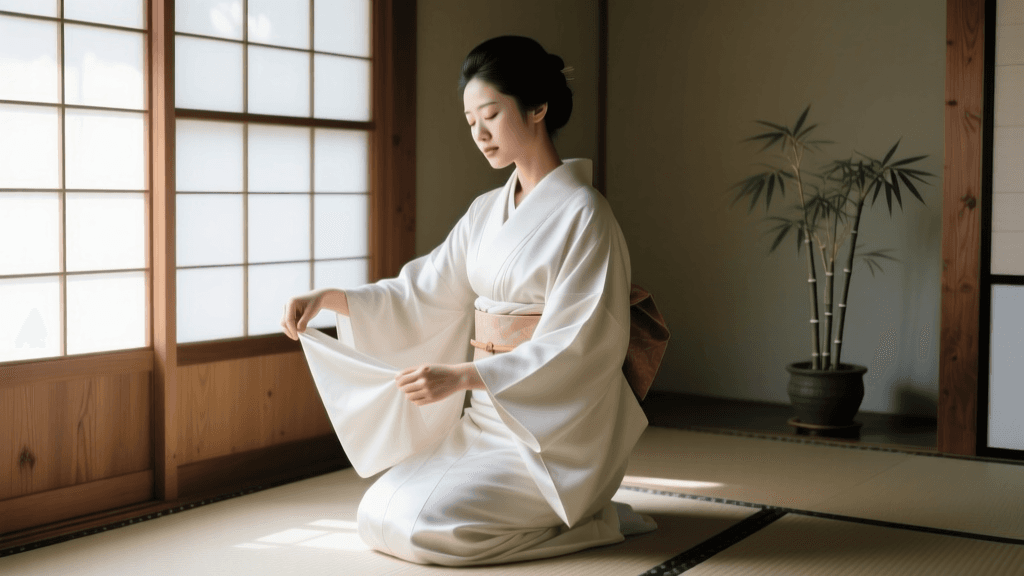
The meditation does not end when the kimono is removed. The traditional folding method (hon-datami) is a geometric puzzle that requires the practitioner to kneel, smooth the fabric, and align the seams with exactitude. This final act of care is a practice in gratitude and closure, allowing the mind to transition peacefully from the structured elegance of the garment back into the fluidity of daily life.
Conclusion: Wearing Stillness in a Moving World
As we navigate the complexities of 2026, the kimono offers more than a connection to Asian heritage; it offers a wearable sanctuary. Mindful kitsuke is a rebellion against the frictionless, instantaneous nature of modern life. It asks us to slow down, to feel the weight of the silk, to honor the geometry of the fold, and to find stillness in the deliberate act of dressing. In every tied knot and aligned seam, the practitioner weaves mindfulness directly into the fabric of their day.