Miao Silverwork And Embroidered Garments: A Buyer Guide
Introduction to Miao Textile and Silver Traditions
The Miao people, widely known in Southeast Asia as the Hmong, represent one of China's most culturally rich and diverse ethnic minority groups. Primarily concentrated in the mountainous provinces of Guizhou, Yunnan, Hunan, and Sichuan, the Miao have historically lacked a traditional written language. Instead, they have encoded their mythology, migration history, and clan identities into their clothing. As noted by the Encyclopedia Britannica, the textile arts of the Hmong and Miao are not merely decorative; they are a complex, wearable language that communicates a woman's marital status, her village of origin, and her family's social standing.
For collectors, fashion historians, and cultural enthusiasts, Miao garments and silverwork represent some of the most highly sought-after pieces in the Asian traditional textile market. However, navigating the authenticity, pricing, and preservation of these items requires a deep understanding of their craftsmanship. This guide provides actionable insights into identifying, purchasing, and caring for authentic Miao ethnic minority clothing and silver jewelry.
The Wearable History: Miao Embroidery Techniques
Miao embroidery is globally recognized for its staggering complexity and vibrant color palettes. The creation of a single festival jacket can take a skilled artisan anywhere from one to three years to complete. The motifs are deeply rooted in animist mythology, frequently featuring the 'Butterfly Mother' (Mai Bang), the water buffalo, and stylized dragons.
Core Embroidery Methods
- Flat Stitch (Pingxiu): The most common technique, used to cover large areas of fabric with smooth, solid blocks of vibrant silk thread.
- Seed Stitch (Daxi): A painstakingly slow method where tiny, knot-like stitches are applied to create a textured, three-dimensional surface, often used for floral and animal motifs.
- Horsehair Embroidery (Maweixiu): Unique to certain Guizhou subgroups, artisans wrap white horsehair with white silk thread, then couch these raised cords onto the fabric and wrap them with colored silk, creating a striking bas-relief effect.
- Appliqué and Reverse Appliqué: Layers of dyed cotton or silk are cut and folded to reveal contrasting colors underneath, a technique heavily utilized by the White and Green Miao subgroups.
According to UNESCO's Intangible Cultural Heritage frameworks, preserving these specific regional techniques is vital, as modernization and the influx of machine-made synthetic threads threaten the survival of hand-spun silk and natural indigo dyeing practices.
The Weight of Tradition: Miao Silverwork
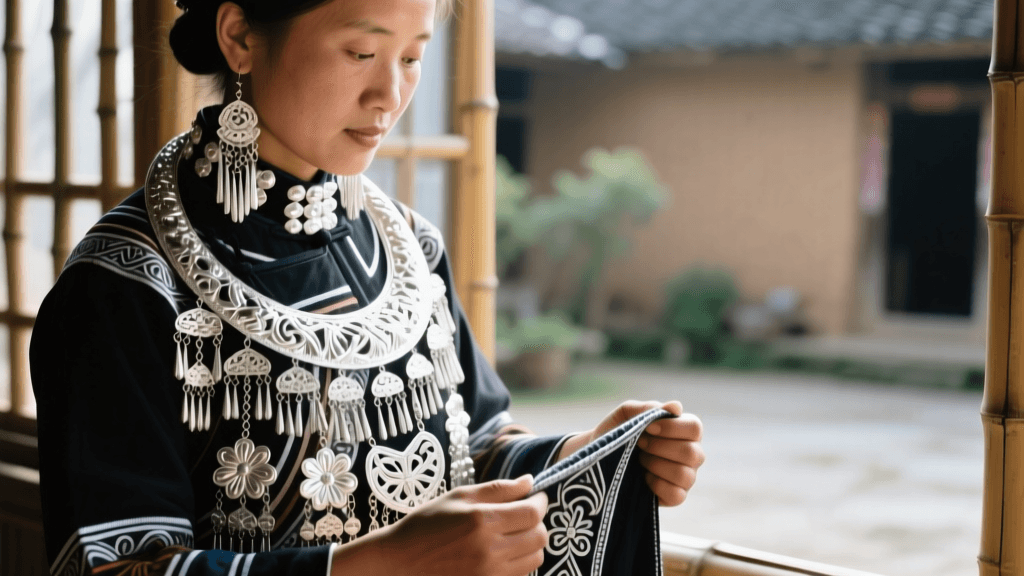
In Miao culture, silver is believed to possess spiritual properties that ward off evil spirits and bring good fortune. A traditional Miao proverb states, 'A girl without silver is like a garden without flowers.' During major festivals, a Miao woman may wear upwards of 10 to 15 kilograms of solid silver.
The most iconic piece is the Silver Horn Headdress (Yinjiao). Resembling the horns of a water buffalo, this massive headpiece is constructed from thin sheets of hand-hammered silver, intricately repoussé with dragons, phoenixes, and flowers. Another staple is the Multi-layered Neck Ring (Xiangquan), consisting of several heavy, twisted silver torcs that rest on the collarbones, often accompanied by hanging bells that create a distinctive chiming sound with every step the wearer takes.
'The sound of Miao silver is the sound of our ancestors walking with us. When the bells chime, the spirits know we are here.' — Traditional Guizhou Miao saying.
Regional Variations: Subgroup Comparison Chart
The term 'Miao' is an umbrella classification for dozens of distinct subgroups, each with unique sartorial rules. Understanding these differences is crucial for accurate attribution and appraisal in the collector's market.
| Subgroup | Primary Location | Key Garment Feature | Silver Prominence |
|---|---|---|---|
| Black Miao | Southeast Guizhou (Xijiang, Leishan) | Deep indigo-dyed pleated skirts, dark glossy jackets polished with egg whites. | Very High (Massive horn headdresses, heavy chest locks). |
| White Miao | Yunnan / Sichuan borders | White hemp skirts, intricate cross-stitch geometric embroidery, batik jackets. | Moderate (Smaller hairpins, silver combs, lightweight chest plates). |
| Long-Horn Miao | Liupanshui, Guizhou (Suojia) | Massive wooden horn wrapped with yards of ancestral hair and black yarn. | Low (Focus is on the hair horn; minimal silver jewelry worn). |
| Red Miao | Hunan / Eastern Guizhou | Short pleated skirts, heavy use of red silk thread in floral embroidery. | High (Thick twisted neck rings, elaborate silver hairpins). |
Actionable Collector's Guide: Pricing, Timing, and Sizing
For those looking to acquire authentic Miao garments and silverwork, whether for a private collection, museum archive, or personal wear, specific market knowledge is required. Organizations like Cultural Survival emphasize the importance of ethical purchasing, ensuring that artisan communities are fairly compensated and that sacred items are not stripped from villages under duress.
1. Product Identification and Pricing
- Antique Indigo Pleated Skirt (Baiqun): A genuine, hand-pleated skirt made from home-woven cotton and fermented indigo requires 15 to 20 meters of fabric compressed into a waistband of just 50 to 60 centimeters. Cost: $300 to $800 USD for mid-century antique pieces; $1,500+ for 19th-century examples with intact embroidery panels.
- Artisan Silver Horn Headdress: Modern master silversmiths in Kaili or Xijiang charge based on the daily spot price of silver plus labor. A standard 1.5 kg horn will cost between $1,200 and $1,800 USD. Antique horns (pre-1950s) are rare and command $4,000 to $10,000+ at auction.
- Hundred Bird Coat (Bainiao Yi): An incredibly rare ceremonial jacket featuring appliqué and embroidery of various bird motifs. Cost: $2,000 to $5,000+ depending on age and condition.
2. Sizing and Measurements
Traditional Miao clothing is rarely tailored to individual body measurements; instead, it is wrapped, tied, and pleated to fit. When purchasing a jacket, look for a flat shoulder width of 40-45 cm and wide, batwing-style sleeves. Skirts are universally sized by waist wrap (usually 60-80 cm unwrapped) but the hem circumference can range from 4 to 6 meters when fully expanded.
3. Timing Your Purchase
The best time to source authentic pieces directly from artisans and local markets is during major regional festivals. The Sisters' Meal Festival (usually held in April in Taijiang County) and the Lusheng Festival (held in autumn across various Guizhou prefectures) are prime opportunities. During these times, local markets swell with silversmiths and textile traders, allowing buyers to inspect the weight, hallmarks, and stitch density of items in person.
Caring for Antique Indigo and Silver
Preserving ethnic minority textiles requires specialized care, as the materials and dyes react poorly to modern storage methods.
Textile Preservation
- Avoid Plastic: Never store indigo-dyed cotton or silk in plastic bags. Indigo is a living dye that requires airflow; plastic traps moisture and causes the cotton to rot and the dye to bloom with white mildew.
- Storage Environment: Wrap garments in unbleached, acid-free cotton muslin. Store in a cool, dark place with a relative humidity of 45-55%. The glossy finish on Black Miao jackets (achieved by pounding the fabric with egg whites and ox-hide glue) will flake if folded too tightly; always roll these garments around acid-free cardboard tubes.
Silver Maintenance
Miao silver is traditionally an alloy of pure silver mixed with small amounts of copper or zinc to increase durability for intricate repoussé work. Do not use harsh chemical silver dips, which will strip the antique patina and damage the delicate solder joints of the hanging bells. Instead, clean pieces using a mild solution of warm water and phosphate-free dish soap, gently agitating with a soft-bristled baby toothbrush, and pat dry immediately with a microfiber cloth.
Conclusion
The clothing and silverwork of the Miao people are masterclasses in human ingenuity and cultural resilience. Whether you are an archivist seeking a museum-quality Hundred Bird Coat, or a jewelry enthusiast looking to acquire a hand-hammered silver hairpin, understanding the regional variations, craftsmanship techniques, and proper valuation metrics is essential. By approaching these acquisitions with respect and knowledge, collectors play a vital role in sustaining the livelihoods of rural artisans and ensuring that the wearable history of the Miao continues to endure for generations to come.