Discover Nishijin-ori: Kyoto's Premier Kimono Weaving Workshops
The Legacy of Nishijin-ori: Kyoto’s Crown Jewel of Textiles
When discussing the pinnacle of Japanese traditional garments, the conversation inevitably turns to the breathtaking textiles of Kyoto. Among these, Nishijin-ori (Nishijin weaving) stands as the undisputed crown jewel. Unlike Yuzen dyeing, where patterns are painted onto finished white silk, Nishijin-ori is a yarn-dyed weaving technique. The threads are meticulously dyed before they ever touch the loom, allowing for the creation of extraordinarily complex, multi-layered, and textured fabrics that are most famously used for high-end kimono obi (sashes).
The name 'Nishijin' translates to 'Western Camp,' a direct reference to the devastating Onin War (1467–1477) that tore Kyoto apart. The western army set up camp in the area, and when the war finally ended, the displaced weavers returned to this specific district to rebuild their lives and looms. Today, the Nishijin district remains the beating heart of Japan's luxury textile industry. According to Japan's Ministry of Economy, Trade and Industry (METI), Nishijin-ori is officially designated as a Traditional Craft Product, a status that protects its rigorous manufacturing standards and ensures the survival of its ancestral techniques.
The Intricate Anatomy of a Nishijin Textile
To truly appreciate a Nishijin obi, one must understand the staggering division of labor required to create it. A single, formal Maru Obi or Hon-Fukuro Obi can take several months to complete and involves over twenty distinct, highly specialized artisan processes. These steps are traditionally handled by different master craftsmen, each operating in small, independent workshops scattered throughout the Nishijin district.
Thread Preparation and Dyeing
The process begins long before the weaving starts. Raw silk threads are sourced, twisted, and refined. The dyeing process is an art form in itself. Artisans use both natural plant dyes and advanced synthetic colors to achieve the precise shades required by the textile designer. For luxurious pieces, threads may be wrapped in ultra-thin sheets of pure gold or silver leaf, a technique known as kin-ran or gin-ran. These metallic threads catch the light beautifully but require immense skill to weave without breaking.
The Weaving Process: Jacquard and Handlooms
Nishijin-ori encompasses several distinct weaving styles. Two of the most revered include:
- Kara-ori (Chinese-style weave): A highly complex technique that creates a brocade effect, making the fabric look almost embroidered. It is incredibly stiff and heavy, traditionally reserved for the most formal bridal and court kimono.
- Tsuzure-ori (Tapestry weave): Often called 'fingernail weaving' because the artisan uses the serrated edges of their filed fingernails to pack the weft threads tightly together. This allows for curved, painterly designs that resemble a woven tapestry.
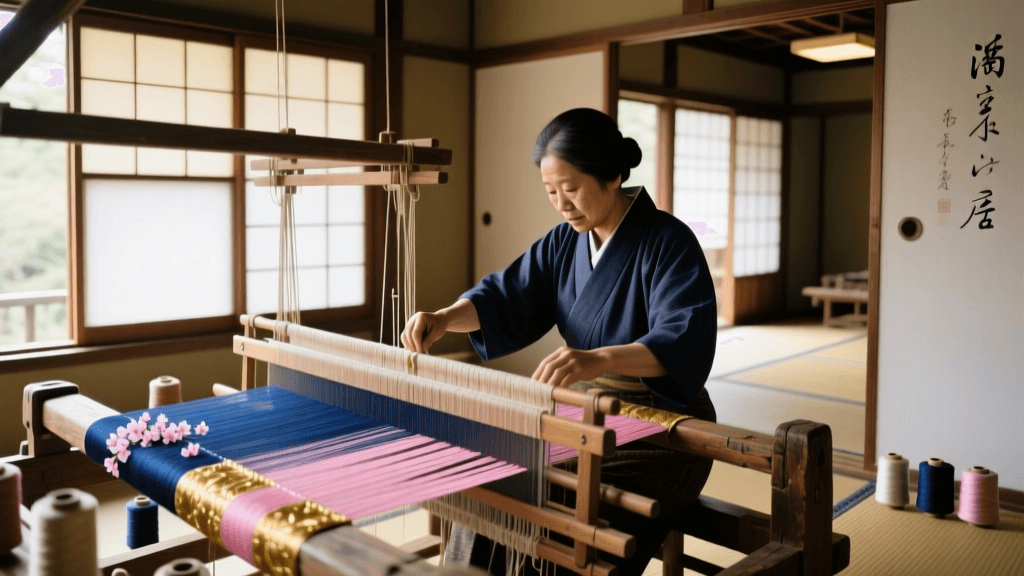
While modern Nishijin workshops utilize computerized Jacquard looms for commercial production, the highest-end, museum-quality obi are still woven on traditional hand-operated sorabata (draw looms). Operating a sorabata requires two people: the weaver who operates the pedals and shuttle, and the 'draw boy' (or master assistant) who sits atop the loom, manually pulling the warp threads to create the intricate pattern sheds.
Experiencing the Craft: A Guide to Kyoto’s Artisan Workshops
For textile enthusiasts, kimono collectors, and cultural travelers, visiting a Nishijin workshop is an essential Kyoto itinerary item. However, because many of these are active, small-scale production studios rather than commercial showrooms, navigating the visiting experience requires some planning.
Nishijin Textile Center
The most accessible starting point is the Nishijin Textile Center, a large, multi-story facility dedicated to the promotion and preservation of the craft. Here, visitors can watch daily kimono fashion shows, observe artisans working on traditional handlooms, and browse a massive showroom of finished textiles. The center also offers hands-on weaving experiences where you can use a small table loom to create your own silk coaster or placemat.
Orinasu Kan and Independent Studios
For a more intimate and historically immersive experience, seek out Orinasu Kan. Housed in a beautifully preserved early-Showa era merchant's house, this museum and workshop combo allows you to see antique looms in a traditional machiya (wooden townhouse) setting. Furthermore, heritage houses like Hosoo, founded in 1688, have opened flagship stores and gallery spaces in Kyoto that offer guided architectural and textile tours, showcasing how they are adapting Nishijin techniques for modern interior design and global haute couture.
Workshop Comparison Chart
To help you plan your textile tour, below is a structured comparison of the primary Nishijin-ori experiences available to the public.
| Workshop / Venue | Primary Focus | Estimated Cost (JPY) | Duration | Booking Requirement |
|---|---|---|---|---|
| Nishijin Textile Center | General overview, fashion shows, basic table-loom weaving | Free entry; ~2,500 JPY for weaving | 1.5 - 2 Hours | Walk-ins welcome; weaving requires same-day sign-up |
| Orinasu Kan | Historical machiya setting, antique loom demonstrations | ~1,000 JPY (Museum entry) | 1 Hour | Walk-ins welcome |
| Hosoo Flagship & Gallery | Modern applications, luxury textiles, architectural tours | ~5,000 JPY (Guided Tour) | 1 - 1.5 Hours | Strict advance reservation required online |
| Independent Artisan Studios | Deep-dive into specific techniques (e.g., Tsuzure-ori) | 3,000 - 10,000 JPY | 2 - 3 Hours | Must book via specialized cultural tour agencies |
Traveler Tip: The best time to visit independent weaving studios is between Tuesday and Thursday, ideally around 10:00 AM. Many traditional workshops are closed on weekends, and arriving in the morning ensures you can hear the rhythmic clacking of the looms before the midday break.
Practical Advice for Collectors and Enthusiasts
If you are inspired to purchase an authentic Nishijin-ori obi or kimono fabric during your visit, it is vital to understand the market, pricing, and care requirements.
Identifying Authenticity and Pricing
Authentic, hand-woven Nishijin obi are investment pieces. A standard, machine-assisted silk Nagoya Obi (pre-folded and easier to tie) typically starts around 30,000 to 50,000 JPY. However, a fully hand-woven Hon-Fukuro Obi featuring real gold leaf threads and complex Kara-ori brocade can easily range from 300,000 JPY to over 3,000,000 JPY.
When shopping, look for the official Nishijin-ori certification tag, which guarantees the textile was produced within the designated Kyoto district using approved methods. According to the Victoria and Albert Museum's extensive Asian textile collections, the structural integrity and the use of metallic threads in Nishijin brocades are defining characteristics that separate them from regional imitators.
Measurements and Tailoring
Unlike Western clothing, kimono textiles are sold in specific, standardized bolts or pre-cut lengths. A standard Maru or Fukuro obi is approximately 31 centimeters (12.2 inches) wide and 4.5 meters (14.7 feet) long. If you are buying fabric by the bolt (tanmono) to have a kimono tailored, ensure it is the standard 38 centimeters (15 inches) width required for modern kimono construction.
Care and Preservation
Nishijin textiles, particularly those with metallic threads or stiff brocade structures, require meticulous care. Never wash a Nishijin obi at home. The metallic threads can tarnish, and the silk can lose its structural tension. If the obi becomes soiled, it must be taken to a specialized kimono dry cleaner (arai-hari specialist) who understands how to handle yarn-dyed, multi-layered weaves. When storing, wrap the obi in acid-free tatou paper and keep it in a low-humidity environment to prevent mold and silk degradation.
The Future of Nishijin-ori in Modern Fashion
While the kimono market has contracted in modern Japan, the artisans of Nishijin are far from obsolete. Today, the survival of these traditional workshops relies on innovation. Master weavers are collaborating with European luxury fashion houses, creating Nishijin textiles for haute couture runways in Paris and Milan. Furthermore, the application of these ancient weaving techniques to modern accessories, such as luxury neckties, handbags, and interior upholstery, is providing a vital economic lifeline to the district.
Visiting a Nishijin-ori workshop is not merely a look into Japan's past; it is a front-row seat to a living, breathing artisan community that is actively fighting to weave its heritage into the fabric of the future. Whether you are tying a hand-woven obi for a tea ceremony or simply admiring the flash of gold thread in a Kyoto gallery, you are participating in the preservation of one of Asia's most magnificent textile traditions.