Guide to Miao Silverwork and Embroidered Festive Dress
The Heart of Guizhou: Understanding Miao Provincial Dress
Deep within the karst mountain ranges of China's Guizhou province, the Miao people have cultivated one of the most visually stunning and culturally profound sartorial traditions in Asia. Unlike the widely recognized Hanfu or the tailored Qipao, the regional folk dress of the Miao is not a single uniform garment, but a complex, heavily ornamented tapestry that communicates lineage, marital status, and spiritual beliefs. For textile collectors, cultural historians, and travelers, understanding the nuances of Miao provincial dress offers a masterclass in indigenous craftsmanship and wearable art.
The Miao (also known as Hmong in Southeast Asian contexts) do not possess a traditional written language. Instead, their history, mythology, and cosmological maps are encoded directly into their clothing. As noted by Smithsonian Magazine, the intricate embroidery and heavy silverwork serve as a wearable archive, preserving the epic migrations and ancestral legends of a people who have navigated centuries of displacement and adaptation.
The Anatomy of the Miao Festive Ensemble
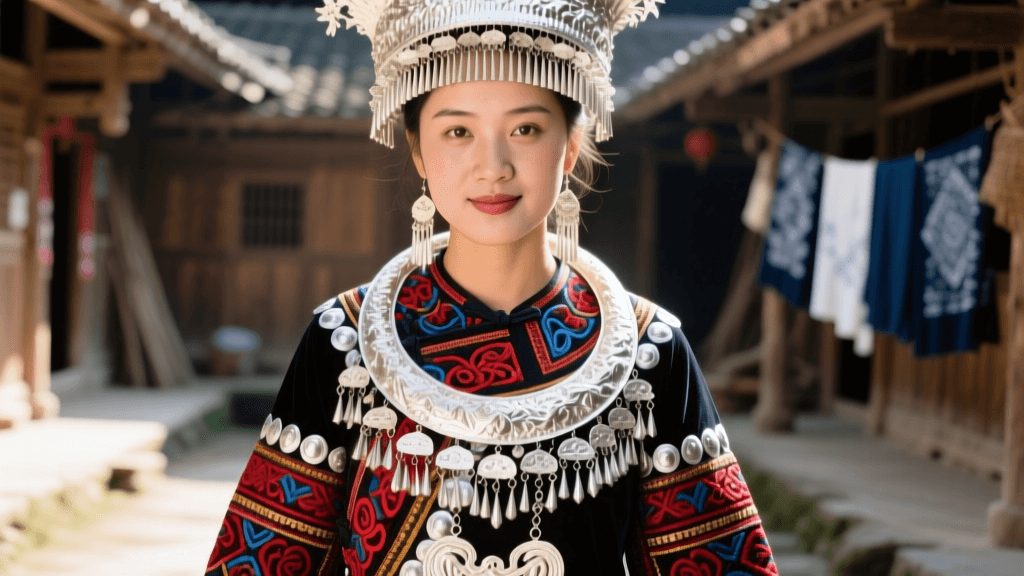
A full Miao festive ensemble is a marvel of structural engineering and textile artistry. It is typically reserved for major provincial gatherings, weddings, and harvest festivals. The outfit is composed of three primary elements: the indigo-dyed pleated skirt, the heavily embroidered jacket, and the monumental silver ornamentation.
The Pleated Skirt (Baidai Qun)
The foundation of the traditional Miao woman's festive dress is the Baidai Qun, or hundred-pleat skirt. Creating a single authentic skirt from the Shidong region is a monumental task that requires immense technical precision. Artisans weave, dye, and fold up to 20 to 25 meters of heavy, indigo-dyed cotton into hundreds of microscopic pleats. The fabric is treated with ox blood and egg white, then pounded with wooden mallets to achieve a stiff, glossy finish that holds the pleats permanently. A high-quality, hand-pleated Shidong skirt takes approximately three to four months to complete and can cost between 3,000 and 8,000 RMB ($400 to $1,100 USD) depending on the density of the pleats and the quality of the indigo.
The Silver Ornaments: Weight, Cost, and Acquisition
No Miao festive dress is complete without its silver armor. The silverwork is not merely decorative; it is a display of family wealth, a spiritual talisman to ward off evil spirits, and a physical manifestation of the 'Butterfly Mother' mythology. A full festive set includes a towering horned crown, heavy neck rings, chest plates, and hairpins.
- Measurements & Weight: A complete festive silver set weighs between 5 and 10 kilograms (11 to 22 lbs). The crown alone can weigh up to 2 kilograms.
- Material Composition: Historically, Miao silver was an alloy of silver and copper. Today, collectors can commission sets in 99% pure silver or traditional white copper (bai tong) for a fraction of the cost.
- Cost & Pricing: In artisan hubs like Kaili or Xijiang, silver is priced by weight plus a craftsmanship fee. Raw silver hovers around 5-7 RMB per gram, but finished artisan Miao silverwork costs 15 to 30 RMB per gram. Therefore, a 5-kilogram authentic silver set will cost between 75,000 and 150,000 RMB ($10,000 to $20,000 USD).
- Authentication Tip: When purchasing, always ask for a magnet test and a hallmark stamp. Traditional Miao silver is non-magnetic. If buying vintage pieces at the Kaili Sunday Market, bring a portable jeweler's scale and a loupe to inspect the repoussé detailing.
Regional Variations: A Comparison of Miao Subgroups
Guizhou is home to dozens of Miao subgroups, each distinguished by their specific skirt length, embroidery style, and silver configurations. According to Encyclopedia Britannica, the diversity among these subgroups is so vast that their dialects and dresses often differ radically from one mountain valley to the next.
| Subgroup / Region | Skirt Style | Primary Textile Craft | Silver Crown Style | Best Festival Timing |
|---|---|---|---|---|
| Xijiang (Long Skirt Miao) | Maxi-length, flowing pleats | Flat-stitch silk embroidery | Tall, wide buffalo horns | Lusheng Festival (Oct/Nov) |
| Shidong (Short Skirt Miao) | Mini-skirt (15-20cm) over leggings | Double-needle geometric stitch | Compact, floral-motif tiaras | Sisters' Meal Festival (April) |
| Danzhai (Batik Miao) | Mid-calf, heavily wax-resist dyed | Beeswax batik (Laran) | Minimalist silver hairpins | New Year (Lunar Nov/Dec) |
| Bala River Region | Tiered, apron-over-skirt style | Cross-stitch and appliqué | Asymmetrical floral combs | Eat New Grain Festival (Autumn) |
Embroidery Techniques: Stitching the Epic
The embroidery on a Miao jacket is where the true narrative of the garment lies. The motifs are not random floral patterns; they are deeply symbolic. The 'Butterfly Mother' (Mai Bang) represents the creator of humanity, while the buffalo horn symbolizes agricultural prosperity and ancestral strength. The UNESCO Intangible Cultural Heritage list recognizes the oral epics of the Miao, but these same epics are visually transcribed onto the back panels and sleeves of the festive jackets.
Two prominent techniques define Guizhou Miao embroidery:
1. Shuangzhou (Double-Needle Stitch): This technique involves folding a piece of silk or cotton ribbon and stitching it down simultaneously on both edges. It creates a raised, three-dimensional effect that is highly durable and catches the light beautifully. It is predominantly used for the geometric borders on Shidong jackets.
2. Bianxiu (Plait Stitch / Braid Stitch): Artisans braid multiple threads of silk into a fine cord, which is then couched onto the base fabric in swirling, intricate patterns. This method allows for the fluid, curving lines needed to depict dragons, birds, and the mythical Butterfly Mother.
'To wear the Miao dress is to wear the mountains, the rivers, and the spirits of the ancestors. Every stitch is a word in a history book that cannot be burned.'
— Proverb from the Kaili Ethnic Minorities Museum
Practical Guide to Acquiring Authentic Miao Garments
For collectors and cultural enthusiasts looking to acquire authentic provincial Miao garments, timing and location are everything. The commercialization of villages like Xijiang has led to an influx of machine-made, mass-produced costumes that lack the structural integrity and cultural soul of true folk dress.
When and Where to Buy
Timing: Plan your acquisition trip around the Sisters' Meal Festival (usually mid-April, based on the lunar calendar) or the Lusheng Festival (October/November). During these times, local families bring out their heirloom pieces, and regional markets are flooded with both vintage textiles and newly commissioned artisan works.
Locations: Avoid the main tourist thoroughfares of Xijiang. Instead, head to the Kaili Sunday Market or the Shidong Market (held on specific lunar cycle days). In Shidong, you can commission skirts directly from the women who weave and pleat the indigo cotton in their homes. Expect to pay a 30% deposit upfront, with a completion time of 60 to 90 days.
Measurements and Custom Commissioning
If you are commissioning a jacket or skirt for personal wear or museum display, precise measurements are vital. Traditional Miao jackets are cut in a cross-shaped, flat pattern with no shoulder seams. They are designed to drape loosely. When providing measurements to a local artisan, provide your full wingspan (fingertip to fingertip) for the sleeve length, as the sleeves are meant to extend past the hands and fold back to reveal contrasting silk linings. For the pleated skirt, provide your waist measurement, but remember that the waistband is typically a separate, heavily embroidered band of white or blue cotton that ties at the side, requiring an extra 15 centimeters of overlap for a secure fit.
Preserving and Caring for Provincial Textiles
Owning a piece of Guizhou folk dress comes with the responsibility of proper conservation. The natural indigo dye used in the Baidai Qun is living and breathing. It should never be washed with modern alkaline detergents, which will strip the blue pigment and destroy the stiff, pleated structure. Instead, air the skirt out in a shaded, well-ventilated area. If the pleats begin to relax over decades, the skirt must be re-pleated and re-pounded by a specialist.
Silver ornaments require equal care. The high humidity of Guizhou means that silver tarnishes rapidly. Store silver crowns and neck rings wrapped in anti-tarnish cloth or acid-free tissue paper inside a climate-controlled cedar chest. To clean vintage Miao silver, avoid harsh chemical dips that can strip the dark patina from the repoussé crevices—a patina that highlights the artisan's intricate hammer work and proves the piece's age and authenticity.
Conclusion
The regional folk dress of the Miao people in Guizhou is far more than a provincial costume; it is a resilient, wearable archive of an ancient culture. From the hundreds of meticulously folded indigo pleats to the heavy, chiming silver crowns, every element is calculated, symbolic, and deeply rooted in the landscape of southern China. By understanding the specific measurements, regional variations, and authentic acquisition methods, collectors and enthusiasts can help preserve and honor one of Asia's most magnificent textile traditions.