Miao Minority Dress: Guide to Embroidery and Silverwork
The Living History of Miao Provincial Dress
The Miao people, widely recognized in the West as the Hmong, represent one of China’s most culturally vibrant and historically resilient ethnic minorities. Concentrated primarily in the mountainous provinces of Guizhou, Yunnan, and Hunan, the Miao have cultivated a profound sartorial tradition that functions as far more than mere adornment. Because the Miao historically lacked a formalized written language, their traditional clothing—often referred to as provincial folk dress—serves as a wearable manuscript. Every stitch, dye, and silver ornament encodes genealogical records, mythological epics, and clan identifiers. For textile collectors, cultural historians, and enthusiasts of Asian traditions, understanding Miao dress requires a deep dive into its regional variations, masterful embroidery, and iconic silverwork.
Miao Embroidery (Miao Xiu): Threads of Mythology
At the heart of Miao provincial dress is Miao Xiu, an intricate embroidery tradition that demands years of mastery. The motifs are deeply rooted in animistic beliefs and creation myths. The most prominent motif is the Butterfly Mother (Mais Bangx Mais Lief), the mythological ancestor of the Miao people, who is said to have laid twelve eggs that hatched into humans, gods, and beasts. Other common motifs include the water buffalo (a symbol of agricultural wealth and ancestral reverence), the Jiwei bird, and stylized dragons that differ markedly from the imperial Han Chinese dragon, often appearing as earth-bound, caterpillar-like creatures.
The techniques employed are staggeringly diverse. Artisans utilize flat stitch (Pingxiu) for broad color blocking, braid stitch (Bianxiu) to create raised, textured outlines, and the incredibly meticulous seed stitch (Daxi), where tiny knots are clustered to form three-dimensional, velvet-like surfaces. The creation of a single fully embroidered festival jacket can take a skilled artisan over a year of continuous work, often requiring the spinner to cultivate their own silkworms and process raw cotton. According to cultural reports from Sixth Tone, Miao embroidery serves as a vital economic and cultural lifeline, with rural cooperatives empowering women to preserve these ancient techniques while generating sustainable income.
The Weight of Tradition: Miao Silverwork
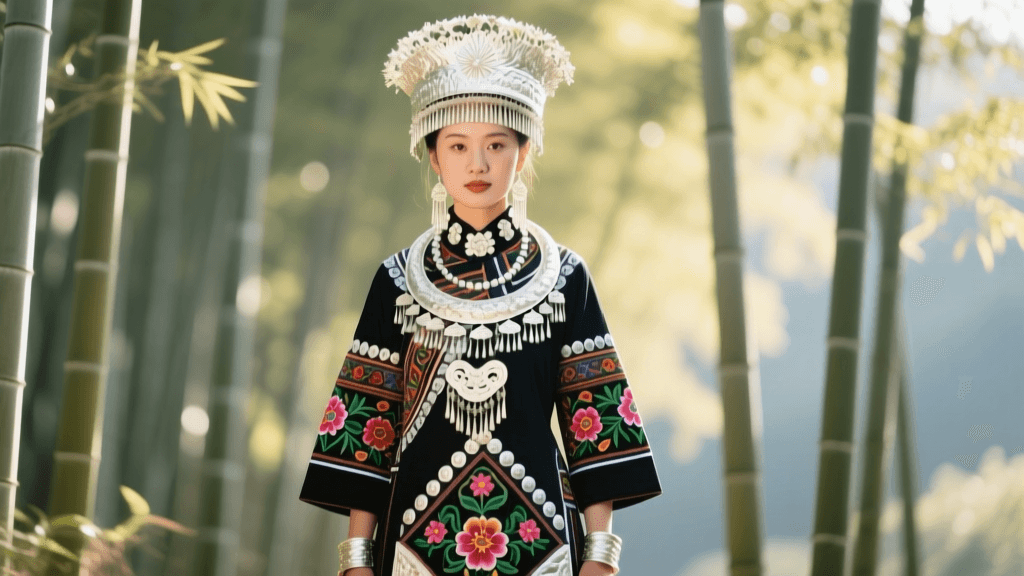
No discussion of Miao folk dress is complete without addressing its spectacular silverwork. In Miao culture, silver represents purity, wealth, and spiritual protection. It is believed that the bright luster of silver can ward off evil spirits and illuminate the path for ancestors. Silversmithing is traditionally a male-dominated craft passed down patrilineally, involving complex processes of smelting, hammering, braiding, and filigree. The silversmithing process itself is a marvel of rural engineering. Artisans use rudimentary charcoal forges and bamboo blowpipes to reach the melting point of silver, before hammering the ingots into gossamer-thin sheets and fine wires.
During major festivals, a Miao woman may wear up to 10 kilograms of silver, including massive horned headdresses, tiered necklaces, breastplates, and bracelets. The Xijiang Silver Horn Headdress is perhaps the most iconic piece, featuring sweeping horns that mimic the water buffalo, adorned with intricate filigree butterflies and birds. The sheer weight of the silver is a point of pride, demonstrating the family's prosperity and the wearer's physical fortitude.
Regional Variations in Miao Folk Dress
China's vast topography has led to distinct subgroups within the Miao ethnic classification, each with unique sartorial markers. Below is a comparison chart detailing the primary regional variations in provincial Miao dress:
| Region / Subgroup | Skirt Style | Silver Usage | Primary Motifs & Techniques |
|---|---|---|---|
| Xijiang (Leishan) | Long, heavily pleated indigo skirts (up to 20 meters of fabric) | Massive, elaborate silver horns and heavy tiered necklaces | Butterfly Mother, dragons, dense flat-stitch embroidery |
| Shiqian / Danzhai | Short, stiff pleated skirts (often above the knee) | Moderate; focuses on silver hairpins and smaller combs | Geometric patterns, heavy braid-stitch, bird motifs |
| Huishui | Wrap-around batik skirts with wide hems | Minimalist; simple silver bangles and earrings | Wax-resist batik (indigo dye), floral and star geometry |
| Rongjiang | Long, flowing skirts with apron overlays | Ornate silver breastplates and hair crowns | Bird-feather embroidery, appliqué, bright silk threads |
The preservation of these diverse regional techniques is increasingly recognized globally. Initiatives tracked by organizations like UNESCO Intangible Cultural Heritage highlight the urgency of protecting these localized crafts from the homogenizing effects of modern mass production. Furthermore, industry insights from China Daily Culture frequently highlight the revival of provincial folk dress on contemporary runways, blending ancient Miao motifs with modern silhouettes.
Practical Buyer’s Guide: Sourcing Authentic Miao Garments
For collectors and enthusiasts looking to acquire authentic Miao provincial dress, navigating the market requires specific knowledge. Here is an actionable guide to sourcing, sizing, and pricing.
Key Garments and Product Names
- Xijiang Silver Horn Headdress: The centerpiece of festival wear. Authentic vintage pieces are rare; modern artisan pieces are custom-forged.
- Indigo Batik Pleated Skirt (Baiqun): A staple of Huishui and Xijiang dress. Requires months of hand-pleating and indigo dyeing.
- Butterfly Mother Jacket (Huiyi): A heavily embroidered, collarless cropped jacket, typically worn over an inner tunic.
Sizing and Measurements
Traditional Miao garments are rarely tailored to exact modern sizing charts. They rely on wrap-around and tie-fastening systems:
- Pleated Skirts: Usually one-size-fits-most, designed as wrap skirts. Look for waistbands that accommodate 70cm to 110cm, secured with woven cotton ties rather than zippers.
- Cropped Jackets: Typically feature a loose, boxy fit. Standard lengths range from 45cm to 55cm, with bust measurements spanning 90cm to 105cm. The sleeves are often wide and three-quarter length to showcase the inner tunic's cuffs.
Costs and Pricing Tiers
Authenticity dictates price. Beware of machine-embroidered tourist replicas.
- Mass-Produced / Tourist Grade: $30 – $80. Machine-stitched, synthetic dyes, alloy silver that tarnishes green.
- Artisan Contemporary: $200 – $600. Hand-embroidered by rural cooperatives, natural indigo dye, sterling silver (marked 990 or 999).
- Vintage / Antique (Pre-1980s): $800 – $3,000+. Sourced from specialized textile dealers. Features unparalleled stitch density and natural, fermented indigo that has aged to a rich, dark mahogany.
Timing Your Purchase
The best time to source authentic pieces directly from artisans in Guizhou is during major cultural festivals. The Miao New Year (typically falling in November or December) and the Sisters' Meal Festival (in April) are ideal. During these periods, villages like Xijiang and Shiqian open their homes, and local markets overflow with newly finished textiles and silverwork. Buying directly from the artisan during these festivals ensures fair compensation and guarantees authenticity. When inspecting silver, look for the artisan's hallmark or the purity stamp (such as Zu Yin for pure silver). Genuine Miao silver is intentionally left with a slightly matte, brushed finish rather than a high-gloss machine polish.
Caring for Handmade Indigo and Silver
Provincial folk dress requires specialized care to maintain its structural and historical integrity.
- Indigo Textiles: Natural indigo is notoriously prone to bleeding. Never machine wash Miao skirts or jackets. Hand wash in cold water with a cup of white vinegar or rock salt to help set the dye. Do not wring; gently press out water and dry flat in the shade. Sunlight will rapidly fade natural botanical dyes.
- Silver Ornaments: High-purity Miao silver (999) is soft and prone to scratching. Store pieces wrapped in anti-tarnish cloth. To clean tarnished silver without damaging delicate filigree, use the aluminum foil and baking soda method: line a bowl with aluminum foil, add hot water and two tablespoons of baking soda, and submerge the silver for five minutes. Rinse and pat dry with a microfiber cloth.
By understanding the profound cultural weight, regional nuances, and material realities of Miao provincial dress, collectors and enthusiasts can ethically source and preserve these wearable masterpieces for future generations.