Authentic Miao Indigo Batik and Silver Jewelry Guide
The Living Heritage of Miao Textile and Silver Artistry
The Miao people, one of China's largest and most culturally diverse ethnic minority groups, possess a sartorial heritage that functions as both a wearable art form and a historical archive. Because the Miao historically lacked a written language, their history, mythology, and clan identities were woven into their clothing. Today, the traditional garments of the Miao—particularly those from the Guizhou, Yunnan, and Hunan provinces—remain some of the most intricate and highly sought-after textiles in Asia. For collectors, cultural enthusiasts, and ethical fashion buyers, understanding the nuances of Miao indigo batik and silver ornamentation is essential to distinguishing genuine heritage pieces from mass-produced tourist souvenirs.
According to cultural heritage documentation by UNESCO, the traditional craftsmanship of ethnic minority textiles is a vital component of global intangible cultural heritage. Preserving these techniques requires not only appreciation but also informed, ethical sourcing that supports the artisans directly.
The Alchemy of Authentic Miao Indigo Batik
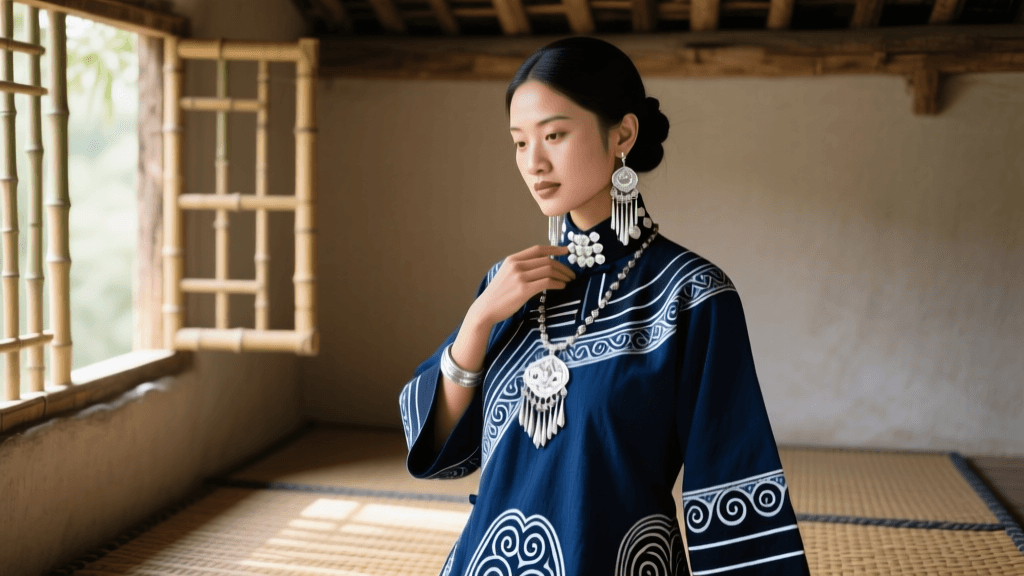
Miao batik, known as laba, is a resist-dyeing technique that relies on natural beeswax and fermented indigo. The process begins with harvesting the indigo plant (Persicaria tinctoria) in late summer, typically between July and August. The leaves are fermented in wooden vats for weeks to create a living dye bath. Artisans use a specialized brass tool called a ladao (batik knife) to melt beeswax over a charcoal brazier and draw intricate geometric and mythological patterns directly onto raw cotton or hemp.
Once the wax hardens, the fabric is submerged in the indigo vat. Authentic Miao indigo dyeing is not a single-step process. To achieve the deep, lustrous navy-blue characteristic of high-quality Miao textiles, the fabric must be dipped, oxidized in the air, and re-dipped up to twenty times over a period of two to three weeks. Finally, the cloth is boiled in water to melt away the beeswax, revealing the stark white pattern against the deep blue background. The resulting fabric often features a subtle 'ice-crack' effect where the dye seeped into natural fractures in the wax, a hallmark of genuine hand-drawn batik.
Sourcing Real Indigo: A Buyer's Checklist
When shopping in markets in Kaili, Danzhai, or Beijing's antique textile districts, use these practical metrics to verify authenticity:
- The Smell Test: Authentic fermented indigo has a distinct, earthy, slightly fermented botanical scent. Chemical dyes smell sharp, metallic, or like synthetic ammonia.
- The Water Test: Rub a damp white cloth vigorously on the blue dye. Natural indigo will transfer a slight, soft blue tint that washes out easily, whereas chemical dyes will bleed harshly and stain permanently.
- The Reverse Side: Hand-dipped natural indigo rarely penetrates thick cotton entirely. The back of authentic Miao batik will often be a lighter shade of blue or off-white. If the blue is perfectly uniform on both sides, it is likely commercially screen-printed.
- Cost Expectations: Authentic, hand-drawn Miao batik from master artisans costs between 200 to 400 RMB ($28 to $55 USD) per meter. Commercially stamped chemical alternatives sell for as little as 20 RMB ($3 USD) per meter.
The Weight of Tradition: Miao Silver Ornaments
No Miao festival ensemble is complete without silver. In Miao cosmology, silver represents the moon, purity, and spiritual protection against evil spirits. The sheer volume of silver worn by a woman during festivals like the Lusheng Festival or the Sister's Meal Festival is a direct indicator of her family's wealth and social standing.
The most iconic piece is the Yinjiao, or silver horn headdress. These elaborate crowns can weigh anywhere from 1.5 kilograms to over 3 kilograms and are composed of dozens of individual silver pieces, including butterflies, dragons, and birds, all attached to a heavy silver band. Ethnographic archives at The British Museum highlight the exceptional silversmithing of the Miao, noting the use of repoussé, chasing, and intricate wire-work that rivals European metalwork of the same eras.
Buying Miao Silver: Measurements and Market Realities
If you intend to purchase Miao silver jewelry, you must navigate a market flooded with 'Tibetan silver' and white copper alloys. Here is how to buy smart:
- Purity and Weight: Authentic Miao silver is typically 99% pure (S990) or sterling (S925). Artisans charge by the gram. Expect to pay the daily spot price of silver plus a craftsmanship fee, usually totaling 15 to 30 RMB per gram.
- The Magnet Test: Bring a strong neodymium magnet. Pure silver is non-magnetic. If the hairpin or neck ring pulls toward the magnet, it contains iron or steel.
- The Sound Test: When gently tapped, pure silver produces a dull, soft 'thud' rather than a high-pitched, resonant 'ping' associated with brass or copper alloys.
- Product Names to Request: Ask for specific traditional items such as the Yinxiangquan (silver neck ring with a locking clasp) or Yinzan (silver hairpins with dangling floral motifs).
The Hundred-Pleated Skirt: Engineering and Elegance
The Baizhequn, or 'hundred-pleated skirt,' is a marvel of textile engineering. Worn primarily by Miao women in southeastern Guizhou, these skirts are not cut from a pattern but are meticulously folded and bound. A single high-quality skirt requires 15 to 20 meters of indigo-dyed cotton and features between 500 and 1,000 microscopic pleats.
Creating the pleats involves spraying the damp, dyed cotton with a mixture of water and straw ash, folding it accordion-style, and binding it tightly with hemp thread to set the shape. The skirt is left to dry and cure for several weeks. When worn, the skirt flares out in a perfect, stiff bell shape. To care for an authentic Baizhequn, never wash it in a machine or submerge it in water, as this will destroy the pleats. Instead, spot-clean gently and store it tightly rolled or bound in its original pleated state in a cool, dry environment.
Comparative Guide: Authentic vs. Commercial Miao Batik
To help buyers and collectors make informed decisions, the following table contrasts genuine artisanal Miao batik with mass-produced commercial alternatives commonly found in tourist hubs.
| Feature | Authentic Artisanal Batik | Commercial / Tourist Batik |
|---|---|---|
| Dye Source | Natural fermented indigo plant | Synthetic chemical indigo vat dyes |
| Resist Material | Pure, locally harvested beeswax | Paraffin wax or synthetic resins |
| Application Tool | Hand-drawn brass ladao knife | Silk-screen printing or metal stamps |
| Pattern Symmetry | Slight organic imperfections | Perfect, mathematical symmetry |
| Ice-Crack Effect | Natural, random, and unique | Printed on, uniform, and repetitive |
| Cost per Meter | 200 - 400 RMB ($28 - $55 USD) | 15 - 30 RMB ($2 - $4 USD) |
Ethical Sourcing and Festival Timing
The most effective way to source authentic Miao garments and support the local economy is to visit the villages directly during major cultural festivals. As reported by Sixth Tone, the revitalization of rural ethnic crafts relies heavily on conscious cultural tourism that compensates artisans fairly for their time-intensive labor.
Timing Your Visit:
- The Sister's Meal Festival (April/May): Held in Taijiang County, this is the premier event to see young women wearing their family's most elaborate silver headdresses and pleated skirts. It is an excellent time to commission custom silver pieces directly from village smiths.
- The Lusheng Festival (Autumn): Celebrated across the Miao regions of Guizhou, this harvest festival features vibrant textile displays. Artisans are more likely to sell personal, high-quality heirloom pieces during the post-harvest season when household incomes are supplemented.
- Dyeing Season (July/August): Visit Danzhai County during the late summer to witness the indigo fermentation process and purchase freshly dyed yardage directly from the dye masters before it is tailored into garments.
'When you buy a piece of real Miao batik, you are not just buying cloth. You are buying the three weeks of the dyer's life, the sting of the bees, and the memory of the mountains.' — Elder Artisan, Danzhai County
By understanding the rigorous craftsmanship behind the indigo vats and the silversmith's forge, collectors and enthusiasts can ensure their acquisitions honor the profound legacy of Miao ethnic minority clothing traditions. Whether you are investing in a heavy silver neck ring or a meticulously pleated indigo skirt, prioritizing authenticity and ethical sourcing guarantees that these ancient Asian traditions will continue to thrive for generations to come.