Inclusive Kimono Styling for Every Body Type and Gender
The Myth of 'One Size Fits All'
The traditional Japanese kimono is often misunderstood in the West as a rigid, 'one-size-fits-all' garment. In reality, the kimono is a masterpiece of modular tailoring. Unlike Western fashion, which cuts fabric to hug the body's contours, the kimono is constructed from straight bolts of fabric called tanmono. The fit is achieved not through darts and seams, but through the art of kitsuke (dressing), which uses folding, tucking, and padding to create the desired silhouette. According to The Metropolitan Museum of Art, the kimono's T-shaped structure allows it to be disassembled, washed, and re-tailored, making it inherently adaptable. However, as global interest in kimono wearing grows, so does the need for inclusive styling for curvy, tall, and gender-nonconforming bodies. This guide provides actionable advice for navigating kimono dimensions, modern styling hacks, and rental shop logistics for every body type.
Decoding Kimono Measurements and Architecture
Before addressing specific body types, it is crucial to understand the primary measurements of a kimono. The three most critical dimensions are mitake (garment length), yuki (sleeve span from the center back to the wrist), and sode (sleeve width and depth). Standard vintage and modern women's kimonos are typically tailored for a height of about 155cm to 160cm (5'1" to 5'3"), with a yuki of around 62cm to 64cm. Men's kimonos are scaled proportionally larger but still assume a relatively slender, straight frame. The Victoria and Albert Museum notes that the kimono's historical evolution was heavily tied to standard silk bolt widths, meaning the garment's width is fundamentally limited by the fabric itself, usually around 36cm per panel.
Standard vs. Inclusive Adjustments
| Body Feature | Standard Kimono Dimension | Inclusive Adjustment Technique |
|---|---|---|
| Bust/Chest | Flat, cylindrical ideal | Towel padding to smooth curves; deep V-neck crossing |
| Waist/Hips | Straight drop | Additional waist ties (koshihimo); padded corset |
| Height (Tall) | ~160cm (Mitake) | Wear ankle-length; pair with modern footwear or boots |
| Shoulders (Broad) | ~64cm (Yuki) | Shift shoulder seams; layer with haori jacket |
Styling for Curvy and Plus-Size Bodies
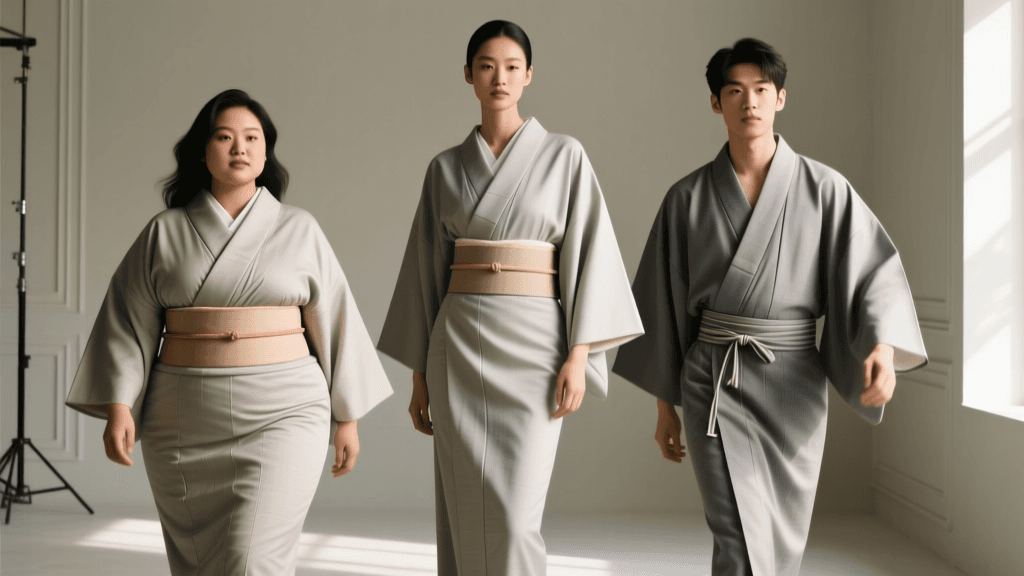
The traditional kimono silhouette is famously cylindrical, designed to minimize the bust, waist, and hips. For curvy or plus-size individuals, this can seem daunting, but the dressing process actually offers brilliant solutions. The secret lies in strategic padding. Rather than using Western shapewear to cinch and squeeze, professional kitsuke artists use specialized towels and a garment called a kimono bra or corset to fill in the dips of the waist and lower back. By creating a smooth, tube-like foundation, the kimono fabric drapes elegantly without pulling or wrinkling at the bust or hips.
When wrapping the front panels, the left panel is always wrapped over the right (except when dressing the deceased). For larger busts, the collar can be pulled into a deeper V-shape, known as 衣紋を抜く (pulling the collar back from the neck), which elongates the torso and prevents the fabric from choking the neckline. Furthermore, plus-size wearers should look for kimonos made from synthetic blends or modern cottons, which often feature wider panel widths than antique silk, providing extra room around the hips and ensuring the overlapping front panels do not gape open while walking.
Solutions for Tall Wearers
Height is the most challenging metric to adjust in traditional kimono wearing due to the fixed mitake (length). A standard women's kimono will often fall above the ankles on someone over 170cm (5'7"). Historically, showing the ankles was considered improper. Today, however, fashion-forward dressers have embraced the 'ankle-baring' look. Pairing a shorter kimono with opaque tights, modern leather boots, or even sneakers has become a celebrated street-style trend in Harajuku and Kyoto.
If you are purchasing a kimono, seek out vintage meisen (a type of ikat-woven silk) from the Taisho and early Showa eras. According to textile historians, women in the 1920s and 30s were generally taller and embraced more liberal, Western-influenced silhouettes, resulting in longer vintage garments. Alternatively, modern brands like Jotaro Saito offer custom-length denim and polyester kimonos that cater specifically to taller, international clientele, though custom orders can cost upwards of ¥100,000 ($650+ USD).
Masculine and Gender-Inclusive Styling
The binary division of otoko-mono (men's garments) and onna-mono (women's garments) is deeply ingrained in kimono culture, but modern wearers are increasingly blurring these lines. Men's kimonos are cut with a straighter drop, lack the underarm slits (miyatsukuchi) found in women's garments, and feature subdued colors like navy, charcoal, and olive. The obi (sash) for men is worn low on the hips, tied in a simple, flat knot at the back.
For gender-nonconforming individuals or women who prefer a masculine silhouette, adopting the hakama (pleated trousers) is a powerful styling choice. Originally worn by samurai and male aristocrats, hakama are now widely worn by women in martial arts and university graduation ceremonies. Pairing a dark, unpatterned kimono with a striped hakama and a short haori jacket creates a striking, gender-neutral silhouette that accommodates broad shoulders and taller frames beautifully. The Japan National Tourism Organization highlights that many modern rental shops in Tokyo now offer 'genderless' kimono packages, allowing clients to mix and match masculine and feminine accessories, such as pairing a vibrant, floral women's kimono with a structured, masculine haori and leather footwear.
Practical Guide: Navigating Rental Shops
If you are visiting Japan and plan to rent a kimono, advance preparation is essential for non-standard body types. Most standard rental shops in Kyoto and Asakusa stock garments for average Japanese dimensions. If you are over 175cm tall, wear a US size 14 (UK 18) or above, or have broad shoulders, you must contact the shop in advance.
- Communication: Email the shop your exact height, bust, waist, and hip measurements in centimeters. Ask specifically if they have 'LL size' or 'overseas size' inventory.
- Cost Expectations: Standard rentals cost between ¥4,000 and ¥7,000. Requesting extended sizing, custom padding time, or private dressing rooms may incur a ¥2,000 to ¥5,000 surcharge.
- Footwear: Rental zori (sandals) are notoriously small, often maxing out at 24.5cm. Tall or broad-footed individuals should plan to wear their own shoes or purchase modern, adjustable footwear to avoid discomfort.
'The kimono does not demand that your body change to fit the cloth; rather, the cloth and the dresser work together to honor the space your body occupies.' — Modern Kitsuke Philosophy
Ultimately, the kimono is a living garment. While its roots are steeped in strict historical conventions, its modular nature makes it one of the most forgiving and adaptable garments in global fashion history. Whether you are using towels to smooth a curvy silhouette, rocking an ankle-baring vintage piece, or blending masculine and feminine elements, the kimono offers a profound way to engage with Asian traditions on your own terms.