A Guide to Miao Silver and Hmong Embroidery Garments
The Wearable Archives of the Miao People
The Miao people, widely known in the West through their diaspora as the Hmong, possess one of the most visually striking and culturally profound sartorial traditions in Asia. Concentrated primarily in the mountainous regions of China's Guizhou, Yunnan, and Hunan provinces, the Miao comprise numerous sub-groups, each distinguished by unique clothing styles, such as the Long-Horn Miao, Black Miao, and Flower Miao. Historically lacking a formal written language, the Miao transformed their textiles into 'wearable history books.' Every stitch, motif, and silver ornament encodes centuries of migration, mythology, and ancestral reverence.
According to cultural historians and reports from Sixth Tone, the transmission of these textile arts is strictly matrilineal. Mothers begin teaching their daughters the complex arts of spinning, weaving, dyeing, and embroidering from as young as five years old. A Miao woman's festival garments are not merely decorative; they are a testament to her patience, skill, and spiritual connection to her lineage, often taking three to five years to complete by hand.
Mastering the Thread: Embroidery and Batik Techniques
The foundation of Miao clothing is typically hand-woven cotton or hemp, transformed through an arduous natural dyeing process. The signature deep indigo hue, known as jian, is achieved through repeated fermentation and dipping. Artisans use a mixture of indigo plant leaves, rice wine, and alkaline ash water. The fabric is dipped and oxidized up to thirty times over several weeks to achieve a color so dark it appears almost black, with a subtle, metallic sheen when polished with egg whites or ox hide glue.
Beyond dyeing, the Miao are legendary for their pleated skirts, or Baimiaoqun. Creating a single traditional skirt requires 15 to 20 meters of indigo-dyed cotton. The fabric is meticulously folded into 500 or more microscopic pleats using bamboo splints, bound tightly with cotton thread, and steamed to set the shape permanently. When worn, the skirt flares out like a bell, allowing for ease of movement across steep mountain terraces.
Comparison of Traditional Miao Embroidery Stitches
Miao embroidery is celebrated globally for its three-dimensional texture and vibrant silk threads. Below is a breakdown of the primary techniques used by master artisans:
| Technique Name | Description & Process | Visual Effect | Time to Complete (per sq. inch) |
|---|---|---|---|
| Pingxiu (Flat Stitch) | Silk threads are laid flat and secured with tiny, nearly invisible couching stitches. | Smooth, vibrant, and painterly; ideal for large surface areas and floral motifs. | 15 - 20 minutes |
| Zhouxiu (Braid/Coiled Stitch) | Silk threads are braided into tiny cords, then coiled and stitched onto the fabric in continuous spirals. | Highly textured, resembling topographical maps or river currents; very durable. | 45 - 60 minutes |
| Dacixiu (Seed Stitch) | Tiny, dense knots are tied across the fabric surface, resembling scattered seeds or beads. | Granular, 3D texture; often used for animal eyes, flower centers, or geometric borders. | 90+ minutes |
| Shuangmianxiu (Double-Sided) | Embroidery worked so precisely that the motif is identical and flawless on both sides of the fabric. | Reversible, seamless elegance; typically reserved for premium collars and baby carriers. | 2+ hours |
The Weight of Heritage: Miao Silver Jewelry
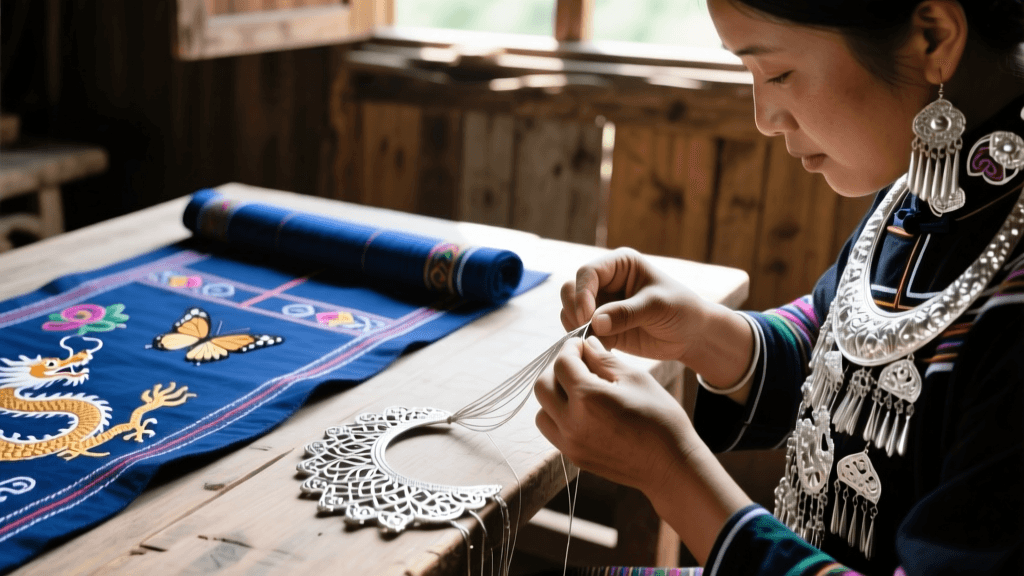
No Miao festival ensemble is complete without elaborate silver jewelry. Silver is believed to ward off evil spirits, illuminate the path to the ancestral realm, and display a family's wealth and social standing. The most iconic piece is the Yinjiao, or silver horn headdress, which can weigh anywhere from 1.5 to over 3 kilograms (3.3 to 6.6 lbs). The horns represent the water buffalo, an animal deeply revered in Miao agrarian society for its strength and vital role in rice cultivation.
The motifs hammered and carved into the silver are deeply symbolic. The 'Butterfly Mother' (Mais Bangx Mais Lief) is a ubiquitous design, stemming from the Miao creation myth where a butterfly laid twelve eggs that hatched into the first humans, dragons, and tigers. Dragons in Miao silverwork are rarely fearsome; they are depicted as benevolent, worm-like, or fish-tailed creatures that protect the harvest and bring rain.
Practical Guide: Sourcing and Purchasing Authentic Pieces
For collectors, textile enthusiasts, and travelers looking to acquire authentic Miao garments and silver, navigating the markets requires a keen eye and an understanding of local commerce. As noted by China Daily, the commercialization of ethnic crafts has led to a surge in machine-made replicas, making it vital to know what to look for.
Where and When to Buy
- Locations: While the Xijiang Thousand Households Miao Village is the most famous tourist destination, serious collectors should visit the Panxing silver market in Kaili or the remote village of Shidong, known specifically for its master silversmiths. For textiles, the weekly markets in Danan and Shiqiao offer direct access to village weavers.
- Timing: The best time to witness these garments in their full cultural context—and to find artisans selling their personal surplus—is during major festivals. The Sisters' Meal Festival (usually mid-April) and the Lusheng Festival (autumn, post-harvest) are prime times for textile and silver trading.
Costs and Authentication
- Textiles: An authentic, hand-embroidered vintage jacket from the 1980s or 90s will cost between $300 and $1,500 USD, depending on the density of the stitching and the rarity of the sub-group's style. Newly commissioned hand-embroidered pieces start around $800 USD due to the hundreds of hours of labor required.
- Silver: Authentic Miao silver is priced by weight plus a craftsmanship fee. Expect to pay between $1.50 and $3.50 USD per gram. A full festival silver set (headdress, neck torcs, chest chains, and bracelets) can easily weigh 5 to 8 kilograms, pushing the cost to $3,000 - $8,000+ USD.
- Verification: Look for the purity stamps '990' or '999' on silver pieces. Authentic hand-hammered silver will have slight, beautiful asymmetries and a softer, matte luster compared to the blinding, uniform shine of factory-stamped Tibetan silver (which is often a nickel-copper alloy with no actual silver content).
Preservation: Caring for Indigo and Silver
Owning a piece of Miao heritage comes with the responsibility of proper preservation. Natural indigo is notoriously sensitive to modern cleaning methods. Never use hot water, bleach, or harsh alkaline detergents on Miao textiles, as this will strip the indigo and cause the natural silk embroidery threads to bleed. Instead, spot clean with cold water and a pH-neutral soap, or rely on traditional airing and gentle brushing. Store the garments flat in a cool, dark place, layered with acid-free tissue paper to prevent the heavy pleats from crushing and the silk threads from snagging.
Silver jewelry requires equal care. The high humidity of southern China means Miao silver is often formulated with a tiny amount of copper to increase durability, which makes it prone to tarnishing. After wearing, wipe the silver with a soft, dry microfiber cloth to remove skin oils. Store the pieces in airtight anti-tarnish bags with silica gel packets. Avoid using liquid silver dips, as they can strip the intentional dark oxidation (patina) that Miao silversmiths use to highlight the intricate carved motifs.
'When a Miao woman puts on her silver and her embroidered jacket, she is not just dressing up; she is wrapping herself in the cosmos, the rivers, and the spirits of her ancestors. She becomes a walking sanctuary.' — Anthropological studies on Hmong material culture, recognized by the UNESCO Intangible Cultural Heritage initiatives.
Collecting and wearing Miao garments is a profound way to engage with Asian traditions. By understanding the immense labor, mythology, and technical mastery behind every pleat and silver scale, enthusiasts can ensure they are supporting authentic craftsmanship and preserving a vital, living history for future generations.