Su Embroidery & China's Four Great Silk Textile Arts
The Legacy of Chinese Silk Embroidery
For over three millennia, silk embroidery has been the defining textile art of China, serving as a visual language for social status, philosophical beliefs, and regional identity. From the intricate dragon robes of the Qing Dynasty to the vibrant ethnic garments of the southwestern provinces, needle and thread have shaped the cultural fabric of Asia. According to The Metropolitan Museum of Art, the mastery of sericulture and silk weaving allowed Chinese artisans to elevate embroidery from mere decoration to a high art form, rivaling painting and calligraphy in its cultural significance.
Today, collectors, fashion historians, and textile enthusiasts seek out these masterpieces not just for their aesthetic beauty, but for the staggering technical skill required to create them. Whether you are looking to commission a traditional garment, invest in a framed textile artwork, or simply understand the heritage of your Asian wardrobe, navigating the world of Chinese silk embroidery requires an understanding of its regional styles, techniques, and market realities.
Su Embroidery: The Pinnacle of Silk Textile Arts
Originating in the water towns of Suzhou, Jiangsu province, Su embroidery (Su Xiu) is widely regarded as the most refined of all Chinese textile arts. Recognized by UNESCO as an Intangible Cultural Heritage, Su embroidery is characterized by its delicate patterns, elegant colors, and astonishingly fine needlework.
The hallmark of a master Su embroiderer is the ability to split a single strand of silk thread into multiple, microscopic filaments. While a standard embroidery might use a whole thread, Su artisans routinely split silk into 1/16th, 1/32nd, and even 1/48th of its original thickness. This allows for imperceptible color gradients and a surface so smooth it resembles a painted brushstroke.
The ultimate display of this skill is Shuangmian Xiu (double-sided embroidery). In this technique, a single piece of sheer silk organza is embroidered so that both the front and back display identical, or sometimes entirely different, images with all thread knots perfectly hidden. A double-sided silk screen featuring a peacock on one side and a tiger on the other can take a master artisan over two years to complete.
Comparing the Four Great Embroideries of China
While Su embroidery claims the spotlight for sheer delicacy, China's textile heritage is broadly categorized into the 'Four Great Embroideries,' each reflecting the climate, culture, and resources of its home province.
| Embroidery Style | Origin Province | Signature Technique | Common Motifs | Avg. Cost (20x20cm Art Piece) |
|---|---|---|---|---|
| Su Xiu | Jiangsu (Suzhou) | Thread splitting, double-sided, flat stitch | Koi fish, peonies, delicate landscapes | $250 - $600 |
| Xiang Xiu | Hunan (Changsha) | Layered stitching, wool/silk blends, bold shading | Lions, tigers, dramatic calligraphy | $150 - $400 |
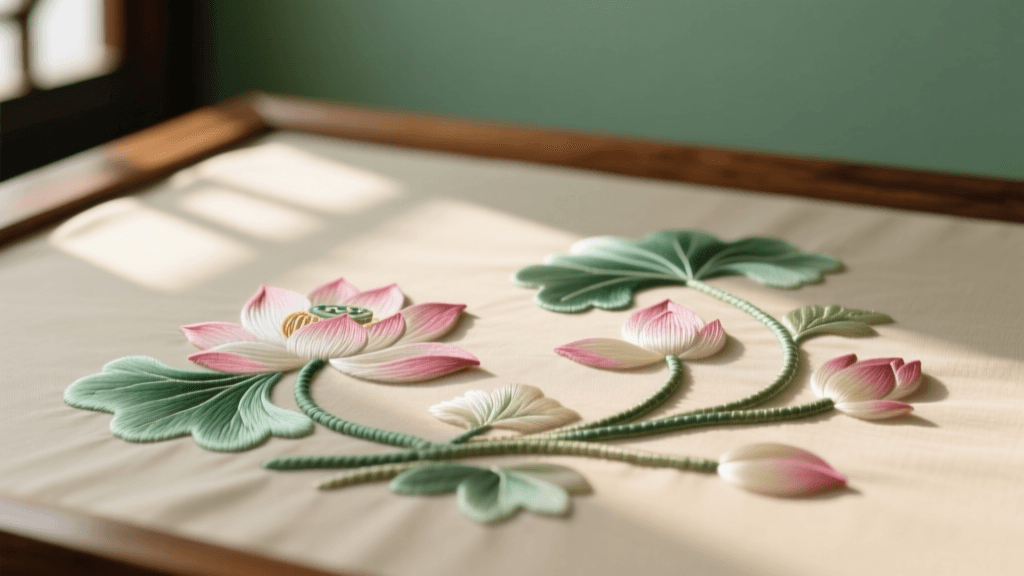
| Shu Xiu | Sichuan (Chengdu) | Soft satin stitch, halo-effect shading | Lotus flowers, pandas, auspicious clouds | $180 - $450 |
| Yue Xiu | Guangdong (Chaozhou) | Gold/silver couching, 3D padding, dense layouts | Dragons, phoenixes, banyan trees | $300 - $800 |
Understanding Xiang, Shu, and Yue Techniques
Xiang Embroidery (Hunan): Known for its striking realism, Xiang embroidery often utilizes a mix of silk and fine wool to capture the texture of animal fur. It is the preferred style for dramatic, powerful motifs like roaring tigers, utilizing a unique 'cross-stitch' layering technique that gives the artwork a almost three-dimensional depth.
Shu Embroidery (Sichuan): Historically used to decorate everyday garments and household items, Shu embroidery is prized for its soft, satin-like finish. The stitches are incredibly tight and even, making it highly durable. It is frequently used in the creation of traditional Changshan (men's robes) and Qipao borders due to its resistance to friction and wear.
Yue Embroidery (Guangdong): Born in the humid, prosperous southern ports, Yue embroidery is opulent and heavily textured. Artisans use cotton padding beneath the silk threads to create raised, 3D effects (known as 'nail gold' or couching), heavily incorporating metallic gold and silver threads. It is the traditional choice for ceremonial wedding garments, specifically the elaborate Qun Kwa bridal jackets.
Beyond the Han: Miao Ethnic Silk Embroidery
While the Four Great Embroideries represent the Han majority, the textile arts of China's ethnic minorities offer a completely different, yet equally masterful, approach to silk. The Miao people of Guizhou and Yunnan provinces are legendary for their intricate embroidery, which serves as a wearable historical record, as the Miao traditionally lacked a written language.
Unlike the refined, painted realism of Su embroidery, Miao embroidery is highly stylized, geometric, and deeply symbolic. Artisans frequently use a technique called 'plaited stitch' or 'braid stitch,' where silk threads are braided into tiny cords before being couched onto indigo-dyed cotton or silk bases. A traditional Miao Bei shan (baby carrier) or a festival jacket can feature motifs of the 'Butterfly Mother' (the mythological creator of humanity) and the water buffalo, taking up to a year of part-time labor to complete. According to the Victoria and Albert Museum, these ethnic textiles are highly prized by anthropologists and collectors for their preservation of ancient mythological narratives.
Practical Guide: Commissioning, Buying, and Caring for Silk Embroidery
Whether you are purchasing a vintage Yue embroidered jacket or commissioning a modern Su silk screen, understanding the market and the material science of silk is crucial for making an informed investment.
Costs and Timelines for Commissioning
- Small Art Pieces (20x20 cm): Expect to pay between $200 and $600 for authentic, hand-stitched Su or Shu embroidery. Machine-made imitations flood the market for under $30; if the price is too good to be true, the thread is likely synthetic polyester.
- Garment Embellishment: Adding custom hand-embroidered cuffs and collars to a bespoke silk Qipao or Tangzhuang will add $400 to $1,200 to the tailoring cost, requiring an additional 4 to 8 weeks of production time.
- Masterworks (50x50 cm and above): Gallery-quality, double-sided Su embroidery screens start at $5,000 and can easily exceed $25,000. Commissioning a piece of this caliber requires a timeline of 18 to 36 months, as master artisans can only work for a few hours a day before eye strain sets in.
Authentication: The Burn Test and Visual Inspection
To authenticate genuine silk thread, request a small snippet of the thread from the seller and perform a burn test. Genuine silk is a protein fiber; when burned, it will smell distinctly like burnt human hair, will not easily sustain a flame, and will leave behind a crushable, dark ash. Synthetic polyester will melt, smell like sweet plastic, and form a hard, uncrushable bead.
Visually, inspect the reverse side of the fabric. While machine embroidery often leaves a messy web of bobbin threads and uniform, perfectly locked stitches, high-quality hand embroidery (especially Su and Shu) will show incredibly neat, deliberate stitch paths, and in the case of double-sided work, an almost identical reverse image.
Preservation and Framing
Silk is highly susceptible to ultraviolet light and fluctuating humidity. To preserve a valuable textile artwork:
- Humidity Control: Maintain a relative humidity (RH) of 45% to 55%. High humidity promotes mold and causes silk fibers to degrade, while low humidity makes the ancient threads brittle.
- UV Protection: Never hang silk embroidery in direct sunlight. When framing, invest in museum-grade UV-filtering acrylic or glass. This upgrade typically costs an additional $100 to $250 at a professional framer but is non-negotiable for preserving the vibrant aniline and natural dyes used in traditional pieces.
- Mounting: Avoid using standard glue or tape. Insist on 'fabric hinges' or hand-stitching the textile to an acid-free, archival cotton mat board to allow the silk to expand and contract naturally with seasonal temperature changes.
'To understand Chinese embroidery is to understand the Chinese conception of time. A master does not stitch to finish; she stitches to capture the breath of the subject. A single petal may take three days, but it will live for three centuries.'
— Traditional Suzhou Embroidery Adage
Conclusion
From the gilded dragons of Guangdong's Yue embroidery to the microscopic, painted-like stitches of Suzhou's Su Xiu, China's silk textile arts represent an unbroken lineage of human ingenuity. Whether you are preserving a family heirloom, investing in a masterwork, or simply admiring the intricate borders of a traditional Changshan, recognizing the immense labor and regional history woven into these garments elevates our appreciation of Asian traditions. By supporting authentic artisans and practicing proper textile conservation, we ensure that these vibrant threads of history continue to be passed down through the generations.