Miao Provincial Dress: Guizhou Silverwork & Batik
The Cultural Tapestry of Miao Provincial Dress
The Miao people, widely known in the West as the Hmong, possess one of the most diverse and visually stunning sartorial traditions in Asia. Concentrated heavily in China's southwestern Guizhou province, the Miao are not a monolithic group; they are divided into over a hundred distinct branches, each with its own dialect, customs, and provincial dress. Unlike the standardized Hanfu or the Manchu-influenced Qipao, Miao clothing is a hyper-local identifier. A garment can reveal the wearer's exact village, marital status, and age group. For textile enthusiasts, historians, and collectors, the provincial dress of Guizhou represents a masterclass in indigo dyeing, intricate embroidery, and monumental silverwork.
Historically, the Miao did not possess a written language. Instead, they recorded their mythology, migration history, and cosmological beliefs directly onto their garments. As noted by cultural historians and archives at the Metropolitan Museum of Art, Miao textiles serve as wearable archives. Every stitch and silver motif tells a story of ancestral journeys across the Yellow River and into the mountainous terrain of the southwest.
Regional Variations: A Comparative Guide
Guizhou's rugged topography has isolated communities for centuries, leading to extreme regional variations in folk dress. While the base material is almost universally hand-woven cotton dyed in fermented indigo vats, the cut, embroidery style, and pleating techniques vary drastically from one mountain valley to the next. Below is a comparison of four major regional styles within Guizhou province.
| Region / Branch | Key Garment Features | Dominant Motifs | Skirt Style & Pleating |
|---|---|---|---|
| Xijiang (Leishan) | Cropped, wide-sleeved indigo jackets with heavy cross-stitch lapels. | Buffalo horns, butterflies, and dragons. | Long, heavily pleated indigo skirts requiring up to 30 meters of fabric. |
| Danzhai | Batik-dominant jackets with minimal embroidery, paired with woven sashes. | Birds, bees, and the 'Butterfly Mother' (Mai Bang). | Short, stiff pleated skirts worn with heavily embroidered front aprons. |
| Huangping | Brightly colored silk embroidery on red and orange bases, departing from indigo. | Geometric stars, pomegranates, and stylized fish. | Medium-length skirts with fine, tight pleats and bright silk borders. |
| Rongjiang | Long, flowing wrap-around coats with ancient, appliqué dragon panels. | Mythological beasts, water buffalo, and ancestral spirits. | Long, unpleated wrap-around skirts with elaborate hemline embroidery. |
According to ethnographic resources like China Highlights, these regional distinctions are fiercely guarded, and wearing the dress of a neighboring village during a festival is considered a significant cultural faux pas.
The Art of Indigo Batik and Embroidery
The foundation of most Miao provincial dress is the indigo dye vat. Unlike the chemical dyes used in mass-produced tourist souvenirs, authentic Miao indigo is cultivated locally, fermented with rice wine, wood ash, and sweet rice water, and maintained for years. A master dyer can achieve over fifty distinct shades of blue, culminating in a deep, metallic black-blue that requires dozens of dips and oxidations. To give the fabric a distinctive sheen and water-resistant quality, the dyed cotton is repeatedly pounded with wooden mallets and rubbed with pig's blood or egg whites.
Batik (Laba): In regions like Danzhai, women use a brass stylus (ladao) to draw intricate patterns on white cotton using melted beeswax. The cloth is then submerged in the indigo vat. Once the desired shade is reached, the fabric is boiled, melting away the wax to reveal crisp, white, un-dyed patterns against the deep blue background. The slight cracking of the wax during the dyeing process creates a delicate, web-like veining that is the hallmark of authentic, hand-drawn Miao batik.
Embroidery Techniques: Miao embroidery is legendary for its complexity. Artisans utilize up to a dozen distinct stitching methods. The 'broken stitch' (po xian xiu) involves twisting silk threads into microscopic coils, creating a raised, three-dimensional texture that mimics crocodile skin or dragon scales. The 'counted stitch' (shu sha xiu) is used for geometric patterns, requiring the embroiderer to count individual warp and weft threads of the base fabric to ensure perfect symmetry.
Mastering Miao Silverwork: Craftsmanship and Weight
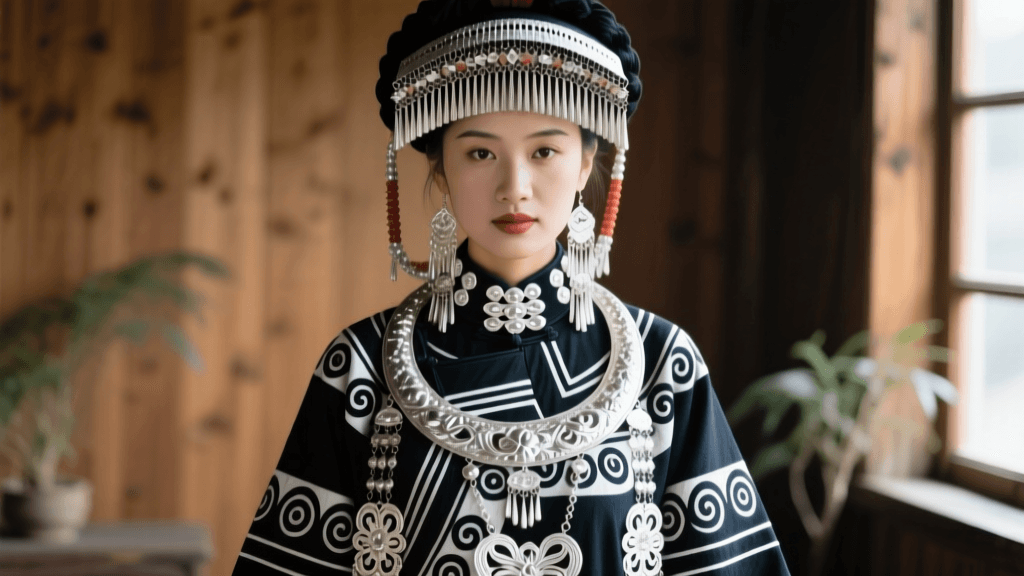
No discussion of Miao provincial dress is complete without addressing the monumental silver jewelry that accompanies festival wear. For the Miao, silver represents light, purity, and spiritual protection against malevolent mountain spirits. A full festival ensemble for a young woman can weigh between 5 to 10 kilograms, consisting of horned headdresses, massive multi-layered neck rings, chest plates, and hairpins.
The iconic silver horn headdress (yin jiao) mimics the water buffalo, an animal deeply revered in Miao agrarian society. Crafted using repoussé, filigree, and granulation techniques, these headdresses are masterpieces of provincial metalwork. The British Museum houses several examples of Miao silver and textile combinations, noting the extraordinary level of detail in the hand-chased floral and zoomorphic motifs that cover every millimeter of the metal.
Practical Guide for Collectors and Enthusiasts
For those looking to acquire authentic Miao garments, study the craftsmanship, or attend regional festivals, a strategic approach is necessary. The markets in Kaili and the tourist shops of Xijiang are flooded with machine-made replicas. Here is actionable advice for serious collectors and cultural travelers.
Sizing and Measurements
Traditional Miao garments were not tailored to individual measurements but were constructed using standardized, geometric cuts that accommodate a wide range of bodies. When purchasing vintage or authentic handmade pieces, keep these standard measurements in mind:
- Cropped Festival Jackets: Length is typically 40cm to 50cm (ending above the waist). Shoulder width ranges from 38cm to 45cm, with wide, straight sleeves measuring 55cm to 60cm in length.
- Pleated Skirts: These are almost universally wrap-around styles secured with woven cotton ties. They do not use zippers or buttons and can comfortably fit waist measurements from 65cm to 95cm. The length varies by region, from 45cm (Danzhai) to 85cm (Xijiang).
- Baby Carriers (Bei Shan): A highly collectible item, these T-shaped embroidered panels measure approximately 80cm by 90cm, featuring heavy padding and intricate butterfly motifs to protect the child's spirit.
Pricing and Authenticity Verification
Authentic, handcrafted Miao provincial dress is an investment. When evaluating pieces, use the following benchmarks:
- Vintage Embroidered Jackets (1950s-1980s): Expect to pay between $300 and $1,200 USD. Authenticity is verified by examining the reverse side of the embroidery; hand-stitched pieces will show neat, deliberate knotting, whereas machine-made replicas will have a continuous, locked thread line. Furthermore, vintage indigo will have a distinct, earthy scent and may show slight, natural fading at the friction points (shoulders and cuffs).
- Silver Jewelry: Miao silversmiths typically charge based on the daily weight of silver plus a craftsmanship fee. While raw silver trades for roughly 6 to 8 RMB per gram, artisan Miao silverwork costs between 25 and 45 RMB per gram ($3.50 to $6.25 USD). A solid, hand-forged 500g silver neck ring will cost approximately $175 to $315 USD. Always ask for the '999' pure silver hallmark, as traditional Miao silverwork uses near-pure silver for its malleability, unlike the '925' sterling silver used in Western jewelry.
Timing Your Visit
To witness these garments in their proper, kinetic context, timing your visit to Guizhou is crucial. The best time to observe authentic provincial dress is during major lunar festivals:
- The Sisters' Meals Festival (Zimei Fan Jie): Held in mid-April (based on the lunar calendar), primarily in Taijiang and Xijiang. Young women don their most elaborate silver headdresses and pleated skirts to court suitors. This is the premier event for observing Huangping and Leishan regional variations.
- The Lusheng Festival: Occurring in late autumn (usually November), this festival features massive courtyard dances accompanied by the lusheng (a traditional bamboo pipe organ). The swirling dances are specifically designed to show off the stiffness and swing of the heavily pleated indigo skirts.
By understanding the regional nuances, the painstaking craftsmanship of indigo and silver, and the practical metrics of acquisition, enthusiasts can deeply appreciate and responsibly preserve the extraordinary legacy of Miao provincial dress.