Complete Hanfu Ensembles: A Guide to Jade Hair Accessories
The Art of the Complete Hanfu Ensemble
The global revival of Hanfu (traditional Han Chinese clothing) has evolved far beyond simply wearing a beautifully embroidered robe. True historical accuracy and aesthetic harmony require a complete ensemble, where headwear and hair accessories play a pivotal role. In traditional Chinese culture, the head was considered the most sacred part of the body, and adorning it was a reflection of one's social status, age, and moral refinement. According to the ancient Book of Rites (Liji), the capping ceremony for men and the hairpin ceremony (Ji Li) for women marked the crucial transition into adulthood. Today, modern Hanfu enthusiasts honor these traditions by meticulously curating their accessories, with jade remaining the most revered material in Chinese ornamental history.
As noted by The Metropolitan Museum of Art, jade has been worked into objects of personal adornment and ritual significance in China for over seven thousand years. It symbolizes purity, moral integrity, and immortality. When building a complete Hanfu wardrobe, understanding how to select, style, and care for jade hair accessories is essential for achieving an authentic and elegant silhouette.
Understanding Traditional Jade Hair Accessories
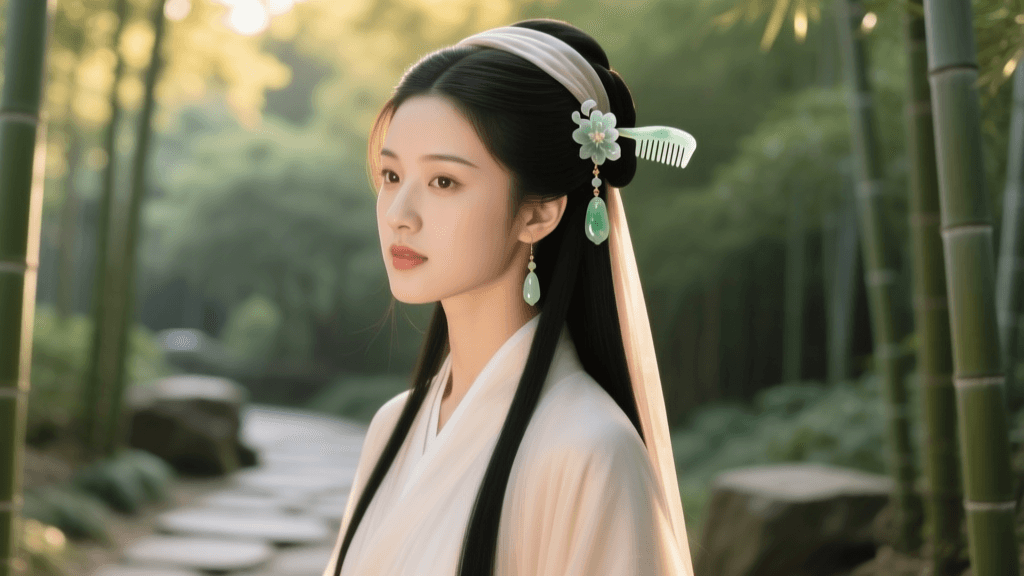
Traditional Chinese hair accessories, collectively known as shoufu (headwear) or toushi (hair ornaments), come in various structural forms. When incorporating jade, the stone is usually carved into decorative heads and mounted onto metal prongs made of brass, copper, or silver-plated alloys. Pure gold or silver is rarely used for the prongs themselves, as these precious metals are too soft to support the significant weight of carved jade without bending.
Zan (Single-Pronged Hairpin)
The Zan is the most fundamental hair accessory, featuring a single prong used to secure buns or pierce through the topknot. Jade Zan heads are often carved into auspicious motifs like lotus flowers, magpies, or ruyi scepters. For practical use, a standard jade Zan should have a prong length of 12cm to 16cm and a thickness of at least 4mm to prevent snapping under the tension of thick hair.
Chai (Double-Pronged Hairpin)
The Chai features two prongs, providing greater stability and allowing for more elaborate, heavier jade carvings. Chai are often used to secure the sides of complex updos like the Tang dynasty Feixian Ji (flying fairy bun). The dual prongs distribute the weight of the jade more evenly, making them ideal for larger, statement pieces featuring intricate openwork carving.
Sheng (Frontlets and Floral Clips)
Worn at the front of the hairline or temples, Sheng are decorative pieces that do not always pierce the hair but are attached via hidden combs or smaller pins. Jade Sheng are popular in Song and Ming dynasty styling, offering a subtle, elegant flash of green or white against dark hair.
Selecting Authentic Jade: Nephrite vs. Jadeite
When shopping for Hanfu hair accessories, it is crucial to understand the gemological distinction between the two minerals commonly referred to as 'jade'. The Gemological Institute of America (GIA) clarifies that while both are used in jewelry, they possess different historical and physical properties. Historically, Han Chinese culture revered Nephrite (Hetian jade), while Jadeite (Burma jade) became highly popular later during the Qing dynasty.
| Feature | Nephrite (Hetian Jade) | Jadeite (Feicui) |
|---|---|---|
| Historical Era | Neolithic to Ming Dynasty (Traditional) | Qing Dynasty to Modern Era |
| Appearance | Buttery, translucent,温润 (warm and moist) | Glassy, highly translucent, vibrant colors |
| Colors | White (Mutton Fat), Celadon, Yellow, Black | Imperial Green, Lavender, Red, Yellow |
| Mohs Hardness | 6.0 - 6.5 | 6.5 - 7.0 |
| Price Range (Hairpin) | $80 - $500+ (Highly variable by quality) | $150 - $1,000+ (Premium greens are costly) |
For pre-Tang, Tang, and Song dynasty Hanfu ensembles, Nephrite (especially pale celadon or 'mutton fat' white) is the most historically accurate choice. For Ming dynasty or Qing-inspired clothing, vibrant Jadeite is entirely appropriate and visually striking. As detailed in the GIA Nephrite Guide, authentic nephrite possesses a fibrous interlocking structure that makes it incredibly tough, ideal for the intricate carvings required for hairpin heads.
Styling Your Hair Accessories for Different Hanfu Styles
Matching your jade accessories to your specific Hanfu silhouette ensures a cohesive and historically grounded look.
- Tang Dynasty Ruqun (Chest-high skirts): Tang styling is characterized by opulence and volume. Use large, heavy Jadeite Chai adorned with gold wire and pearl drops. The hair is often styled high and wide, requiring robust double-pronged pins to anchor the heavy jade securely.
- Song Dynasty Beizi (Long outer coats): Song aesthetics favor minimalism, elegance, and restraint. A single, exquisitely carved white Nephrite Zan placed horizontally through a simple, low bun perfectly captures the scholarly and refined spirit of the era.
- Ming Dynasty Aoqun (Jacket and skirt): Ming styling often incorporates elaborate gold and gemstone jewelry. Pair deep green Jadeite hairpins with gold-leaf accents. The Diji (a specific Ming dynasty hair ornament base) can be decorated with small jade inlays to complement the structured, dignified silhouette of the Ao jacket.
Practical Guide: Building Your First Jade Accessory Collection
Starting a collection of authentic jade hair accessories can be daunting due to the prevalence of dyed quartz, glass, and resin imitations in the market. Here is a practical approach to building a reliable, high-quality collection for your Hanfu wardrobe.
1. Budgeting and Sourcing
Allocate a budget of $50 to $150 for your first authentic Nephrite Zan. Avoid suspiciously cheap 'jade' hairpins (under $20), which are almost certainly dyed serpentine or glass. Source your accessories from specialized Hanfu jewelers who provide gemological certificates, or reputable antique dealers who specialize in Chinese export jewelry. When buying online, request natural sunlight photos and videos to check for the stone's internal fibrous structure or crystalline inclusions, which are hallmarks of genuine jade.
2. Weight and Hair Preparation
Jade is dense and heavy. A carved jade head can weigh between 15 and 40 grams. To support this weight without the hairpin slipping out or causing scalp tension, you must build a strong structural base in your hair. Use a hair donut or padding to create volume, and secure the base with multiple bobby pins and a strong-hold hair net before inserting the jade Zan or Chai. Always insert the pin at a downward angle, catching the hair close to the scalp for maximum leverage.
3. Metal Prong Maintenance
Because jade is harder than most base metals used for the prongs (like brass or copper), the metal will wear down over time. Inspect the prongs of your hairpins regularly. If you notice thinning or bending, take the piece to a jeweler to have the prong reinforced or replaced with a thicker sterling silver or stainless steel rod to protect your investment and prevent the jade head from snapping off and breaking on the floor.
Caring for Your Jade Hairpieces
Jade is tough, but it is not invincible. A sharp impact against a hard surface, such as a marble floor or a glass vanity, can cause internal fractures or catastrophic breaks. When removing your Hanfu ensemble at the end of the day, never pull the jade hairpin out by the carved head; always grip the metal prong or the base of the stone to avoid loosening the adhesive or wire wrapping that binds the jade to the metal.
Clean your jade accessories using only warm water and a soft, lint-free cloth. Avoid ultrasonic cleaners and harsh chemical jewelry dips, as these can strip the natural oils from Nephrite, leaving it looking dry and chalky, and can damage the delicate metal filigree often found on Ming-style hairpins. Periodically, you can rub a tiny drop of baby oil or specialized jade wax onto the stone to maintain its lustrous, 'wet' appearance, honoring the ancient Chinese appreciation for jade's温润 (warm and moist) tactile beauty.
Conclusion
Building a complete Hanfu ensemble is a deeply rewarding journey into Asian traditions, textile arts, and historical aesthetics. By thoughtfully selecting authentic jade hair accessories—understanding the historical weight of Nephrite, the structural requirements of the Zan and Chai, and the specific styling nuances of different dynasties—you elevate your Hanfu from a mere costume to a living, breathing homage to Chinese cultural heritage. Whether you are attending a Hanfu convention, participating in a traditional tea ceremony, or simply enjoying a photoshoot, the quiet elegance of jade in your hair will undoubtedly complete your sartorial masterpiece.