Miao Folk Dress: Guizhou Silver Jewelry & Pleated Skirts
The Living Textiles of Guizhou: An Introduction to Miao Dress
The Miao people, an indigenous ethnic group predominantly residing in the mountainous regions of Guizhou, Hunan, and Yunnan provinces in China, possess one of the most visually striking and culturally profound sartorial traditions in Asia. Because the Miao lacked a formal written language for much of their history, their clothing served as a vital historical record. Every stitch, motif, and silver ornament tells a story of migration, mythology, and clan identity. According to research documented by Cultural Survival, Miao textiles are not merely decorative; they are a wearable archive of a resilient people.
For collectors, cultural enthusiasts, and fashion historians, understanding the nuances of regional Miao folk dress requires looking beyond the mass-produced souvenirs found in tourist hubs. True provincial dress is defined by its staggering craftsmanship, particularly the indigo-dyed "Hundred-Pleat" skirts and the heavy, intricate silver jewelry that adorns the wearer during festivals and weddings.
The "Hundred-Pleat" Skirt (Bai Zhe Qun): Measurements and Craftsmanship
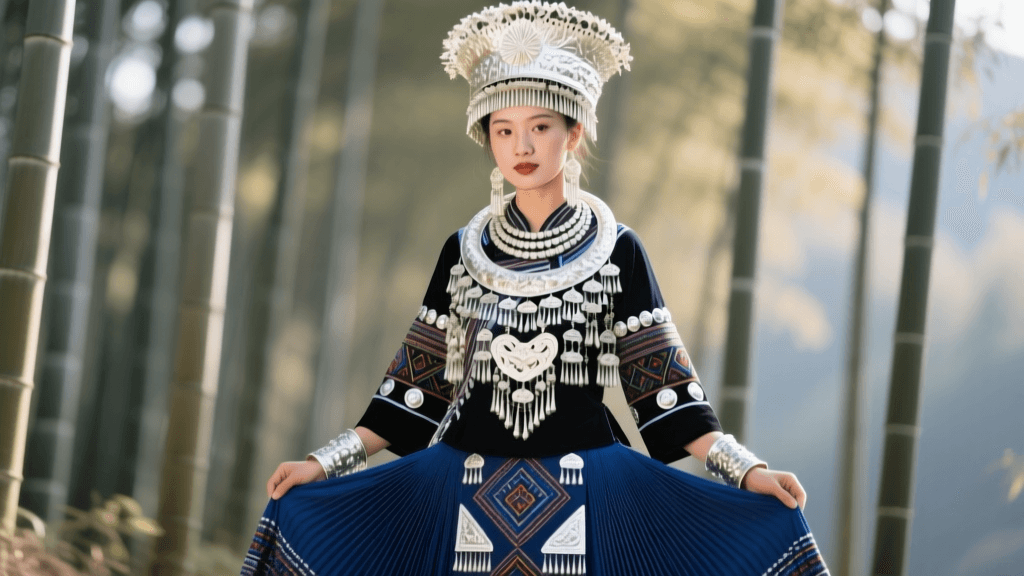
The hallmark of traditional Miao women's attire in southeastern Guizhou is the Bai Zhe Qun, or Hundred-Pleat Skirt. Despite the name, a high-quality ceremonial skirt often contains between 500 and 1,000 microscopic pleats. The skirt is not tailored to the body in a Western sense; rather, it is a masterpiece of geometric fabric manipulation.
Measurements and Construction
Creating an authentic pleated skirt requires an immense amount of material and precise calculations. If you are commissioning a bespoke piece from a village artisan in areas like Xijiang or Danzhai, you must understand the baseline requirements:
- Fabric Yardage: A single skirt requires 15 to 20 meters (approx. 16 to 22 yards) of hand-woven cotton.
- Waist Sizing: The waistband is typically constructed with a 10cm to 15cm ease allowance, secured not by zippers, but by wrapping and tying a woven silk sash.
- Weight: Due to the density of the cotton and the heavy indigo dye, a finished ceremonial skirt can weigh between 1.5kg and 2.5kg (3.3 to 5.5 lbs).
The pleating process involves folding the damp, dyed fabric and binding it tightly with cotton thread. The bound skirt is then left to set for several weeks. When the threads are finally cut, the skirt springs into a rigid, accordion-like bell shape that requires no petticoat to maintain its volume.
Indigo Dyeing: Timing and Technique
The deep, lustrous blue-black hue of the skirt is achieved through natural indigo fermentation. Timing is critical for artisans and those looking to source freshly dyed textiles. The indigo vat requires consistent warmth to ferment properly. Therefore, the optimal time for dyeing is between May and August, when daytime temperatures in Guizhou consistently stay above 20°C (68°F).
The dye bath is a living organism, fed with rice wine, ash water, and indigo paste extracted from the Strobilanthes cusia plant. Fabric must be dipped, oxidized in the air, and re-dipped up to 30 times over a month to achieve the prized metallic sheen known as "eggshell blue." Synthetic indigo, used in tourist-grade garments, lacks this depth and will fade unevenly.
Miao Silver Jewelry: Weight, Craftsmanship, and Sourcing
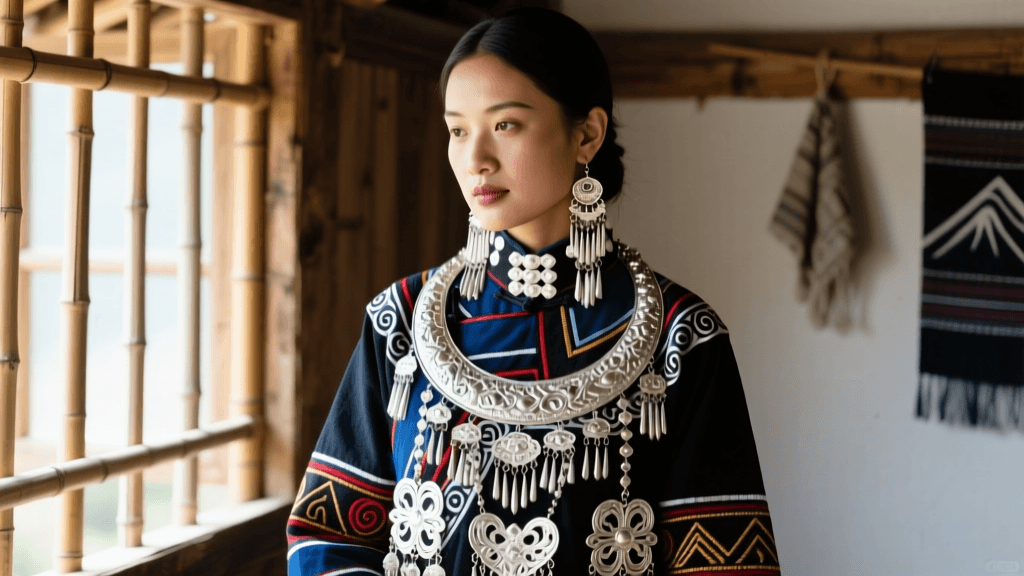
While the textiles represent the earth and history, Miao silver represents light, spiritual protection, and familial wealth. As noted in the archives of The British Museum's Miao Collection, silver is believed to ward off evil spirits and is an essential component of a bride's dowry. A full ceremonial silver set can weigh upwards of 10kg (22 lbs), transforming the wearer into a shimmering, chiming deity-like figure.
Key Silver Pieces and Market Costs
When sourcing authentic Miao silver, it is crucial to understand that you are paying for both the raw material (usually 990 or 999 pure silver) and the master silversmith's labor. Prices fluctuate with the global silver spot market, but here is a practical breakdown of key items and estimated costs as of recent market rates:
- Silver Horn Headdress (Yinjiao): The most iconic piece, featuring sweeping horns inspired by the water buffalo. Weight: 1.5kg to 3kg. Cost: $1,500 to $3,500+ USD.
- Silver Torque / Neck Ring (Xiang Quan): A thick, twisted collar worn close to the neck. Weight: 400g to 800g. Cost: $350 to $800 USD.
- Silver Crown / Comb: Worn at the back of the hair bun, featuring intricate repoussé floral and dragon motifs. Weight: 150g to 300g. Cost: $150 to $350 USD.
- Layered Necklaces: A set of 3 to 5 cascading chains with butterfly or fish pendants. Weight: 500g to 1kg total. Cost: $500 to $1,200 USD.
Actionable Advice: Always bring a portable digital jewelry scale when purchasing in local markets. Genuine Miao silver is high-purity and relatively soft; if a piece feels unusually rigid or lightweight, it may be an alloy or silver-plated brass.
Regional Variations: Xijiang vs. Shidong
Miao dress is not a monolith. The provincial dress varies drastically from village to village, often separated by mere mountain ridges.
- Xijiang (Leishan County): Famous for the "Long-Horn" Miao. The embroidery is vibrant, utilizing bright reds, greens, and yellows in flat-stitch silk threads. The silver headdresses are massive and highly polished.
- Shidong (Taijiang County): Renowned for a more subdued, incredibly intricate style. Instead of bright silk, Shidong artisans use horsehair wrapped in microscopic silver wire to create raised, three-dimensional embroidery motifs. The silver jewelry here is often darker, featuring an intentional oxidized patina to highlight the relief work.
Comparison Chart: Authentic vs. Tourist-Grade Miao Garments
When shopping in Guizhou, it is vital to distinguish between provincial heirloom pieces and mass-produced theatrical costumes. Use this chart to guide your purchases:
| Feature | Authentic Handmade (Provincial) | Mass-Produced (Tourist Grade) |
|---|---|---|
| Skirt Material | Hand-woven raw cotton, stiff and heavy | Machine-woven polyester or thin cotton blend |
| Pleat Count | 500 to 1,000+ microscopic pleats | 50 to 100 wide, heat-pressed pleats |
| Dye Process | Natural indigo, fermented over weeks | Synthetic chemical dyes, uniform color |
| Embroidery | Hand-stitched silk or silver wire (months to complete) | Machine-embroidered rayon (hours to complete) |
| Silver Purity | 990+ pure silver, hallmarked by the smith | Tibetan silver (copper/nickel alloy) or plated brass |
| Price Range | $800 - $5,000+ USD (Full Set) | $50 - $150 USD (Full Set) |
Practical Guide: Sourcing, Wearing, and Caring for Miao Dress
Where and When to Buy
For serious collectors, bypass the main tourist streets of Xijiang Miao Village. Instead, travel to Kaili City, the capital of the Qiandongnan Prefecture. Visit the Kaili Ethnic Minorities Museum for context, then explore the local textile markets on Sunday mornings. If you are commissioning a custom pleated skirt or silver set, expect a lead time of 3 to 6 months. Artisans do not keep full ceremonial sets in stock; they are made to order for weddings and the annual Lusheng festival.
Care and Maintenance
Caring for provincial Miao dress requires specific environmental considerations:
- Indigo Skirts: Never dry-clean a natural indigo skirt. The chemicals will strip the dye and destroy the pleats. Spot clean with cold water and a mild, pH-neutral soap. Store the skirt bound in its pleated state, wrapped in acid-free tissue paper, in a cool, dry place to prevent the cotton from mildewing.
- Silver Jewelry: Miao silver is meant to be worn; the natural oils from human skin keep it polished. However, if storing it, wrap each piece individually in anti-tarnish cloth. Do not use harsh commercial silver dips, as they will remove the intentional oxidized detailing in the repoussé crevices. Use a soft jeweler's cloth for routine polishing.
"To wear the clothes of the ancestors is to carry the weight of the mountains and the flow of the rivers. The silver is our armor, and the indigo is our night sky." — Traditional Miao proverb, translated and preserved by regional ethnographers.
The preservation of these techniques is an ongoing effort, recognized globally by organizations like UNESCO Intangible Cultural Heritage, which highlights the importance of safeguarding traditional craftsmanship. By understanding the measurements, costs, and cultural significance behind Miao provincial dress, collectors and enthusiasts can support authentic artisans and ensure this wearable history survives for generations to come.