Miao Traditional Dress: Guizhou Silverwork & Embroidery Guide
Introduction to Miao Provincial Dress
Deep within the mountainous terrain of China's Guizhou province lies the heartland of the Miao (Hmong) people. For centuries, the geographic isolation of this region has fostered an extraordinary diversity of sub-groups, each with its own distinct dialect, customs, and sartorial traditions. Because the Miao historically lacked a written language, their clothing became a vital historical archive. Every stitch, motif, and silver ornament tells a story of migration, mythology, and clan identity. Today, Miao traditional dress is celebrated globally as one of the most intricate and visually stunning examples of regional folk and provincial dress in Asia.
According to the British Museum's ethnographic archives, Miao textiles are not merely decorative; they are complex socio-cultural markers that indicate a wearer's age, marital status, and specific village lineage. For collectors, cultural enthusiasts, and fashion historians, understanding the anatomy of a Miao festival outfit is essential before attempting to source, wear, or preserve these masterpieces.
The Mythology Woven in Cloth
To understand Miao embroidery, one must understand the 'Butterfly Mother' (Mai Bangx Mais Lief) creation myth. According to Miao legend, the universe began when a sacred maple tree gave birth to a butterfly, who then laid twelve eggs. These eggs hatched into the first humans, dragons, tigers, and elephants. Consequently, the butterfly motif is ubiquitous in Miao garments, symbolizing fertility, protection, and the origin of life. Dragons in Miao embroidery differ vastly from the imperial Han Chinese dragons; they are often depicted with the bodies of water buffalo, centipedes, or fish, reflecting an agrarian, animistic worldview rather than imperial authority.
The Anatomy of a Miao Festival Outfit
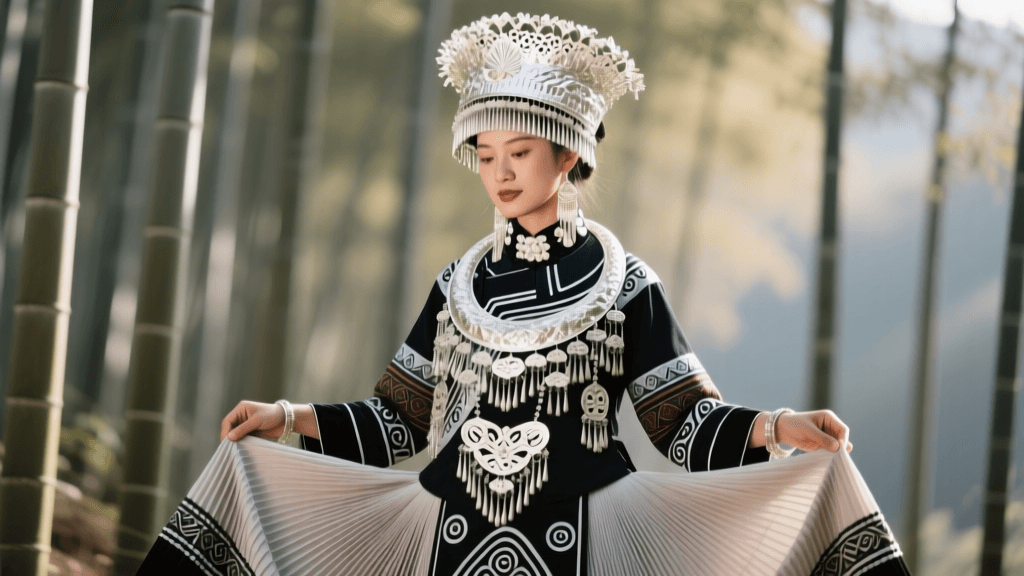
A complete Miao festival ensemble is a triumph of textile engineering and metallurgy, often taking years to complete and weighing up to 20 kilograms when fully adorned.
Indigo Dyeing and Batik (Laran)
The foundation of most traditional Miao garments is hand-woven cotton dyed with fermented indigo. The process is labor-intensive and highly seasonal. Indigo leaves are harvested, soaked, and fermented with rice wine and wood ash lye to create a dye vat. The fabric is dipped repeatedly—sometimes up to 30 times over several weeks—to achieve a deep, lustrous navy blue that borders on black. In regions like Danzhai, artisans practice laran (batik). Using a specialized copper pen called a lakan, women draw intricate geometric and floral patterns onto white cotton using melted beeswax. The cloth is then dyed in the indigo vat and boiled to melt away the wax, revealing striking white patterns against the deep blue background.
The Pleated Skirt (Baidai Qun)
The most iconic garment of the Miao women in southeastern Guizhou is the pleated skirt. Creating a single skirt requires up to 20 meters of hand-woven cotton. The pleating process is a communal activity where women use their fingernails and specialized straw markers to fold the fabric into hundreds of microscopic, uniform pleats. Once pleated, the skirt is tightly bound with string and steamed to set the folds. Finally, the surface is glazed with a mixture of egg white, ox-hide glue, and sometimes pig's blood, then pounded with a wooden mallet. This gives the skirt a stiff, armor-like texture and a brilliant, metallic sheen that protects the wearer from the damp mountain climate.
Silverwork: The Weight of Wealth and Protection
No Miao festival outfit is complete without elaborate silver ornaments. As highlighted by UNESCO Courier's feature on Guizhou's cultural heritage, silver is believed to possess the spiritual power to ward off evil spirits and illuminate the wearer's path in the afterlife. During major festivals like the Lusheng Festival or the Sisters' Meal Festival, women wear massive silver horn headdresses, multi-layered neck rings, chest plates, and hairpins.
The silver is traditionally forged by local Miao silversmiths using techniques passed down through generations. The metal is melted, hammered into thin sheets, and shaped using intricate repoussé and filigree methods. A full festival silver set can weigh between 10 and 15 kilograms. The sound of the silver bells and pendants chiming as the women dance is considered a crucial element of the festival's auditory landscape.
Embroidery Techniques
Miao embroidery is renowned for its complexity and three-dimensional quality. Artisans employ over a dozen distinct stitching techniques, including:
- Flat Stitch (Pingxiu): Used for broad areas of color and smooth gradients.
- Plaited Stitch (Bianxiu): Threads are braided and then couched onto the fabric, creating raised, rope-like outlines.
- Seed Stitch (Dazi Xiu): Also known as the French knot, this technique is used to create textured, three-dimensional surfaces resembling seeds or scales.
- Broken Thread Stitch (Poxian Xiu): Silk threads are wrapped with fine cotton or silk to create a raised, velvet-like texture, often used for the bodies of dragons and buffalo.
The Metropolitan Museum of Art's textile collection showcases several historical Miao jackets that highlight the incredible density and colorfastness of these natural silk dyes, which remain vibrant even after a century.
Regional Variations: A Comparison Chart
Guizhou is home to dozens of Miao sub-groups, often named by outsiders based on their most prominent sartorial features. Below is a comparison of four prominent regional styles:
| Sub-Group Name | Primary Location | Key Garment Feature | Silver Headdress Style | Skirt Length |
|---|---|---|---|---|
| Long-Horn Miao | Liupanshui (Zhijin County) | Massive wooden horn wrapped with yards of white linen and ancestral hair. | Wooden horn base, minimal silver. | N/A (Trousers/Bound legs) |
| Short-Skirt Miao | Qiandongnan (Leishan County) | Ultra-short pleated skirts (15-20 cm) worn over embroidered aprons and leggings. | Compact silver floral crowns. | 15 - 20 cm |
| Black Miao | Qiandongnan (Taijiang County) | Heavy indigo-dyed tunics with minimal embroidery, focusing on the sheen of the fabric. | Large, wide silver horn crowns. | Mid-calf (70 cm) |
| River Miao | Qiandongnan (Jianhe County) | Elaborate cross-stitch geometric patterns on dark backgrounds, heavily pleated skirts. | Tiered silver pagoda-style crowns. | Ankle-length (90 cm) |
Sourcing Authentic Miao Garments: A Buyer's Guide
For collectors, museums, and fashion enthusiasts looking to source authentic Miao provincial dress, navigating the markets requires knowledge of pricing, timing, and geography.
Where to Buy
While tourist hubs like Xijiang Qianhu Miao Village offer mass-produced replicas, serious collectors should visit specialized markets and artisan villages. Shiqiao Village in Danzhai County is renowned for authentic batik. Kaili City hosts a massive Sunday market where rural women sell vintage textiles and silver. For direct commissioning of silverwork, Kongbai Village is famous for its multi-generational silversmiths.
Costs and Pricing Structure
- Antique Textiles (Pre-1980s): Authentic, naturally dyed, hand-embroidered vintage jackets and skirts range from $800 to $5,000+ USD, depending on the rarity of the stitch, condition, and provenance.
- Modern Festival Replicas: Machine-embroidered or partially hand-stitched modern outfits typically cost between $150 and $400 USD.
- Silver Ornaments: Authentic handmade silver is sold by weight. Expect to pay 25 to 45 RMB ($3.50 - $6.50 USD) per gram for artisanal pieces. A standard silver neck ring (approx. 500g) will cost around $2,500 USD. A full 10kg festival set can exceed $45,000 USD.
Measurements and Sizing
Traditional Miao pleated skirts are wrap-around garments secured with woven sashes, making them highly adjustable and essentially one-size-fits-all for the waist. However, the accompanying bodices and jackets are cut with zero-waste, straight-line geometry. When commissioning a custom jacket, you must provide exact bust, shoulder width, and sleeve length measurements, as traditional garments lack the darts and curved seams of Western tailoring and require precise sizing to drape correctly over the body.
Timing and Lead Times
If you are commissioning a fully hand-embroidered jacket using traditional silk floss and natural dyes, be prepared for a significant wait. A single artisan working part-time between agricultural duties may take 6 to 12 months to complete a single heavily embroidered festival jacket. Silver commissions from master smiths typically require a 2 to 4 month lead time.
Care and Maintenance
Preserving Miao garments requires specialized care due to the organic materials used in their creation.
- Indigo and Egg-White Glazed Skirts: Never wash a traditional pleated skirt in water, as this will dissolve the egg-white and hide-glue finish, destroying the pleats and the sheen. Spot clean only with a barely damp cloth. Store the skirt rolled tightly along its original pleat lines in a cool, dry place, wrapped in acid-free tissue paper.
- Embroidered Jackets: Dry cleaning is generally not recommended, as harsh chemicals can strip natural silk dyes. Air them out in the shade and gently brush away dust with a soft-bristled brush.
- Silver Ornaments: Miao silver is often an alloy containing copper, which oxidizes and tarnishes. Store pieces in anti-tarnish cloth bags. To clean, use a specialized silver polishing cloth; avoid liquid dips, which can damage the delicate filigree and loosen the natural resin adhesives sometimes used in the settings.
Conclusion
The traditional dress of the Miao people in Guizhou is far more than provincial folk costume; it is a wearable encyclopedia of an ancient civilization's cosmology, history, and artistic genius. From the deep, fermented vats of indigo to the rhythmic hammering of the silversmith's forge, every element of the garment is a testament to human ingenuity. Whether you are a textile collector, a historian, or a cultural traveler, approaching Miao garments with an understanding of their profound complexity ensures that these magnificent traditions are respected and preserved for generations to come.