15th-Century Burgundian Houppelande Sewing Guide for 2026
The Resurgence of the Burgundian Houppelande in 2026
As the historical reenactment and living history communities embrace stricter authenticity standards for the 2026 festival season, the demand for meticulously crafted medieval garments has reached an all-time high. Among the most iconic and visually striking garments of the late Middle Ages is the Burgundian houppelande. Originating in the opulent courts of the Dukes of Burgundy in the late 14th and 15th centuries, this voluminous, floor-length gown became the height of European fashion. According to the Victoria and Albert Museum's overview of medieval fashion, the houppelande represented a dramatic shift from the closely fitted cotehardie to garments that emphasized luxury, heavy drapery, and ostentatious displays of wealth through excessive fabric use.
Whether you are preparing for a high-end Renaissance faire, a strict 15th-century living history encampment, or a historical European martial arts (HEMA) civilian showcase, constructing an authentic houppelande requires a deep understanding of historical tailoring. This comprehensive 2026 guide will walk you through fabric sourcing, pattern drafting, and the specialized construction techniques required to bring this magnificent garment to life.
Anatomy of the 15th-Century Silhouette
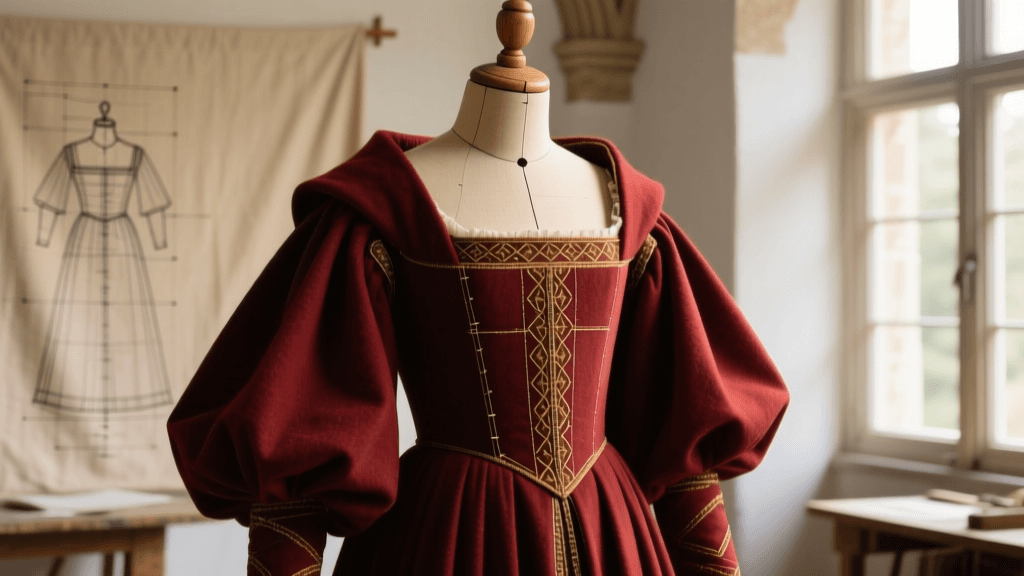
The houppelande is not merely a dress or a coat; it is an architectural marvel of medieval tailoring. Before cutting into your expensive 2026 textile shipments, it is crucial to understand the defining characteristics of the garment:
- The High Collar: Often stiffened and standing up to the ears, the collar (or 'carcan') is a hallmark of the Burgundian style, framing the face and emphasizing the wearer's posture.
- The Bombard Sleeves: These massive, bell-shaped sleeves are exceptionally wide at the wrist and often lined with contrasting fur or silk. They were so large that they sometimes had to be tied back or pinned to prevent dragging in the mud.
- The Voluminous Body: Constructed from multiple gores or cut in a full circle, the body of the garment features deep, tubular folds that cascade to the floor, sometimes pooling into a modest train.
- The Cinched Waist: Despite the volume, the garment is tightly belted high on the waist (for women) or at the natural waist/hips (for men), creating a bloused effect over the belt.
2026 Fabric Sourcing and Budgeting Guide
Sourcing historically accurate textiles remains the most critical step in medieval costuming. The Metropolitan Museum of Art's Heilbrunn Timeline of Art History notes that the wealth of the Burgundian court was directly reflected in their use of imported Italian silks, fine Flemish wools, and luxurious furs. For the modern costumer in 2026, achieving this look requires navigating a specialized market of historical textile merchants.
Below is a breakdown of the materials required for a standard floor-length houppelande, along with current 2026 market pricing and recommended suppliers.
| Material Role | Recommended Fabric Type | 2026 Est. Cost (per yard) | Yardage Needed (60" wide) | Top 2026 Supplier |
|---|---|---|---|---|
| Outer Shell | Heavy Wool Broadcloth or Melton | $45.00 - $65.00 | 5 - 7 yards | Sartor Bohemia / Burnley & Trowbridge |
| Lining | Medium-weight Linen or Silk Taffeta | $25.00 - $40.00 | 5 - 7 yards | Fabrics-store.com / Silk Baronne |
| Interlining (Collar) | Heavy Canvas or Pad-stitched Wool | $12.00 - $18.00 | 1 yard | Local Upholstery Supply |
| Trims / Edge Binding | Silk Velvet Ribbon or Faux Fur | $15.00 - $30.00 | 3 - 5 yards | Renaissance Fabrics |
Note: Prices reflect early 2026 market rates for premium, historically accurate fibers. Synthetic blends are strongly discouraged for high-level reenactment events.
Pattern Drafting: Circles, Gores, and Collars
Unlike modern garments that rely on complex darts and curved side seams to fit the body, the 15th-century houppelande relies on geometric draping. There are two primary methods for drafting the body of the garment:
1. The Full-Circle Method
For the most opulent, courtly look, the body is cut as a full circle with a hole for the neck. To calculate the radius of your neck hole, divide your neck circumference plus 2 inches of ease by 6.28 (2 x Pi). The outer edge of the circle will naturally form the deep, tubular folds when gathered into a waistband or belted. This method consumes a massive amount of fabric and requires piecing the circle from multiple panels, as historical broadclooms rarely exceeded 30 inches in width.
2. The Rectangular Gores Method
For a more practical, everyday houppelande, the body is constructed from a front and back panel with large triangular gores inserted at the sides and center back. This method is more fabric-efficient and mimics the extant garments found in Scandinavian bogs and Northern European archives.
Drafting the Bombard Sleeve
The bombard sleeve is essentially a massive cone. The top of the cone (the armscye) must be large enough to allow for the deep folds of the bodice. The bottom of the cone is cut on a sweeping curve, allowing the back of the sleeve to touch the floor while the front rests near the wearer's knees. When drafting, always create a mock-up (toile) in cheap muslin to test the drape of the sleeve before cutting into your premium 2026 wool.
Step-by-Step Construction Techniques
Constructing a houppelande requires mastery of several historical hand-sewing and machine-assisted techniques. While modern sewing machines can be used for long structural seams, the finishing techniques must remain historically plausible.
- Interlining the Collar: The high collar must stand stiffly without collapsing. Cut your collar interlining from heavy canvas or stiffened wool. Use a dense pad-stitching technique—small, diagonal running stitches that anchor the interlining to the outer wool shell. This gives the collar a beautiful, organic roll and immense structural integrity.
- Assembling the Shell: Sew the main body panels together using a flat-felled seam. This encloses the raw edges and provides a clean finish on the inside of the garment, which is crucial since the skirt will flare open when walking.
- Bag-Lining the Sleeves: Because the bombard sleeves are so wide, they must be fully lined. Sew the outer sleeve and lining sleeve together at the wrist opening, right sides facing. Turn the sleeve right-side out and press the edge. The top of the sleeve (the armscye) is left raw and will be inserted into the bodice later.
- Attaching the Sleeves and Collar: The sheer weight of the wool and lining requires reinforcement. Bind the raw edges of the armscye and neckline with a sturdy linen bias tape before attaching the sleeves and collar to prevent the heavy fabric from tearing under its own weight during wear.
- Edge Finishing (Prick Stitching): To keep the front openings and hem edges crisp, use a silk prick stitch along the edge. This tiny, nearly invisible stitch taken from the right side catches only a single thread of the outer fabric, anchoring the facing or lining and preventing the edge from rolling outward.
Essential Accessories: The Hennin and Chaperon
No Burgundian ensemble is complete without its iconic headwear. For women, the steeple hennin—a conical wire and buckram frame draped in sheer silk veils—remains the ultimate symbol of 15th-century elegance. In 2026, modern milliners utilize lightweight thermoplastic mesh (like Fosshape) to create historically accurate but breathable hennin frames for summer reenactment festivals.
For men, the chaperon—a complex, twisted turban-like headdress evolved from the humble hood—is mandatory. A proper chaperon requires a padded roll (the bourrelet) stuffed with raw wool or cotton batting, adorned with a draped cornette (the liripipe tail). Tooling a leather belt with brass hardware to cinch the massive folds of the houppelande at the waist completes the silhouette, providing both structural support and a canvas for displaying personal heraldry.
Caring for Your Medieval Garments
Investing in premium historical textiles requires proper maintenance. Never machine-wash a wool houppelande. Instead, brush the garment vigorously with a natural bristle clothes brush after every wear to remove dust and dirt. For spot cleaning, use a damp cloth and a mild, lanolin-based wool soap. Store the garment flat or folded with acid-free tissue paper in the bodice and sleeves to prevent the heavy wool from stretching out of shape on a hanger over time.
By adhering to these historical construction methods and sourcing the finest materials available in 2026, you will create a Burgundian houppelande that not only survives the rigors of the reenactment field but also serves as a wearable tribute to the golden age of European medieval tailoring.